Recession-Proof Investment Opportunities!

Franchises say they could be your ticket to financial security. For some investors, they are the ultimate get-poor-quick scheme.

—International Franchise Expo.
Tue March 31, 2009 3:00 AM PST

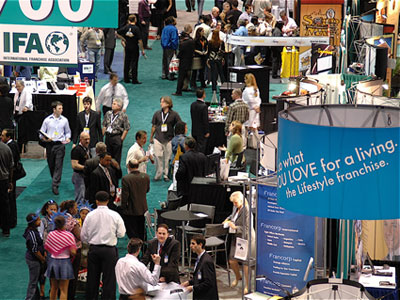
"Can you succeed in a recession?" screams the sign for the Fast-Fix jewelry franchise booth. The company says you can, if you can just come up with $152,000 to open up a Fast-Fix jewelry and watch-repair kiosk in your local mall. Touting "extremely high margins" and financial security in a tough economy, the franchise was one of many exhibitors at the recent International Franchise Expo in Washington, DC, promising recession-proof moneymaking schemes.


story continues below story continued from above

Given the dire straits many Americans now find themselves in, such prospects may look tempting, particularly to those who got a little cash when they were shown the door at their last corporate job. The Obama administration is even trying to make it easier for people to obtain financing should they decide that they were made to run a watch-repair kiosk. But according to folks selling everything from Bojangles to Sign-o-Rama outlets, even promises of recession-proof investments don't seem to be luring many takers at the expo. As with the real estate business, the franchise industry is showing signs that much of its recent growth over the past decade may have been fueled largely by access to cheap credit and frequently gullible investors rather than, say, actual product sales.

George Lambro, one of the men staffing the Fast-Fix booth, assures me that an investment in a Fast-Fix outlet will deliver "80 percent profit margins" to a lucky investor. He claims that in the right mall, his stores generate $1,143 per square foot annually, which is more than three times what he says an average mall store generates. "Once you get the manager and jeweler in place, they run themselves," he tells me. To attract potential franchise owners, Lambro relies on a smooth sales pitch, promises of a "proven concept," and, best of all, free ultrasonic jewelry cleaning in the booth. It doesn't have quite the draw of the nearby pile of chocolate-chip cookies offered by Mrs. Fields, but at least the jewelry cleaning takes long enough that he can make most of his spiel while people wait to get their diamonds back. (By contrast, the cookie-eaters blow by Mrs. Fields with hardly a glance at the brochures.)

Lambro's come-ons, however, aren't drawing as many takers this year as they have in the past. He thinks it might be those six figures at the starting gate. A year or two ago, most people who invested in Fast-Fix franchises did so by taking out home equity loans. Now that so many people owe more on their houses than they're worth, he says the only people buying franchises these days are cashing out what's left of their 401(k) plans. (Helpfully, the convention offers a free seminar on how to do this without tax penalties.)

Lambro does find one potential franchisee: Cynthia Bellian, who was recently laid off from the marketing department at Alcoa. She has traveled all the way from one of the nation's foreclosure capitals, Cleveland, Ohio, to check out potential business opportunities. She has severance money coming to her and she and her husband are considering going into business for themselves. She has a friend who imports jewelry from Italy who might be a good partner for a Fast-Fix. "There's always the risk of building something on your own," she explains, after getting her ring cleaned at the Fast-Fix counter. "If somebody's already got a turnkey system," she says, already versed in franchise lingo, why not go that route? Besides, she tells me later, the competition for jobs in her area is stiff. Days after the franchise expo, she would go to a job-seekers group and discover 200 people there, making the franchise option look even more appealing. "Maybe now really is the time to be your own boss and start your own business. Maybe I could be the hiring company down the road," she says.

"Turnkey systems"—i.e., franchises like SportClips, Fast-Fix, Quiznos, and the dozens of others on display at the Expo—are tiny engines of entrepreneurialism that the Obama administration is trying to jump-start with the help of people like Bellian. On March 16, the White House announced a plan to "unlock credit for small business" that includes boosting the federal government's guarantee of loans backed by the Small Business Administration to 90 percent, up from 75. The new guarantee is an attempt to get banks lending money again to people who want to start a small business or open up a franchise. SBA-backed loans have all but frozen up during the recent credit crunch. The White House press release on the new program says the guarantees will "help provide lenders with the confidence that they need to extend credit, knowing they both have a backstop against their risk and a source of liquidity."

In the case of franchises, however, that backstop is going to need some serious reinforcements. In February, the Wall Street Journal reported that franchisees were defaulting on existing loans in record numbers. Defaults jumped 52 percent in fiscal 2008 over the previous year, for nearly $100 million in losses. Moreover, many of the franchise brands topping the list of defaults are those that have been accused of defrauding franchisees, including the Curves fitness chain, Cold Stone Creamery, and Quiznos, which led the way with the most defaulted loans. This suggests that, as in the mortgage sector, the lending standards by SBA-backed bankers were anything but strict.

Part of the problem is that many franchises make most of their money by selling franchises, not subs, coffee, or other products. So they aren't especially judicious in where they allow people to open stores or to whom they sell franchises. (One of the raps against Cold Stone Creamery is that the company was so interested in expansion that it authorized franchisees to open practically next door to each other, ensuring that the stores would cannibalize each other.) Companies often require franchisees to buy overpriced supplies only from approved buyers who kick back to the corporate parent for the sales, all of which can make it difficult for an individual franchisee to turn a profit even without any element of fraud. Franchise contracts are also usually laden with mandatory binding arbitration clauses that prevent investors from trying to recoup their money in civil suits when they've been screwed over. All of this may hinder the administration's hopes of fueling the economy by encouraging the growth of franchises, despite the SBA's presence at the expo.

Bellian, 45, says she realizes there are risks in investing in a franchise. But she believes she could avoid that problem with due diligence. She went to a session at the expo sponsored by the Federal Trade Commission on what to look for and how to vet a potential franchise. "The key message I got was research it, talk to other franchisees. Visit those locations and know what you're walking into," she says.

Still, as Dick Mueller, vice president of franchise sales at SportClips, concedes, not everyone makes it. While he says the company, which sells sports-themed men's hair salons and is opening five new stores a week, has about a 1 percent store failure rate, that doesn't mean 99 percent of the investors succeed. Rather, many of them will go broke starting up the store and spend years digging themselves out of bankruptcy and debt. If that happens, the company can still sell the store to a new owner. Either way, the corporate parent will make money. After all, he says, "Even in bad economic times, people still get their hair cut."

Get Mother Jones by Email - Free. Like what you're reading? Get the best of MoJo three times a week.
Comments
no profile pic for comment author

Risks aren't discussed by Carnival Barkers...but they are here:

Franchising is like a marriage. 50% end up in divorce, bankruptcy or worse. Don't believe what you hear from the snake oil guy who doesn't have to live through your divorce.

http://www.wikidfranchise.org/the-marriage:introduction

no profile pic for comment author

Franchising may mean a personal recession for franchisees

Franchising is always pushed in recession, when jobs are scarce and Americans are trying to scare up a living for themselves. If citizens have money saved and can access their 401's and 403's, etc.. or their home equity, they are vulnerable to being exploited by franchisors, who are the REAL entrepreneurs or thieves, as the case may be!

FranchiSEES, under law and public policy, are merely expendable resources for franchisors and for large organizations who want to buy franchisors to exploit cheap labor and cheap venture capital of franchisees in order to avoid the expense and responsibility of creating a corporate division and being employers subject to the employment laws of the United States.

Franchising is not what it seems to be! That is, franchisors are sold as somewhat "risk free" but the statistics bear out that 50% of franchisees FAIL out of business within the first five years and only 29% of them survive as long as ten years. Yet, most franchisors require a commitment of ten years or more because the long-term contract acts as a trap to squeeze a failing franchisee into giving their business away when they don't thrive and want to try to avoid bankruptcy. (See Small Business Trends --Startup Failure Rates) "Churning" of franchised units is what has made franchising so durable in our economy.

The SBA subsidizes franchising and the banks and lenders who sell the, now, 90% guaranteed loans in the secondary markets to investors and make a profit.

Shamefully, federal regulation, the FTC Rule, permits franchisors to sell franchises without disclosing MATERIAL risk factors known by the franchisor to the new buyer. The media help the franchisors to obscure the risk of franchising and the blood of franchisees who lose everything runs freely in our Republic. See and Read Franchising fraud: the continuing need for reform. Source: American Business Law Journal, published January 1st, 2003, for an honest discussion of the FATAL FLAW in the FTC Franchise Rule.

Thanks to Mother Jones for the warning. LET THE BUYER BEWARE ! !

no profile pic for comment author

Last night I heard the head

Last night I heard the head of the TARP Funds Oversight speak about what lack of regulation and ineffective regulation has done to our economy since 1979, when the call for free market policies appeared to work over the following years to deregulate our financial system in the interests of feeding greed to maximize corporate profits for those on the top of the pyramid.

The FTC Franchise Rule, promulgated in the late 70's, is a good example of how the regulators were captured by the regulated and the other special interests who profit from franchising at the expense of middle class Mom and Pop franchisees who lose their life savings and often their homes when they invest in highly risky and unprofitable franchises.

The FTC, as demonstrated by the comments above, still won't step up to the plate and correct the fatal flaw that exists in the FTC rule governing franchising and still pushes "due diligence" with references in Item 20 of the Rule to the new buyers, instead of fixing the flaw in the original FTC Rule ----that flaw being the failure of the FTC to require the SELLER of the franchise, the franchisor, to disclose all material information to the new buyer of the franchise. Is Item 20 an Artifice that permits the franchisors to withhold MATERIAL risk factors from new buyers of franchises?

In the library paper, referenced in the above comment, the attorney authors indicate:

"It would be hard to argue, moreover, that a failure to disclose information concerning prior franchise failures in the area of interest, or the earnings history of franchisees amounts to fraud by material omission, particularly if neither state nor federal law requires such disclosures to be made, notwithstanding the vital importance of such information to the franchisor's decision to purchase."

Yet, those who UNKNOWINGLY buy high risk/low profitability franchises in good faith believing that these franchises have minimum risk ARE defrauded because MATERIAL information was not provided to them before the purchase that would have protected them from making a bad investment that could destroy them financially and emotionally.

Thanks to Stephanie Menciner and Mother Jones for bringing this to the attention of the public.

no profile pic for comment author

Recession Proof Opportunities

Yes! Hopefully, the Defense Contracts are up for bid, and this will be an area where there will continue to be employment, but the competition is stiff and fair, we hope! Interesting to note that enlistments are up in the Armed Forces because this also provides a means of earning income when there are no jobs to be had.

No doubt the biggest problem our country faces today is: Where are Americans going to work to earn enough money to live the American Dream? Where will the jobs come from? Our manufacturing base is not what it used to be! Our great industries struggle to survive in the global economy. Only one quarter or less of the American workforce is working for corporate America who now operates in a global economy to maximize profits for their shareholders.

Should the Stock Market be the barometer of the health of the American economy and should policy be made to support the Stock Market that doesn't necessarily support the majority of the people who live on Main Street in The United States of America? As the Financial Services Industry shrinks in the current scenario, where will these people work in the future?

Our President recognizes the great problems we have and the experts are trying to find solutions to this failure of capitalism that brought many black swans into the financial markets and great trouble to Main Street. These swans are still swimming in a pool of government bailout money that, hopefully, will mean that the white swans will return to the majority and restore order to our markets and to Main Street.

Unfortunately, the industry of franchising INCREASES during recessions when newly unemployed prospects, who have cash and savings and equity in a home or retirement plan, determine that "a business of their own" will offer them a means and a solution to making a living and profits as well. The government and the status quo and the media have been pushing the "entrepreneurial" sector as the answer to our economic problems and jobs. The problem, however, is that the MATERIAL RISK FACTORS, as demonstrated by unit performance in franchise systems are not required under regulation to be disclosed to the new buyers of franchises.

Unfortunately, because of ineffective government regulation that was promulgated to encourage franchisors, the entrepreneurs, to franchise their retail businesses (or someone else's) the franchisors CAN make a good living even as a great percentage of their franchisees don't and operate at breakeven or less until they fail and give their businesses away to a second-generation franchisee who can perhaps sustain the franchised business for some additional time because of lowered initial cost and lowered overhead.

Reliable statistics from academics, however, indicate that 50% (See Startup Failure Rates in Small Business Trends in a Google Search) of small businesses, especially retail, fail by the fifth year. The "Ponzi" franchisors, however, both big business and small business franchisors can beat these bad odds because they don't fail when their original franchisee fail as long as they can keep the business unit open with a second-generation franchisee.

Franchisors appear to be viable and respectable because they are licensed by the government by means of disclosure under the FTC Rule or the State Franchise Disclosure Document. Many franchisors with high failure rates of franchisees and low profitability for units appear on the SBA Franchise Registry and are eligible for "quick" loan guarantees for their franchisees.

The business model of franchising, itself, invites exploitation and abuse of franchisees manifested as "churning and encroaching" because franchisors CAN survive even as franchisees fail in great numbers and lose everything.

The American Retail Industry, however, is not, in the opinion of the experts, the solution to our deep problems and yet the International Franchise Association continues to get a blank check from the Congress because this "subsidy" of regulation and SBA loans continues to be sold to the Congress and the Regulators as a means of producing badly needed jobs in bad economies as well as "product" for the banks and lenders and the Mall developers and the REIT's. The 90% guaranteed loans are sold by the banks and lenders in the secondary markets to investors, who also receive NO disclosure as to the unit performance of the franchise systems.

Franchising has grown because of the many recessions we have had since 1974. Don't we need to look for a "recession proof ECONOMY" or some means of taming our "boom and bust" economy? Can this be done if government encourages a reinflation of the already saturated retail sector with 90% guaranteed SBA loans for unsustainable small retail businesses, 50% of them who will fail out of business within the first five years? Does the means justify the end?

no profile pic for comment author

Recession ---Franchising ---Moral Hazard ---Moral Turpitude

The Moral Hazard provided by ineffective regulation intended to subsidize the franchise industry has enabled intentional torts and fraud against franchisees, the less informed cheap labor and capital providers on the bottom of the pyramid.

It seems, however, that moral hazards in regulation that lead to the problem of moral turpitude, as with Bernie Madoff, are forgiven under franchise regulation and franchisors can lie, cheat, and steal under cover of regulation whenever this is necessary to sustain their EBITDA's.

Let the Buyer Beware!

no profile pic for comment author

Another investment opportunity that is "economy proof"

Ive been hearing a lot about online investing with social lending companies, like Prosper, lending club and virgin money. It seems to me that this is a pretty good investment opportunity especially in an economy like what we are facing. With the current credit crisis many people with poor credit are unable to get personal loans from banks and so they turn to online social lending where they are willing to accept higher interest rates. I think it makes sense as an investor.

Post a comment
Alternately, you may login to or register an account
The content of this field is kept private and will not be shown publicly.
  • Web page addresses and e-mail addresses turn into links automatically.
  • Allowed HTML tags: <a> <ul> <ol> <li> <blockquote> <img>
  • Lines and paragraphs break automatically.

More information about formatting options


Jail.org - Inmate Search
Criminal records, instant public records & people search & current court records. www.jail.org

U.S. Public Records Search
Search County & State Court Records, Criminal records, Vital and Adoption Records www.PublicRecordsInfo.com

Records.com - People Search
Public Records and Background Checks. Instantly Search Criminal Records, Addresses and Court Records www.Records.com

Court Records & County Records
Find Instant Public Records, Criminal Records as Well as County Property Records Search. www.PublicRecordsIndex.com

Mother Jones Podcast
Get in on the conversation! We talk about culture, politics, the environment, the economy and more. Listen now!

TalkBackTees.com
A treasure trove of liberal wit, wisdom and quotations, from ancient to modern, on colorful, cotton tees.

Support Independent Artists
Amazing art, crafts, apparel, paper-goods and more. A carefully curated selection of sundries since 1999.

FREE CONNECTIONS FOR GREEN SINGLES
Meet progressive singles in the environmental, vegetarian & animal rights community who share your values