Is Geithner's Hedge-Fund Bailout Illegal?

It's certainly a creative workaround—and yet another windfall for the rascals who got us here.

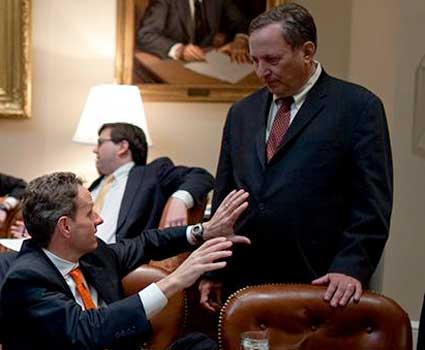
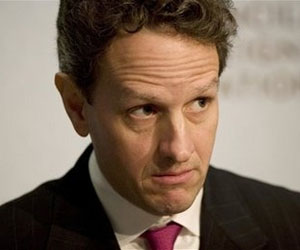
—Photo used under a Creative Commons license by flickr user congresscheck
Tue April 14, 2009 9:30 AM PST

In recent months, Treasury Secretary Timothy Geithner and other regulatory officials have made much ado about those "toxic" securities the Wall Street demons concocted by bundling together thousands of mortgages and dicing them up a dozen different ways to sell to investors. The big problem, as we've all learned by now, is that it's next to impossible to figure out what the accursed things are worth. Wall Street firms and pretty much everyone else went by their exchange price rather than by analyzing the loans within. Which all worked out just fine until the underlying subprime mortgages began defaulting like mad. All of a sudden, nobody wanted to trade in these byzantine assets, and banks that owned heaps of them were in serious trouble.

It's easy to see why government regulators might want to do something about all of this. The trouble is that much of Geithner's new $100 billion program to help Wall Street hedge funds purchase "toxic assets" from banks—and which could put us on the hook for up to $500 billion—doesn't involve these securities at all. Instead, about half of that money goes to a Legacy Loans Program to help hedge funds purchase relatively conventional loans. Yes, plain old loans, as opposed to the nightmarishly complicated mortgage-backed securities that have America's finance sector scratching its head. "This is a big surprise to me," says New York University economics professor Lawrence J. White, who helped spearhead the government's response to the savings and loan crisis during the 1980s. "I don't know why they're doing it."


story continues below story continued from above

Why, indeed? A March 23 press release from the Treasury Department claims Geithner's plan will "reduce uncertainty" on bank balance sheets and help banks and investors figure out what the loans are worth. Yet that's never really been the issue. Sure, valuing loans involves a bit of forecasting: You have to predict whether a borrower will keep her job, stay healthy, not accumulate other debts, and so forth. But these factors are comparatively easy to calculate. "If you're talking about individual loans, you can put some value on it," says Ann Graham, a former litigator with the Federal Deposit Insurance Corporation (FDIC) who now teaches law at Texas Tech University. "It's far easier than evaluating these exotic mortgage-related securities."

Geithner's loan strategy goes beyond merely missing the point. Given years of lax federal oversight, the plan all but guarantees—see if this theme sounds familiar—a windfall for banks that lied to regulators and investors so that they'd be allowed to lend out far more money than they could realistically afford to.

To understand this, a little background is useful: A bank that trades heavily in mortgage-backed securities is in trouble if the market for those assets dries up—and it has, and they are—but regular loans are different. So long as a bank intends to sit on them and collect the interest rather than sell them to another company, the government lets that bank use its own secret financial formula to determine the loan values. In short, banks have carte blanche to claim their assets are worth far more than they really are—White refers to this as "trust me" accounting.

Given this long leash, banking executives have naturally inflated the book value of their mortgages. And even as more and more of their customers fail to make payments, bankers have proved reluctant to admit their hubris and take a hit on the balance sheet. Why is that? Well, the government says banks have to keep enough assets on hand to cover their behinds if things go south. So if a bank that has foolishly overextended itself admits it was overvaluing its loan assets all along, it will fall short of this critical regulatory requirement. And when that happens, under the "prompt corrective action" laws enacted after the savings and loan crisis of the 1980s, federal regulators are obliged to invoke the N-word: nationalization.

But Geithner's plan is voluntary, meaning that if the naughty banks don't like the price that hedge fund investors are offering, they can simply turn the deal down. And no bank on the precipice of nationalization is going to voluntarily sell loans to Wall Street for less than it has been claiming they're worth. Doing so would be corporate suicide. Instead, the only way a troubled bank will likely participate is if it receives an absurdly generous price for its dubious assets—a full-fledged bailout, in other words. "I'm troubled about the pricing aspect of the plan," notes Graham.

Still confused? Consider this scenario: FirstFed Financial is a California bank whose stock—down 98 percent in the past year—now trades at about 50 cents per share. That gives it a market value of $6.8 million, but the company's most recent quarterly accounting statement puts its liquidation value—based on how its executives value its loans—at $256.5 million, or $18.74 per share. Clearly, investors don't believe the loans are worth anywhere near what the company claims. But if FirstFed sells its loans under Geithner's plan, it will almost certainly score prices close to, or perhaps higher than, those book values. That's because FirstFed, like many banks these days, has allowed itself a razor-thin capital cushion. If it sells off its loans too cheaply, regulators will be legally obligated to step in and take it over.

Treasury's treatment of mortgage-backed securities—the more convoluted toxins—is less sinister. Since these assets from hell can only be valued at market prices due to their sheer complexity, getting hedge funds to trade them may at least theoretically serve some useful valuation function. The government is basically letting fund managers make a huge bet, while guaranteeing that we'll cover most of the losses if things don't work out.

A similar strategy will apply to the loans, and Geithner clearly wants our most troubled banks to participate—otherwise his plan would do nothing more than subsidize the earnings of healthy companies. But allowing these banks to dispense of their overvalued loans puts him on tenuous legal footing. In fact, using the government to help faltering banks improve their capital position is precisely what the prompt corrective action laws were enacted to prevent.

When the FDIC takes over a bank—a process called receivership—the bank's shareholders are wiped out and its executives are given the boot. This discourages future investors from putting money into bad institutions and gives regulators a clean slate for disposing of the bank's assets. It's exactly what happened in July 2008 when regulators seized exotic-mortgage lender IndyMac. It's also prudent policy: We don't want predatory lenders in charge of our economic recovery.

"After the savings and loan debacle, we passed a law because regulators had been too unwilling to close insolvent institutions," explains William Black, a senior regulator from the 1980s who now teaches law and economics at the University of Missouri-Kansas City. "We mandated that well before banks were insolvent, the government would force them to bring in adequate capital or promptly close them down…That statute has been ignored by the current administration and the last one."

Get Mother Jones by Email - Free. Like what you're reading? Get the best of MoJo three times a week.
Comments
no profile pic for comment author

There is nothing illegal

There is nothing illegal about the government setting it's own rules in trouble times if most people in the administration believe this is the right thing for the country. The banks are in this for the money...this is business that is why banking executives have inflated the book value of their mortgages. The government knows this and so does everyones else who know the industry.

no profile pic for comment author

Nothing Illegal?

"There is nothing illegal about the government setting it's own rules in trouble times if most people in the administration believe this is the right thing for the country."

A little bit naive? After all that's been documented and happened over the last eighteen months, you think this fresh one hundred day bunch is oh-so-much-more-trustworthy? And you think it's perfectly fine for the administration to set and change whatever rules they want to? Where are you from? It can't be the U.S. because we have a constitution that precludes administration officials from making rules to suit what they think without the benefit of legislation.

Here's a thought . . . maybe they'll suspend the requirement to actually pay your taxes . . .

no profile pic for comment author

In case you are unaware, in

In case you are unaware, in our country the Govt. is required to follow the Laws.
One of the so-called strengths of our so-called capitalistic system and why money was attracted to this country was that we had a tradition of lawfullness, and unlike so-called "bannana Republics" the laws could not be changed on a whim.
Welcome to the new Bannana Republic of the United States. Lee S.

no profile pic for comment author

Most people in the administration...

think first of their own well-being. "The banks are in this for the money... and everyone accepts it." And this is good for the country how?

no profile pic for comment author

isn't the emperor's new suit

isn't the emperor's new suit lovely?

dskaugrud

The Gaming of the Economic Bailout of 2009

Gaming is a favorite American pass time. We all love games, either in sports, or on our video screens, or in our social and economic lives, we all love our games. But "Gaming" has a different meaning. "Gaming" means the intentional undermining of the rules of the game, to allow clever accountants and lawyers the ability to "spin" the language of the rule book to benefit and to give an unfair advantage to a select few.

Now consider this, in 8 years of the Bush Administration, $3 billion dollars was spent by K-Street lobbying firms with money donated by Americas wealthiest public and private interests, to influence politicians to provide "Gaming" opportunities for their clients. One easy example is in the paper industry and how they extract over $1 billion dollars in direct Federal Government subsidies for a program meant to promote green friendly fuel use.

What chance does Geithner have to push back against the powerful financial interests aligned against him, unless he is given the power by Congress and the President to do so? And does he have the intelligence and will power to take on this entrenched lobby to remove the loop holes? Does he the time to do so?

The "Gaming" of our economy has got to be reigned in. Unless K-Street is dismantled and the election system totally switched to public support with a limited time frame for campaign season, NOTHING WILL CHANGE!

dskaugrud

no profile pic for comment author

Criminals commit crimes, it's what they do

Geithner has NO interest in fighting the "powerful financial interests", he is one of them. As head of the NY Fed he failed in his main duty of protecting the Banking System. In his time at the IMF he helped impoverish millions with misguided policies. He too comes from Goldman Sachs and is as criminal as Hank Paulson,
Robert Rubin (who enabled Citi's Enron frauds for which citi paid hundreds of millions in fines) and Larry Summers.

no profile pic for comment author

Trembling Tim

Why does Geitner always look as if he's about to go into the corner and throw up?

Jay Taber

Ruling Class

So we've traded the Soprano model of government for the Corleone model. Perhaps Pepe Escobar at The Real News Network is right when he says, "Blood will flow". Let's hope that this time the blood is blue.

no profile pic for comment author

GEITHNER AND THE BAIL OUT

Geithner is a PIMP for Wall Street.

no profile pic for comment author

What if Toxic Assets aren't really that hard to value?

This is an important article, but it perpetuates one idea that deserves to be challenged: the impossibility of valuing mortgage backed securities aka "toxic assets." Imagine for a moment that valuing MBS is actually crystal clear and that once the depth of the housing crisis became apparent it was obvious to the banks that they'd lost, say, 70% on these investments. They immediately realized they were bankrupt by normal rules. Not wanting to admit this, they spread this idea that MBS are "impossible" to value and that no one could know what they were really worth until years hence. This would be perfectly consistent with their attempts to obfuscate their accounting in general. Reporters should look into this claim that these assets are impossible to value.

For example, before the crisis no one had trouble valuing MBS. There was a thriving market for them. Everyone used a standard software package to value them. The values spit out by that software turned out to be wrong because they relied on assumptions about delinquencies and rising home values that turned out to be wrong. But what if we just used that software with the correct assumptions it would give us a valuation. Not impossible to value after all... Now, the software might still give incorrect values, but it would be an important data point.

no profile pic for comment author

Exactly. Except that we

Exactly. Except that we don't need programs or algorithims- the market bid is about 10-30 cents on the dollar. That makes the banks bankrupt, so for "National Security" reasons the truth will be hidden. The problem is that reality will triumph, the system will implode, and all those trillions, which could have been used to keep people in their homes (in some cases), feed the future starving, and fund lending by the banks who did NOT do stupid things (and did not buy politicians of both parties). 35 billion each given to ten sound regional banks, leveraged at ten to one (vs the 30 times leverage Citi used), and lent locally, could have put 3.5 trillion to work in the economy. But that's not the point of the bailouts, which is to preserve the favored few wealthy ones. Which, by the way, is fascism, not socialism. LS

no profile pic for comment author

Chop Shop Economics and Stealth Zionism

Causing $64 trillion of liquidity to vanish from the world financial system and then manipulating the US government to reward the perpetrators with bailout money requires the presence of the “right people” in government, academia, and finance industries. [Please read my entire article for details].

no profile pic for comment author

Just out of curiosity...

...under what statute is FDIC authorized to insure anything other than deposits?

no profile pic for comment author

FDIC

They are not authorized to do this, it's just a way around Congressional approval for this particular crime. The FDIC is close to broke anyway, but they will be bailed out when needed. At some point when thousands of banks fail, the Govt. will issue special "promisory notes" to reimburse the 100k insured, much like states recently did with tax refunds. This credit bubble was larger than 1929, the crash will be much worse. But first, a few months of rally to lull everyone into complacency.
Lee S.

no profile pic for comment author

There is no valuation problem

I could quibble with many details of article, but the general idea that CRIMES are taking place is 100% correct. There is NO problem valuing these "assets", the problem is that the FREE MARKET (remember that?) is bidding 15-30 cents on the dollar and the banks value them on there books at 70-100 cents on the dollar. Those same "capitalists" who were willing to sacrifice starving children on the alter of 'free markets" now claim that the "market" is distorted and wrong, that there is a "fire-sale". Well, it's been a mighty long fire, over two years now.
Previously, like when Citi was bankrupt in 1991, the Fed/Treasury let them price assets on there books at delusional prices and time and inflation rescued the System. Probably, that is the history that Obama's (who I voted for) criminal advisors (Rubin, Geithner, Summers) are showing him. The difference now is that a Deflationary Tsunami is now occuring and time is the enemy, not a friend. Many of these assets are worthless and will never regain value. The reason they are going to let the favored hedge funds bid on them using high leverage and protection from losses is to establish FALSE prices for now, to prop up the banks balance sheets. The losses will come later. That is also the reason that the DEAD banks (Citi, JPM, BAC etc.) have been BUYING these same toxic assets from each other lately at high prices- so they can sell them to the false hedge fund bidders at higher prices with taxpayers to take the future losses. When the American people come to fully realize the Crimes and TREASON being committed, they will take to the streets and demand justice. Hank Paulson, Bill Gross, Robert Rubin etc. may well end up being hanged after being found guilty of Treason in a court of law.
I am in process of registering- signed, Lee Stockhamer

no profile pic for comment author

yeah. Obama gambled by

yeah.

Obama gambled by appointing Geithner and Summers - this gamble has been lost, as both guys appear to care more for their former buddies on the WS than the American taxpayer. Too bad. He can't backtrack now. So we're stuck with Rubinomics, for better or worse.

and the bankers & hedgies will be free to continue gaming the system.

no profile pic for comment author

The TARP Program was

The TARP Program was originally passed with the intention of fixing the problems with banks, namely the "toxic assets/legacy assets" or debt securities that many of these banks are stuffed to the gills with. Because of the way many of those assets were packaged, it is nearly impossible to determine what went into making them and so it is likewise almost impossible to determine the riskiness of assets since you don't know the riskiness of those fundamental components. As such, you can't determine the potential losses you might suffer if individuals or businesses started defaulting on their debts, the debts that provides the cash streams which supports most of those toxic assets. So, until people stop defaulting on their mortgages and stop not paying their bills, or at least until the number of people doing so starts to decrease the fundamental values of most of those "toxic assets" will remain indetermenant. Given that, as the market has witnessed increasing levels of foreclosures and the worsening economic conditions have made it more likely that people will default on debt, the insecurity associated with those "toxic assets" has also increased, forcing the market to push down the expected values of most of those assets. Because these "toxic assets" make up a significant portion of the portfolios of many banks, as the market values of those assets drop, the equity value of the banks also gets dragged down. However, since it's incredibly difficult to get some idea of the true value of these assets and the market expects their book values to continue to drop, the banks which own the "toxic assets" are unable to sell them to anyone else.

This was where the TARP was supposed to come in. Secretary Paulson was going to use the $700 billion to buy up "toxic assets" for something like 20cents on the dollar and then keep them in some entity for a few years to let the market calm down. This would also have given us time to determine something of the true value of most of those assets. The treasury, though, didn't want to pay more than just a few cents on the dollar because there is the possibility that many of these assets are worth less than what the banks say they are. So paying the bank's asking prices significantly increases the chances that the Government would get seriously burned, while paying only 20cents or so would go a long way toward limiting its exposure to risk. Banks, however, couldn't be expected to sell those assets at such low levels, even if these prices might be above what some of the assets are worth. With the current situation, banks are continuously cutting the book values of these assets, pulling down the value of the corporation as a whole, but the banks are doing so in steps. True, they may eventually cut them all down to 20cents on the dollar, but something might happen before that which would make it unnecessary for them to cut values to those levels. On the other hand, if banks were forced to knock the values of these assets down to 20cents on the dollar all at once, they would see an instantaneous evaporation of all the equity they were trying to save, and many of those banks would subsequently go bankrupt. Also, until the banks sell those assets, their losses are essentially only book losses, but when they do sell them, the banks will realize in real terms the true financial pain. So the Treasury didn't want to buy the stuff for more than a few cents on the dollar but banks didn't want to sell it for much less than book value. Doing either of those things would result in one of the parties getting burned, badly.

So Henry Paulson abandoned the asset purchase program and instead began injecting capital directly into the banks, taking equity stakes in all the big banks. This was to give the banks the money they said they needed to start lending to each other, but it's not how they spent it. Most of these banks non-government equity was still tied up in those "toxic assets", something which was still continuing to shrink. So, what would incentivize you to lend money when the money you're lending is the only cash you have that's not evaporating at an accelerating rate. You wouldn't lend it, you'd keep it and cover your butt. Also, why would you lend it to the guy next door when you know the ground under him is crumbling away at least as fast as the ground under your own feet. How is he going to pay you back when the "toxic assets" on his books give way and he falls into the upper reaches of Hell? He's not, and if you had lent to him, you would also have soon found yourself down there with him, tied to a spit being slowly turned over some brimstone coals. The underlying lesson is that unless you can get those "toxic assets" off the bank's books, banks won't lend to each other and that makes it very unlikely that they will start lending to us anytime soon either.

So how do you get the "toxic assets" off of the bank's books? You do almost exactly what Henry Paulson was going to do, offer banks 20cents on the dollar or something of that sort for each of those "toxic assets", but you then make one little change. In addition to giving those banks 20% of the original value of the security, you also give them a free option or warrant that allows them to repurchase that security 3-5 years down the road at either 40-60% of the then market value or at the government's purchasing price compounded forward at the average rate of inflation over that period. Whichever is higher. This way, the government can limit its exposure to risk by limiting its purchase price, and banks won't walk away from the deal facing prospects of bankruptcy because they'll be leaving with more than just 20cents on the dollar. They'll also have the value of those options to hopefully fill up at least some of their balance sheets. And if those toxic assets are worth anything, then 3-5 years down the road, when the value of those securities can be determined, the banks can recapture a significant portion of it. On the other hand, if the assets weren't worth above 20cents on the dollar, the government's investment and losses will have been limited and the banks will have avoided a total loss on the instrument. This is unlikely to be a common occurrence though because most of these assets are probably worth a measurable degree above 20% their original value. In fact, depending on what interest rates are when the options mature in 3-5 years, some of these securities could be worth more than their original book value. The majority however will probably worth somewhere between 30-70% of original book value. By going this route the banks will probably suffer some losses, but it'll be better than the 80% loss associated with Henry Paulson's original plan and it'll be better than the 100% loss they can expect if the market were allowed to continue devaluing those assets to nothing. Also, the government WILL make money from this.

So as to avoid having to go to congress to ask for the money needed to put down 20% for each security, since we've already spent what they've given us so far, the treasury could compel banks that have taken bail out funds to surrender these securities, valued at 20% of original value, and the total discounted value of the aggregated securities could be subtracted from the governments prior investments in the company. The government gets these assets at no additional cost, and the banks will have a net gain to book value because while they loose equity when they surrender the "toxic assets", this is completely offset by the canceling of part of their obligations to the government. The banks get the positive gain when you add to this transaction the options to repurchase that banks receive. Those derivatives are likely to have significant value in their own right given how their price is determined. They cover an extremely volatile instrument (+value), they have a very long period (+value), and if the instruments value is anywhere above 20% of the original face value, a likely outcome, they will generate value (+value).

If fact, if the government wanted to expand this program to an international scale, maybe offering less favorable terms yet still quite acceptable, to foreign businesses and governments that have heavily invested in these instruments, the US government could potentially recapture a great deal of value from the rest of the world. Just a thought though, have to get back some of the dollars we've sent to China and the Middle East somehow.

no profile pic for comment author

US bank “stress tests”

US bank “stress tests” being preformed by Geithner/Bernanke are a sham/political cover and cannot possibly tell whether banks are able to cope with increased economic uncertainty. Prof. William K. Black reports: http://www.huffingtonpost.com/william-k-black/the-two-documents-everyon_b_169813.html that the FBI, in 2004, uncovered epidemic mortgage “control fraud,” initiated 80 percent of the time by the lenders. The securitization of nonprime loans on the books of large banks coupled with not having the mortgage paperwork necessary to determine whether their nonprime loans are fraudulent will lead to an exercise in futility. Could the real reason that the government is performing bogus stress tests is so, wonder of wonders, they will turn out positive and the Fed/Treasury can justify more taxpayer money for their crony, loser, insolvent Wall Street banks.

no profile pic for comment author

Gee, you 'd think people

Gee, you 'd think people would be out in the streets protesting this sort of thing ...

Post a comment
Alternately, you may login to or register an account
The content of this field is kept private and will not be shown publicly.
  • Web page addresses and e-mail addresses turn into links automatically.
  • Allowed HTML tags: <a> <ul> <ol> <li> <blockquote> <img>
  • Lines and paragraphs break automatically.

More information about formatting options


Jail.org - Inmate Search
Criminal records, instant public records & people search & current court records. www.jail.org

U.S. Public Records Search
Search County & State Court Records, Criminal records, Vital and Adoption Records www.PublicRecordsInfo.com

Records.com - People Search
Public Records and Background Checks. Instantly Search Criminal Records, Addresses and Court Records www.Records.com

Court Records & County Records
Find Instant Public Records, Criminal Records as Well as County Property Records Search. www.PublicRecordsIndex.com

Mother Jones Podcast
Get in on the conversation! We talk about culture, politics, the environment, the economy and more. Listen now!

TalkBackTees.com
A treasure trove of liberal wit, wisdom and quotations, from ancient to modern, on colorful, cotton tees.

Support Independent Artists
Amazing art, crafts, apparel, paper-goods and more. A carefully curated selection of sundries since 1999.

FREE CONNECTIONS FOR GREEN SINGLES
Meet progressive singles in the environmental, vegetarian & animal rights community who share your values