This story first appeared on the TomDispatch website.
An unremarkable paragraph in a piece in my hometown paper recently caught my eye. It was headlined “White House Believes Karzai Will Be Re-elected,” but in mid-report Helene Cooper and Mark Landler of the New York Times turned to Afghan War commander General Stanley McChrystal’s “redeployment option.” Here’s the humdrum paragraph in question: “The redeployment option calls for moving troops from sparsely populated and lawless areas of the countryside to urban areas, including Kandahar and Kabul. Many rural areas ‘would be better left to Predators,’ said an administration official, referring to drone aircraft.”
In other words, the United States may now be represented in the Afghan countryside, as it already is in the tribal areas on the Pakistani side of the border, mainly by Predators and their even more powerful cousins, Reapers, unmanned aerial vehicles with names straight out of a sci-fi film about implacable aliens. If you happen to be an Afghan villager in some underpopulated part of that country where the U.S. has set up small bases—two of which were almost overrun recently—they will be gone and “America” will instead be soaring overhead. We’re talking about planes without human beings in them tirelessly scanning the ground with their cameras for up to 22 hours at a stretch. Launched from Afghanistan but flown by pilots thousands of miles away in the American West, they are armed with two to four Hellfire missiles or the equivalent in 500-pound bombs.
To see Earth from the heavens, that’s the classic viewpoint of the superior being or god with the ultimate power of life and death. Zeus, that Greek god of gods, used lightning bolts to strike down humans who offended him. We use missiles and bombs. Zeus had the knowledge of a god. We have “intelligence,” often fallible (or score-settling). His weapon of choice destroyed one individual. Ours take out anyone in the vicinity.
He made his decisions from Mount Olympus; we make ours from places like Creech Air Force Base outside Las Vegas, and Davis-Monthan Air Force Base in Tucson, Arizona. Those about whom we make life-and-death decisions, as they scurry below or carry on as best they can, have—like any beings faced with the gods—no recourse or appeal. Seen on screens, they are, to us, distant, grainy figures, hardly larger than ants. This is what implacable means.
Soothing the Children
And none of this strikes us as strange. Quite the opposite, it represents reasonable policy. Comments like the one quoted above are now commonplace. In the Washington Post, for instance, Rajiv Chandrasekaran recently recorded the thoughts of an anonymous U.S. officer in Afghanistan: “If more forces are not forthcoming to mount counterinsurgency operations in those parts of the province, he concluded, the overall U.S. effort to stabilize Kandahar—and by extension, the rest of Afghanistan—will fail. ‘We might as well pack our bags and go home… and just keep a few Predators flying overhead to whack the al-Qaeda guys who return.'”
 We know as well that, in the Washington debate over what to do next in the Afghan War, Vice President Joe Biden has come down on the side of “counterterrorism.” He wants to put more emphasis on those drones and on special operations forces, while focusing more on Pakistan (though without dropping U.S. troop levels in Afghanistan). At the same time, the Pentagon has just created an Afghan Hands program and a Pakistan-Afghanistan Coordination Cell, two units focused on improving military performance in the Af-Pak theater of operations over the next three to five years. All of this represents the norm for military and civilian leaders who, whatever their differences, believe wars that go on for endless years thousands of miles from home are the sine qua non of American safety.
And none of this seems less than reasonable to us, especially given the much publicized “success” of the drone assassination program in taking out Taliban and al-Qaeda leadership figures. What does strike us as strange, though, is that the locals, whether in Pakistan or Afghanistan, find all this upsetting. A recent U.S. poll in Pakistan typically reported “that 76 percent of the respondents were opposed to Pakistan partnering with the United States on missile attacks against extremists by American drone aircraft.”
Then again, we take it for granted that the people of such backward lands are strange, touchy types. Not like us. In George Packer’s recent New Yorker profile of Richard Holbrooke, the president’s special representative for Afghanistan and Pakistan, there were some classic lines reflecting this.
Packer describes Holbrooke on a flying visit to Afghanistan this way: “He seemed less like a visiting emissary than like a proconsul inspecting a vast operation over which he commanded much of the authority.” When that same proconsul makes it out of impoverished, shattered Afghanistan (where the U.S. Embassy, at one point, had to deny he had engaged in a “shouting match” with Afghan President Hamid Karzai) and into Pakistan, a fractious, disturbed, unnerved country of genuine significance, he packs the proconsul away and, according to Packer, becomes Washington’s cajoler-in-chief. As Packer writes, “In moments when I overheard him talking to Pakistani leaders, he took the solicitous tone of someone reassuring an unstable friend. ‘It’s like dealing with psychologically abused children,’ a member of his staff said. ‘You don’t focus on the screaming and the violence—you just hug them tighter.'”
So, if Afghan and Pakistani peasants in the mountainous tribal borderlands are so many ants or rabbits, Pakistani leaders are “children.” It matters little that Holbrooke has a reputation himself as an egotist and a screamer who demands his way. (Among diplomats back in the 1990s when he was negotiating in the former Yugoslavia, one joke went: What’s the most dangerous place in the Balkans? The answer: Between Dick Holbrooke and a camera.)
Packard reports Holbrooke’s disappointment over the amount of aid Congress is ponying up for Pakistan ($7.5 billion) and, to add to his set of frustrations, there’s this: “Because of Pakistan’s sensitivity about its sovereignty, he had been unable to persuade its military to allow American helicopters to bring aid to the refugees,” who had been driven from the Swat Valley by the Taliban and a Pakistani military offensive.
Let’s think about that for a moment, especially since it’s a commonplace of American reporting from the region and so reflects official thinking on the subject. Karen DeYoung and Pamela Constable, for instance, write in a Washington Post piece: “Pakistanis, who are extremely sensitive about national sovereignty, oppose allowing foreign troops on their soil and have protested U.S. missile attacks launched from unmanned aircraft against suspected Taliban and al-Qaeda targets inside Pakistan.” In fact, let’s reverse the situation.
Imagine that, after the next Katrina, Pakistani military helicopters based on a Pakistani aircraft carrier in the Gulf of Mexico are preparing to deliver supplies to New Orleans. Of course, you also have to imagine, minimally, that the Pakistanis are in the process of building a three-quarters of a billion dollar fortress of an embassy in Washington D.C. (to be guarded by armed Pakistani private contractors), that Pakistani drones are regularly cruising the Sierra Nevada mountains, launching missiles at residences in small towns below, that the Pakistanis are offering billions of dollars in desperately needed aid to a hamstrung American government and military in return for not complaining too much about whatever they might want to do in the United States, that top Pakistani military and civilian officials are constantly shuttling through Washington demanding “cooperation,” and finally that Pakistani reporters covering all this regularly point to an “extreme American sensitivity about national sovereignty,” as illustrated by a bizarre unwillingness to accept Pakistani aid delivered in Pakistani military helicopters. Then again, you know those Americans: combustible as spoiled kids.
Such reversals are, of course, inconceivable and so, nearly impossible to imagine. Today, were a Pakistani military helicopter to approach the U.S. coast with anything on board and refuse to turn back, it would undoubtedly be shot down. So much for American touchiness.
But here’s a question that comes to mind: Why is it that Americans like Holbrooke seem to feel so at home so far away from home? Why, for instance, do U.S. military spokespeople so regularly refer to our indigenous enemies in Iraq as “anti-Iraqi forces,” and in Afghanistan as “anti-Afghan forces”? Why does our military in Iraq speak of the neighboring Iranians as “foreign forces” without ever including our own military in that category?
Resistant as Washington may be to the thought, the obvious has recently been crossing some influential minds. Amid the debate over war options—more troops, more training of the Afghan military and police, more drone attacks in Pakistan, or some mix-and-match version of all of the above, but certainly not a withdrawal from the country—it has become more common to express concern that deploying up to 40,000 more U.S. troops might create too big an American “footprint.” As Peter Baker and Thom Shanker of the New York Times wrote in a profile of Robert Gates, the secretary of defense “has repeatedly declared his concern that more troops would make Americans look increasingly like occupiers.”
After almost eight years of war, only now does the danger that we might “look increasingly like occupiers” rise to the surface. Since “occupier” is a role Americans just can’t imagine occupying, let’s consider a fantasy alternative instead, one perhaps easier to imagine: What if it turns out that we are the Martians?
Crushing the Rabbits
The first Martian invasion of this planet—they landed near the town of Woking in England and, before they were done, laid waste to London—took place in 1898, thanks to the Tasmanians, and if you don’t think that’s worth considering more than a century later, think again. In fact, General McChrystal, President Obama, Proconsul Holbrooke, as you’re doing your reassessments of the Afghan War, do I have a book for you.
I was perhaps 12 years old when I first read it—under the covers by flashlight long after I was supposed to be asleep—and it scared the hell out of me. Even now, when alien invasion plots are a dime a dozen, I have a hunch that it could do the same for you. I’m talking, of course, about H.G. Wells’s The War of the Worlds. If you remember, that other Wells, Orson, successfully redid it in a 1938 radio version in which the fictional Martians landed in New Jersey, and many perfectly real New Yorkers were reportedly unnerved. (The 2005 Steven Spielberg movie version, the second film made from Wells’s classic, had all the expectable modern pyrotechnics, but none of the punch of the book.)
 Back in the era when Wells wrote his book, invasion novels were already commonplace in England, with the part of the implacable, inhuman invader normally played by the Germans. Wells, on the other hand, almost single-handedly created the alien invader genre, arming his brainy monsters from the dying planet Mars with poison gas and a laser-like heat ray, and then supplying them with giant walking tripods (think elevated tanks without treads)—all prefiguring the weaponry of the world wars to come (and even of wars beyond our own).
However, nothing in the book—not the weaponry, not even the destruction—is more terrifying than the attitude of the Martians (“intellects vast and cool and unsympathetic”), for this is one of the great role-reversal novels of all time. They are implacable exactly because they see the English as we would see rabbits, or as English colonists in Australia did indeed see the Tasmanians, a people they all but exterminated with hardly a twinge of regret. In fact, that’s where The War of the Worlds evidently began. It seems that Wells’s brother Frank brought up the extermination of the Tasmanians one day and so launched the idea for a book still in print 111 years later. Evidently, the question that came to Wells’s mind was this: What if someone arrived in England with the same view of the superior English that the English had had of the Tasmanians, and the sort of advanced weaponry and technology capable of turning that attitude into a grim reality?
As his unnamed central character comments in the first pages of the novel: “The Tasmanians, in spite of their human likeness, were entirely swept out of existence in a war of extermination waged by European immigrants, in the space of fifty years. Are we such apostles of mercy as to complain if the Martians warred in the same spirit?”
The Martians (actually transmogrified Englishmen) advance through the English countryside and into London, frying everything in sight in a version of what, in the next century, would come to be known as total war—that is, war visited not just on the warriors, but on the civilian population. At the same time, they harvest humans and feed off their blood. In the coming century, there would indeed be Martians aplenty on this planet, more than ready to feed off the blood of its inhabitants.
General McChrystal, President Obama, Proconsul Holbrooke, The War of the Worlds, old as it is, offers a rare example of how to imagine us from the point of view of them. I urge you to study it with the intensity you now apply to counterinsurgency and counterterrorism strategies. After all, in our own way, we could be considered the Martians of the twenty-first century and (how typical!) we don’t even know it.
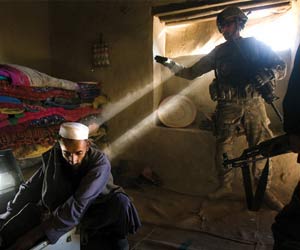
Unlike Wells’s Martians, who arrived on this planet without a propaganda department or a care in the world about English “hearts and minds,” we landed in Afghanistan talking a people-friendly game, and we’ve never stopped, even if much of the palaver has been for home consumption. And yet during the first eight years of our Afghan War, as General McChrystal recently admitted in his 66-page report to the secretary of defense, we could hardly have exhibited a more profound ignorance of the Afghan world, or a more Martian lack of interest in finding out about it, even as we were blowing Afghans away.
Now, the Pentagon is attempting to correct that by setting up a new intelligence unit “to provide military and civilian officials in Afghanistan with detailed analysis of the country’s tribal, political and religious dynamics.” As Robert Dreyfuss of the Nation’s Dreyfuss Report, points out, however, this unit will be based at a center in Tampa, Florida; we will, that is, now study the Afghans as anthropologists might once have studied the Trobriand Islanders. Then we will process that information thousands of miles away, just as our “pilots” do.
Perhaps it’s time to study ourselves instead. What if, from an Afghan point of view, we really are Wells’s Martians? Then, it’s not a matter of counterinsurgency versus counterterror, or more American troops versus more American-trained Afghan ones, or even nation-building versus stabilization. What if—and this is an un-American thought—there is no American solution to Afghanistan? What if no alternative, or combination of alternatives, will work? What if the only thing Martians can effectively do is destroy—or leave? (Remember, even Wells’s aliens finally and involuntary chose to abandon their occupation of England. They died, thanks to bacteria to which they had no immunity.)
What if the Afghans will never see those Predators—our equivalent of the Martian “tripods” and death rays combined—as their protectors? After all, our drones represent the technologically advanced, the alien, and the death-dealing along with, as Toronto Sun columnist Eric Margolis wrote recently, the whole panoply of our “B-1 heavy bombers, F-15s, F-16s, F-18s, Apache and AC-130 gunships, heavy artillery, tanks, radars, killer drones, cluster bombs, white phosphorus, rockets, and space surveillance.” Even our propaganda, dropped from the air (as if from another universe), can kill. Recently, an Afghan girl died after being hit by a box of propaganda leaflets, released from a British plane, that “failed to come apart.” Her heart and mind may be stilled, but rest assured, those of her parents, her relatives, and others who knew her, undoubtedly aren’t.
Here’s a little exchange, as reported at a New York Times blog from an alien “encounter” in another land. A U.S. Army major, Guy Parmeter, had it near Samara in Iraq’s Salahuddin province in 2004 (“[I]t made me think: how are we perceived, who are we to them?”):
Maj. Guy Parmeter: “Seen any foreign fighters?”
Iraqi farmer: “Yes, you.”
Sometimes it takes 66 pages to report on a war. Sometimes a century old novel can do the trick. Sometimes you can write tomes about the “mistakes” made in, and the “tragedy” of, an American counterinsurgency war in a distant land. Sometimes a simple “yes, you” will do.