Photo: <a href="http://www.phoenix.edu/" target="_blank">University of Phoenix</a> website
This story first appeared on the ProPublica website.
After federal regulators accused the University of Phoenix of systematic enrollment abuses in 2004, the school’s parent company paid out nearly $10 million to resolve the allegations.
Phoenix allegedly had broken the law by tying recruiters’ pay to enrollment numbers, U.S. Department of Education investigators found, creating pressure to sign up unqualified students.
In the years since, Phoenix cemented its stature as the nation’s largest for-profit school and the single biggest recipient of federal student aid. But some of the school’s recruiters have continued to use high-pressure, deceptive tactics, according to a dozen current and former students and two former recruiters who spoke to ProPublica and Marketplace as part of a joint investigation.
The students said Phoenix counselors misled them about whether credits would transfer to other schools, pretended to befriend them and lied about financial aid. The recruiters said they were told to rope students in with phony claims that classes were filling fast, or by suggesting that federal grants would cover costs, even if that was uncertain.
Last week, Phoenix’s parent company, the Apollo Group, announced that it had put aside $80 million to settle a whistleblower lawsuit that makes allegations similar to those in the 2004 investigation.
In making the announcement, Phoenix said its “compensation programs and practices were in compliance with the applicable legal requirements.” And the university’s president, Bill Pepicello, said in an earlier interview that if any recruiters had acted dishonestly, it was not with the company’s approval.
Phoenix is not the only for-profit university to get into trouble in recent years. Over the past decade, federal and state agencies have found that other schools improperly paid recruiters based on how many people they signed up, falsified enrollment tests and fabricated financial aid documents.
But with the bad economy, the industry has boomed. Enrollments have leapt 20 percent in the last two years, as people look to gain skills or fill gaps in their resumes. Now the Obama administration plans to expand federal student aid programs to a record $130 billion, further benefiting the schools. Phoenix stands out. With 420,000 students, the school drew $3.2 billion in federal aid last year.
The federal government disburses aid directly to schools, which then use the money to cover tuition and other fees and return the balance to students.
Critics worry that more students than ever are at risk of being sucked in by questionable enrollment methods and left with thousands of dollars of debt— often without graduating.
“There is nothing more counterintuitive than to spend massive amounts of money and end up with actual adverse consequences, to leave people literally worse off after spending money on them,” said Barmak Nassirian, of the American Association of Collegiate Registrars and Admissions Officers, an industry group whose members include some for-profit schools.
But supporters say it’s a mistake to paint the whole sector as scandal-ridden. Proprietary schools serve low-income and minority students, who often do not have access to traditional colleges, according to Diane Jones, a former Bush administration education appointee.
“I think to cast stones at the sector that is working the hardest to serve the most challenging students doesn’t make sense,” she said.
‘Focused on the Numbers’
In July 2006, Brandon Burke took a recruiter job at the University of Phoenix in Portland, Ore. He’d previously worked at another for-profit university where he said he’d been pressured to enroll students so the school could collect the $50 application fee.
At first, things were different at Phoenix.
“It really was all about, ‘Do the job the way it needs to be done and get the right people in here,'” Burke said.
But after two or three months, managers were pressuring recruiters to use what Burke felt were misleading techniques. Among other things, recruiters were encouraged to “create a sense of urgency,” Burke said.
“One thing we would be told to do is call up a student who was on the fence and say, ‘All right, I’ve only got one seat left. I need to know right now if you need me to save this for you, because this class is about to get full.’ Well, that wasn’t true,” Burke said. “We were told to lie.”
The technique was often successful, according to Burke, who said recruiters also led students to believe that course credits could be readily transferred, even to top schools such as Stanford University.
“One of the things we were told to do was, ‘You say we are regionally accredited, which means that they are transferred anywhere,'” Burke said.
Phoenix credits can be transferred, but the recipient school decides which credits to accept, and how many. Stanford has a cap on the number of credits it will accept from online schools, and performs its own assessment of whether the courses are equivalent, a university spokeswoman said.
Phoenix “became more focused on numbers. You had to enroll this amount of people all the time, and it started to become a little bit more about money,” said Burke. “Not about finding the right students and helping the right students get into the program.”
 Asked about such allegations, Pepicello, Phoenix’s president, denied that counselors were trained to trick students into thinking that classes were filling up or that credit transfer was assured. But he defended telling students that credits could transfer to schools such as Stanford. He said recruiters are trained to explain that other institutions decide which credits to accept.
“We are regionally accredited, as is Stanford, and for that reason, normally credits will transfer between mutually regionally accredited institutions,” he said.
Two former students told ProPublica that Phoenix recruiters had lied to them about the transferability of credits.
Angelia Baldwin of Aberdeen, S.D., signed up for a health care course at Phoenix in fall of 2006. Baldwin, 49, is part Native American and explained to her enrollment counselor that she wanted to study alternative therapies to further her new business making natural soaps and lotions. The business was inspired by her grandmother, Josephine, who was a medicine woman on the reservation in Minnesota where Baldwin grew up.
Baldwin said the counselor assured her she could take the general classes in health care and then transfer the credits to a school that offered alternative medicine.
After 18 months and $11,000 in tuition, Baldwin tried to enroll in Everglades University, another for-profit school, but was told her Phoenix credits would not count.
“I hit the roof,” said Baldwin. “My enrollment was put on hold for six weeks before we worked some of this out. And I had to take clinical ethics and chemistry classes over again.”
Michele Rambo signed up at the Dallas campus. Rambo said enrollment counselors assured her that credits would transfer. After discovering problems with her financial aid, Rambo tried moving to Central Texas College and Tarrant County College, but neither would accept her Phoenix credits, she said.
“I don’t really know if I’m going to be able to continue school after this,” said Rambo, 23. “It’s kind of, I had a plan and now I kind of don’t.”
University officials said they were unaware of such incidents.
Best Gloss on Financial Aid
Rambo also claims that the counselors misled her about financial aid.
“I told them specifically what I was looking for, and that was just grants and scholarships,” she said. As counselors guided her through the paperwork, they assured her that, because she was six months pregnant, she was entitled to enough grants to cover her costs, Rambo said.
“They told me, it’s like I was getting paid to go to school,” she said. Then in May, Rambo got a call from a Phoenix counselor who wanted to move her into a bachelor’s degree program. “One of the questions that she asked me completely stopped the whole conversation. She had asked me, ‘So what kind of loan do you have?’ And I told her that I didn’t have a loan.”
Rambo discovered she had loans that would total $18,000 by graduation. She is unemployed and her husband, who works in a factory, earns roughly $20,000 a year.
“They lied to me, and I signed things based on what they were telling me,” she said.
Burke said managers were very clear that recruiters could not lie about the prospect of getting financial aid. But they were encouraged to make it seem likely.
“We would be told to say the phrase, ‘And you don’t know how much you might get in grants,'” he said. “So we were going by the letter of the law, in that we weren’t promising a certain amount of grant money, but we were also told to phrase it in such a way that left it open and positive.”
Pepicello said that he had not heard of such incidents at Phoenix and that they would not be condoned. “We train our financial counselors very carefully to provide an array of options to students and to try and be as specific as they can” about the implications, he said.
Burke and another counselor, Sarah Hunt, who worked at the Portland campus from 2004 to 2007, said there was pressure to push prospects into classes that clearly didn’t match their desires.
Callers inquiring about a bachelor of education were steered into a communications degree, they said. People asking for psychology— not offered at the school— were steered into human services.
“We would get a lot of calls for CSI,” said Burke, referring to the popular television show about forensic sleuths who solve crimes. “Sometimes we were told to go ahead and enroll them in the criminal justice program,” he said.
The university confirmed that its criminal justice program might qualify a graduate to work as a prison guard, but not in forensic investigations.
Three women in different states say they were befriended by counselors but later came to see those friendships as a sales ploy.
 Kat Clark of California and Teresa Barron, then living in Georgia, said Phoenix advisers invited them to meals. Clark went to a BBQ at her recruiter’s house, and they exchanged text messages and e-mails during the work week.
Barron went to watch “Bruce Almighty” with her recruiter, who also talked to Barron about their shared religious beliefs. And Jewel Calderon, who then lived in Fayetteville, N.C., said her recruiter chatted with her grandmother.
“Every time he called, I was never home, so he would speak to my grandmother and he basically found out that we were Christian and deeply religious,” she said. The recruiter prayed with Calderon’s grandmother, in what Calderon described as “church over the phone.”
“I just mainly felt like I could trust him since he said that he was so deeply religious,” she said. “That’s why I decided on that college as opposed to others.”
In all three cases, when the students started having problems with the university, their new friendships evaporated.
“I don’t think it was a genuine thing,” said Clark. “I think it was more of a, ‘This is my job and I’ll do anything to make sure I get paid.'”
Pepicello, the Phoenix president, said the school does not encourage recruiters to use friendship as a sales technique. “Certainly that would not be a practice that we would condone,” he said. “We try our best to instill a very professional demeanor in all our employees.”
Asked why students would be steered to courses that didn’t suit their needs, Phoenix spokeswoman Sara Jones said company policy is to “advise students of the educational options that would best meet their needs.” Enrollment advisers undergo annual training on “ethics and misadvisement,” she said.
Defenders of the University of Phoenix and other for-profit schools say a few anecdotes don’t accurately represent practices in the entire sector.
“When you have a system that’s this complex, with over 2 million students, with close to 3,000 institutions, once in a while you’re going to have a rogue employee,” said Harris Miller, president and CEO of the Career College Association, an industry lobby group.
“Any admissions officer who is misleading students should be fired,” Miller said, “and if his or her supervisor told them to do so, that person should be fired.”
The University of Phoenix is not the only for-profit school accused of misleading prospective students about credits. Class-action lawsuits against Phoenix’s competitors— including some of the biggest providers, such as Career Education Corporation and DeVry University— make similar allegations.
The New Subprime?
In September, the Government Accountability Office published a report showing that some proprietary schools were enrolling students who did not meet the minimum requirements for college— a high school education or its equivalent.
The GAO did not name any particular schools, but said that the instances had been referred to the Education Department’s inspector general.
If prospective students don’t have a high school degree or other academic credential, schools can admit them by administering an “ability to benefit” test, which is designed to ensure a candidate has sufficient skills for college.
The GAO sent two undercover inspectors to deliberately flunk the exam at one for-profit school. The contractors administering the test read the answers aloud to the applicants, and the inspectors later found that the school had crossed out their incorrect answers, and filled them in correctly.
At a congressional hearing about the report, Rep. George Miller, D-Calif., chairman of the House Education and Labor Committee, said he worried about an influx of unqualified students, many of whom take out government loans to pay tuition.
“We’re developing a process here that looks a lot like subprime student loans,” Miller said. “Knowing that these people don’t have the capacity to pay it back, knowing that they may not have the ability to benefit from this education, we go ahead and extend them the credit.”
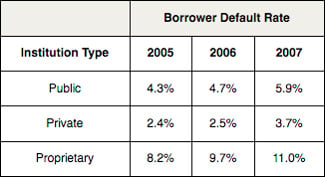 Students at for-profit schools have higher than average loan default rates, according to the GAO report. The average rate at for-profits is 11 percent, compared with 6 percent across higher education, and just under 4 percent for nonprofit private colleges.
The University of Phoenix’s rate, at 9.3 percent, is actually below the average at for-profit schools.
All of these numbers are low because, as earlier government reports have shown, the Department of Education tracks defaults only for the first two years after a student graduates. Defaults increase over time, exceeding 23 percent after four years at for-profit schools, according to the GAO.
Unlike other forms of debt, student loans cannot be erased in bankruptcy.
“Students who default on their student loans have their Social Security benefits intercepted, have their tax returns intercepted, have their wages garnished” and “are ineligible for any other federal benefit program until they arrive at a repayment solution,” said Nassirian, of the association that represents college admission officers. “They are ruined for life.”
Taxpayers don’t suffer because, although the public underwrites the system by providing the loans, the program makes money overall, according to Department of Education estimates.
Some former students said they have had to postpone plans to go on to another college after dropping out of the University of Phoenix because they were saddled with debt.
Dropouts are an issue at Phoenix and other for-profits.
The Department of Education says 5 percent of students enrolled in the University of Phoenix’s online program graduate. The university says the rate is closer to 37 percent for an associate degree.
That is low for for-profit schools, according to the Career College Association’s Miller, who said the average is about 60 percent— the same as at four-year public universities, according to Department of Education data. Miller said the for-profit rate is higher than comparable two-year degrees at community colleges.
Nassirian said the combination of debt and low graduation means these colleges are hurting the people they’re meant to help.
“When you see a pattern of consistent failure to deliver value,” said Nassirian, “you are beginning to see, in my judgment anyway, a very high probability of institutional culpability.”
Tougher Rules on Incentive Pay
Now, it looks like regulators may step up oversight of the sector.
This winter, the Department of Education will review the regulations governing for-profit schools, and compensation of enrollment officers is likely to be a key focus, said Jeff Silber, a financial analyst at BMO Capital who follows stocks of for-profit school.
Silber is bullish on the for-profit industry even as short-sellers crowd into the market, betting that shares of Phoenix’s parent, the Apollo Group, and some other schools will plunge if regulators act.
Silber said regulators are looking seriously at tightening the rules on recruiter pay. Congress in 1992 passed a law banning enrollment-based compensation for schools that participate in the federal aid programs. But under the Bush administration, the Education Department introduced a dozen exceptions. Under those rules, Phoenix continues to use enrollment as one of several factors in recruiter pay; the department’s 2004 investigation faulted the school for using enrollment solely as the basis for recruiter pay.
Critics say the exceptions create pressure to cut corners. The National Association for College Admission Counseling, a group that represents high school and college admissions officers, said the exceptions, along with a “de-emphasis of oversight” during the Bush administration, “gutted” enforcement. The association wants the exceptions scrapped.
Industry backers say for-profit schools are being unfairly singled out by the Obama administration for political reasons. “It’s no secret in Washington that for-profits are tremendous contributors to campaigns for Republicans,” said Jones, the former Bush education appointee.
Education advocates say some fundamental changes are needed to protect students from abusive enrollment techniques.
“Too much of the federal funding that is pumped into the system in the name of increasing access to education is in fact being siphoned off by business men and women, and by Wall Street,” said Nassirian. These companies “do not necessarily, in all instances, do a particularly spectacular job of delivering value.”