Illustration: Dale Stephanos
UPDATE: On Nov. 1, 2011, Goldline executives were charged with fraud. Read on to learn why. And check out our other reporting: Consumers tip off the FTC about Goldline, Beck’s counterattack on Rep. Anthony Weiner, the story behind Goldline’s perfect BBB rating, and the left-wing radio hosts who pitch gold.
TUNE IN TO GLENN BECK’S Fox News show or his syndicated radio program, and you’ll soon learn about the precarious state of the US dollar, a currency on the verge of collapse due to runaway government spending, a ballooning national debt, and imminent Zimbabwe-style hyperinflation. To defend yourself against the coming financial holocaust, Beck explained on his radio show last November, you need to “think like a German Jew in 1934, maybe 1931.” And that means thinking about buying some gold.
Conveniently, Beck made that suggestion as he was in the midst of interviewing his own “gold guy,” Mark Albarian, the president and CEO of Goldline International, a Santa Monica, California-based precious metals company that is a major sponsor of Beck’s radio and cable shows. In a seamless intertwining of anxiety and entrepreneurship, the two amicably debated whether we’ve already hit “peak gold” or whether the price of gold, then at $1,100 an ounce, might yet hit the inflation-adjusted high of $2,200 it saw back in 1980. Beck speculated that gold could go as high as $2,500 an ounce:
“I think people are running out of options on what, you know, could be worth something at all.”
For more than a century, gold has held a special allure for conservatives. Amid economic downswings and social upheaval, the precious metal has come to be seen as a moral and political statement as much as an investment. Ever since the late 19th century, when the gold standard became the center of a ferocious debate about the country’s financial future, gold has been mythologized as a bulwark against inflation, federal meddling, and the corrosive effects of progressivism. (See “Goldbug Variations,” below.) In the late 1970s, South African Krugerrands became a refuge from soaring interest rates and oil prices. In the ’90s, militia groups fearful of big banks and the Federal Reserve hoarded gold.
And now, with the economy limping along and a black Democrat in the White House, gold mania has gone mainstream. Gold prices hit a recent high last December and remained strong as the European debt crisis unfolded this spring. John Paulson, the hedge-fund giant who made billions bundling and betting against Goldman Sachs subprime mortgage securities, has invested heavily in gold, even starting a new fund devoted solely to it. A recent New York Times poll found that 1 in 20 self-identified Tea Party members had bought gold in the past year.
Cashing in on all this is a raft of entrepreneurs who have tapped into financial insecurity and fever dreams of impending tyranny. Nearly every major conservative radio host, including Rush Limbaugh, Sean Hannity, Michael Savage, and Dr. Laura Schlessinger has advertised gold. (See “Full Metal Racket,” page 30.) But none has done more to cheer on the new gold rush than Glenn Beck.
Beck, whose various media enterprises brought in $32 million last year, according to Forbes, has a particular interest in plugging gold. Since 2008, Goldline has been one of his most reliable sponsors. Last year, after Beck called President Obama a racist, and advertisers bailed on his cable show (see “Lonesome at the Top“), Goldline stuck by him. And its loyalty appears to have paid off. In an email, Goldline’s executive vice president Scott Carter says that while its Beck sponsorship doesn’t bring in the majority of its customers, it “has improved sales,” which exceed $500 million a year.
In turn, Beck has stood by Goldline. Last year, he made a promo video in which he stated, “This is a top-notch organization”—a quote featured prominently on Goldline’s website. After the liberal watchdog Media Matters complained about Beck and Goldline’s partnership, Beck posted a video on his site in which he unapologetically noted that he’d started buying from Goldline long before it was his sponsor, back when gold was $300 an ounce.
Such coziness between spokesman and sponsor is not uncommon on talk radio, where hosts can be paid to personally recommend just about any product. In fact, liberal hosts such as Ed Schultz and Thom Hartmann have advertised gold. However, their pitches generally have lacked Beck’s tone of apocalyptic urgency.
The feedback loop between Beck and Goldline is unusually powerful even for talk radio, and even more so by cable standards. When he’s not talking up Goldline, Beck still hypes gold as a way to weather the coming end of the world as we know it. Last December, he stood in front of his famous chalkboard, where he’d written “Gold, God, Guns,” and admonished viewers, “The smart money is saying, ‘Hunker down!'” The more worked up Beck gets, the more Goldline can employ his fears in pitching its products to his audience.
Yet in putting his seal of approval on Goldline, “the people that I trust,” Beck has gone beyond simply endorsing an advertiser. He’s recommending a company that promotes financial security but operates in a largely unregulated no-man’s land, generating a pile of consumer complaints about misleading advertising, aggressive telemarketing, and overpriced products. As this story went to press, Rep. Anthony Weiner (D-N.Y.) asked the Federal Trade Commission and the Securities and Exchange Commission to investigate Goldline for its “predatory policies” and accused the company and conservative pundits of working “hand in hand to cheat consumers.” Beck and other on-air personalities “who are shilling for Goldline,” he said, “are either the worst financial advisors around or knowingly lying to their loyal viewers.”
JAMES RICHARDSON heard about Goldline on Beck’s radio show late last year. A disabled former trucker who lives in Tennessee, Richardson called the company with the intention of buying one-ounce gold bullion coins. The purity of American bullion is guaranteed by the Treasury and its prices are transparent, because they’re closely linked to the spot price of gold. But when Richardson got on the phone with Goldline, he says, a sales rep pressured him into buying something entirely different: $10,000 worth of tiny, 20-franc Swiss gold coins.
“I paid them on a credit card the same day, didn’t have no brochures on them or nothing,” he says. “They make it sound really good, like you can’t lose on them.”
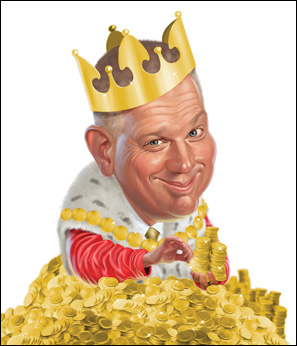 —Dale Stephanos
Richardson regretted the purchase almost as soon as he hung up. “I’m not a coin collector,” he says ruefully. The $10,000 represented one-fifth of his entire savings, and after some research he realized that he had vastly overpaid for the francs. The 34 coins he’d ordered from Goldline were 90 percent gold, amounting to about 6.3 ounces of gold, which was then selling at around $950 an ounce. He’d paid the equivalent of around $1,600 an ounce, meaning it could be years before he recouped his investment—if ever. “It was just a lose-lose situation,” he says.
Goldline’s marketing and disclosure materials explain that customers buying coins “for investment purposes” may not be able recoup their costs. They also say that first-time customers can cancel an order within seven days of purchase. But Richardson says that when he tried to get his money back within that time period, salespeople gave him the runaround and insisted he should keep the coins because the price of gold was going to double. He filed a complaint with the Los Angeles-area Better Business Bureau (BBB), of which Goldline is a member, and eventually he got a refund.
Richardson suspects he’s not the only Goldline customer who didn’t know what he was getting into. “I ain’t got no college degree or nothing, but some of these older people think they’re investing in gold, but you’re not. You’re investing in coins,” he says. The price of gold increased 133 percent between early 2006 and this May, yet many Goldline customers say they have lost money on their purchases after discovering—as Richardson did—that they had badly overpaid. Richardson is one of 44 people across the country who have filed complaints against Goldline with the Los Angeles BBB in the past three years; customers have also have griped about their dealings with the company on message boards such as Ripoff Report and the Pissed Off Consumer. Regulators in Missouri have sanctioned the company for pressuring an elderly couple to liquidate their other investments to buy overpriced coins.
The Federal Trade Commission (FTC) received 17 individual complaints about Goldline’s sales tactics between early 2006 and this May, according to information obtained through the Freedom of Information Act. Many of those stories mirror Richardson’s. One customer, whose name was redacted, filed a complaint in February, writing, “Not knowing anything about buying gold, I called Goldline International, Inc. because of their advertisement on Fox News and the fact that Glenn Beck endorses them.” Like Richardson, this customer originally wanted bullion, but the sales rep “absolutely insisted” on 20-franc coins, and the customer relented. Unable to get a refund, the customer reported paying $369 apiece for coins that could be bought elsewhere for as low as $208.
A Washington state couple nearing retirement told the FTC they’d invested $31,812 in foreign coins after calling to inquire about gold bullion “as a hedge against the falling dollar.” Once they realized they’d overpaid, they were too late for a refund. Another customer complained that a sales rep “insisted” on selling coins, in this case French francs: “He would not relent. He told me lies.” A quadriplegic Californian described being persuaded to pay $5,000 for $3,000 worth of gold coins after disclosing a recent inheritance to a Goldline rep.
I wanted to ask Glenn Beck about these complaints. He never responded, but after I sent his publicist some questions, I received a call from David Cosgrove, a former Missouri securities commissioner and lawyer who represents Goldline. He explained that Goldline is a large operation with 200 salespeople. A few problems, he said, are inevitable, but Goldline works hard to avoid them through compliance monitoring and other safeguards.
Undoubtedly, Beck fans who take his financial advice bear responsibility for not reading the fine print. But their trust in the pitchman is an essential part of the symbiotic relationship between host and sponsor that is common on talk radio, where “direct response” advertisers carefully tailor their spots to complement the programming. Toll-free numbers provide instant feedback on how well promotions are faring and allow companies to fine-tune their ad copy on a week-to-week basis. If, for instance, an advertiser sees a surge in calls during a Beck segment focusing on currency collapse, it can play off of his program’s message in an upcoming round of ads.
Take the Survival Seed Bank, another loyal Beck radio and TV advertiser, whose promotions echo both his and the gold companies’ doomsaying. A spot that ran on Beck’s Fox show earlier this year warned that “the politicians and the bankers are going to bring the whole thing crashing down,” making its vegetable seeds “more valuable than even silver and gold.”
The line between content and commercial is further blurred by guest appearances like the one Goldline CEO Albarian did with Beck last year. Goldline says it does not require such appearances on the shows it sponsors; a spokeswoman for Premier Radio Networks, which syndicates Beck’s radio show, likewise says the host has invited Albarian on “because he wants to. It’s not a contractual obligation.”
Bob Leonard is the head of business development at Strategic Media, a firm that specializes in radio advertising. He says talk radio is a great venue for direct-response advertising because its listeners are especially engaged with what they’re hearing. It’s not a stretch for them to pick up the phone and dial a company like Goldline because, “If you have someone like Glenn Beck saying, ‘You gotta call these guys,’ they’re gonna call.”
BECK OFTEN SAYS that when he buys gold, he sticks with collectors’ coins instead of bullion because the government is less likely to confiscate them. Like many Americans, you are probably unaware that the Obama administration is plotting to raid your safe-deposit box and melt down your bullion. But Beck insists that we must be on guard against such a scenario, citing a Depression-era executive order that made all gold federal property.
In his Goldline promo video, Beck explains, “Back in 1933, FDR said, ‘Okay, we’re going to take all your gold, and [slipping into a Muppet voice] gee, it’s worth—$8 an ounce.'” Beck suggests that some folks “got smart” and claimed their antique coins couldn’t be melted down because they were, well, antiques, and presto! They got to keep their gold. It’s a message Beck has hammered home in other Goldline spots—that in the face of an “out of control” government, collector coins are a safer deal than other kinds of gold.
Of course, this is revisionist history. With Congressional authorization, Roosevelt did indeed sign a 1933 executive order that made most private gold ownership illegal, but G-men didn’t go door to door seizing bullion. Instead, the government offered gold owners almost $21 an ounce—the market rate (and not $8, as Beck claims) to turn in their gold voluntarily. Antique and foreign coins were exempt. The move was intended to combat deflation by getting people to stop hoarding wealth that could instead circulate in the economy. The government also temporarily suspended the gold standard so it could adjust the value of the dollar, stabilizing prices, helping debtors, and encouraging more production. Georgetown University history professor Michael Kazin says FDR’s gold policy, which was championed by populists, boosted the economy and in turn contributed to his landslide reelection in 1936.
Goldline has not let the facts get in the way of using the confiscation myth for marketing. As early as 2002, its website (which then featured an endorsement from Charlton Heston) trumpeted how “the events of the 1930s…prove how important owning scarce and desirable gold coins really is!” Its current website and “investor kit” both provide a copy of FDR’s 1933 order, noting that in its wake, gold’s value increased nearly 75 percent—all the more reason to buy coins and hope for the worst. The pitch seems to be working: Its website reports that European gold coins are “the most popular choice among Goldline clients.”
What Goldline doesn’t say in its promotional materials is that for its own bottom line, collector coins are a lot more lucrative than mere bullion. Profits in the coin business are based on “spread,” the difference between the price at which a coin is sold and the price at which the dealer will buy it back. Most coin dealers, including Goldline, will sell a one-ounce bullion coin for about 5 percent more than they’ll buy it back for, a figure that closely tracks the price of an ounce of gold on the commodities markets. That 5 percent spread doesn’t leave a lot of room for profits, much less running dozens of ads a week on national radio and cable programs, with endorsements by everyone from Beck to Mike Huckabee, Fred Thompson, and Dennis Miller. So, Goldline rewards its salespeople for persuading would-be bullion buyers to purchase something with a bigger markup.
Twenty-franc Swiss coins are a little smaller than a nickel and contain a little less than two-tenths of an ounce of gold. The coins are about 60 to 110 years old and not especially hard to find (though Goldline describes them as “rare”). They are not fully considered collectors’ items or commodities, making their value more subjective than bullion’s. Goldline sets a 30 to 35 percent “spread” on the coins, meaning that it will pay $375 to buy back coins it’s currently selling for $500. At that rate, gold prices would have to jump by a third just for customers to recoup their investment, never mind making a profit. Investing in Goldline’s 20-franc coins would be like buying a blue-chip stock that lost a third of its value the minute it was purchased. It’s difficult to think of any other investment that loses so much value almost instantly. So what persuades people to buy anyway?
Beck has assured fans that Goldline’s sales reps are “not going to pressure you.” I called to find out. I dialed the company’s toll-free number from my office to request one of its free “investor kits.” When I mentioned that I’d heard about Goldline from Glenn Beck, the salesman informed me right away that Beck was one of the company’s best clients. “We’re the only company he buys from,” he told me. After learning that I had never invested in gold before, he plugged “investment grade” coins by assuring me, “That’s what Glenn buys.”
He also cited FDR’s gold order. It “all has to do with the devaluation of the dollar,” he said, warning, “It’s very similar to 1933 today.” He quickly ran through some disclaimers, like the spread and how the company recommends holding on to the coins for at least three to five years—preferably ten. But in the end, he told me, gold is just a great investment. “Are you ready to get started today?” he asked. “Nobody can take it away from you. You can’t print more of it. There is a finite amount of gold.”
About two weeks later, after I’d received my investor kit, the same sales rep called me at work, even though I’d never given him my phone number. Just to double check that Goldline was indeed using caller ID to track potential customers, I called one of its 800 numbers on my cell phone and asked about putting gold into an IRA. I didn’t offer my name or number, but the same sales rep called me back not five minutes after I hung up.
GOLDLINE’S ASSERTIVE TACTICS also extend to its efforts to protect its image. In response to the disgruntled consumers who have congregated on Ripoff Report, it has joined the site’s “Corporate Advocacy Business Remediation and Customer Satisfaction Program,” which has allowed it to bury the negative comments. Its own customer review site, goldlinereviews.com, features only positive feedback. “I am writing to you about my account manager,” writes Y.L.C. from California. “He is the very definition of a caring and polite professional, he is in fact the main reason I chose Goldline (and Glenn Beck).”
Goldline has also tried to keep unhappy customers from making their stories public. Take John Quirindongo, a 77-year-old former New York City postal supervisor. Quirindongo has spent nearly four years trying to get compensation for the money he believes he lost trying to buy platinum bullion from Goldline. When I visited him in Fort Lauderdale, Florida, he was reclining on a sofa, laptop open. A box with two rolls of gold coins sat on a table. His much younger Russian wife flitted around, pouring syrup on a blintz for me before darting off to her job at a children’s clothes store. Quirindongo’s vision is mostly gone. He relies on a walker to get around and a nebulizer to breathe. His hearing is going, he’s missing a couple of bottom teeth, and he gets a little confused sometimes. But when it comes to Goldline, he’s lucid—and very angry.
Quirindongo’s saga started in 2006, when a mortgage broker talked him into taking out a $100,000 subprime loan on his condo, which he owned outright. After paying off his car and some bills, Quirindongo decided to invest $70,000 in platinum. He called Goldline and ordered 54 one-ounce platinum American Eagle bullion coins. After the company received his wire transfer but before the sale was confirmed, a salesman called, telling him he needed to “diversify” his portfolio and pushing him to transfer $34,000 into Swiss 20-franc gold coins.
Even though Goldline’s disclosure materials do mention that its sales reps may call to “discuss other products which carry a higher spread such as the European gold francs” before an order is finalized, Quirindongo was caught off guard. He says he argued that platinum was a better investment, but eventually caved and bought the francs.
Looking on eBay, Quirindongo found similar looking coins selling for far less. He says he called to complain every day for a week, but the Goldline rep insisted he should let his coins gain value for 18 months. Quirindongo missed the weeklong window for a refund and then spent the next year and a half letting his order appreciate. But he was still mad, and in May 2007, he sold the platinum part of his order back to Goldline, making about $219, all of which was eaten up in commissions and storage fees. The real shock came a few months later, when he tried to sell back his gold coins and discovered the buy-back price would leave him more than $10,000 in the hole.
After Quirindongo complained to the American Numismatic Association, of which Goldline is a member, the company offered a partial refund, so long as he signed an agreement promising not to speak publicly or contact any consumer or government agencies. Quirindongo refused. After he rejected a full refund, Goldline tried to close the matter by sending him his gold coins, which now sit partly unwrapped in his apartment.
Still bitter that he was talked out of his original platinum order, which would have appreciated significantly, Quirindongo has continued to bash Goldline. He has posted long online tirades and is currently pursuing a RICO case (an earlier federal suit he’d filed on his own was tossed out). Posting on Ripoff Report, a Goldline representative accused Quirindongo of trying to “extort” money from the company. Quirindongo says he is fighting mainly for his wife Irina’s sake: His monthly postal-service pension will die with him, and her earnings won’t cover his mortgage and metals misadventures. He worries she’ll end up on the street. “I feel like a real chump now,” he says. “The last few years have been absolute torture for me.”
Quirindongo wasn’t the only person I came across who’d been offered a deal in exchange for keeping quiet. California residents Peter Kim and Kyoung Park-Kim bought about $35,000 in 20-franc coins from Goldline in 2007 after listening to the company’s radio show, The American Advisor, which airs on more than 100 stations. They complained about overpaying, and Goldline offered to refund most of their money if they’d sign an agreement like the one offered to Quirindongo. The couple refused and sold the coins on their own, losing between $1,000 and $2,000. “At least we’re young, so we can recoup some time and make money,” says Kim. “But senior citizens, they don’t have that luxury of recouping their investment.” (At press time, Goldline had not responded to a request for comment on Kim’s and other individual consumers’ complaints.)
Goldline’s unhappy customers have few options. They can’t take the company to court, due to a mandatory arbitration clause in its contracts. And even as it plays up fears of big government, Goldline neatly slips between the regulatory cracks. While it describes its coins as investments, it’s not licensed as an investment company. Its salespeople are not licensed as securities brokers or investment advisors and therefore are beyond the reach of state or federal agencies charged with keeping brokers honest. When Quirindongo complained to the FTC, Florida securities regulators, and the Department of Justice, he says, he got the same response: “Everybody said, ‘That’s gold.’ It’s like stamp collecting. It’s unregulated.”
“Trading in coins has been an area that’s very, very difficult for regulators to wrap their arms around,” confirms Maine securities administrator Judith Shaw. As the economy turned sour in 2008, Shaw’s office saw a large uptick in the aggressive telemarketing of gold, prompting her to issue a consumer advisory about “potential scams and pitfalls” being perpetrated by “numerous shady companies operating on the margins of this industry.”
There has been one successful state action against Goldline. In 2006, the children of an octogenarian Missouri woman complained to the state securities commissioner that Goldline had persuaded their mother to invest about $230,000 in gold coins and antique paper currency worth half as much. The state determined that a Goldline salesperson had acted as an unlicensed investment advisor when he encouraged her to liquidate an annuity to buy coins. Goldline agreed to refund $217,000 to the woman.
Cosgrove, who represented Goldline in the Missouri case, cautioned me not to see it as representative of the company as a whole. He said the salesperson who prompted the complaints had already left the company by the time Goldline learned about the problem.
Beck has never acknowledged any of the complaints against Goldline, just as he’s shrugged off concerns about his cozy relationship with the company. If anything, his endorsement of Goldline has taken on a new edge of defiance. Responding to Rep. Weiner’s accusations in May, Beck accused him of McCarthyism and asked his fans to send in images of the congressman “with a wiener nose.” As he railed against the “assault on my advertisers and me” on his radio program, he still managed to sneak in a plug, noting that he had 15 or 20 percent of his investments in gold—”From Goldline. Now, you tell me. If I’m such a scam artist, why would I be scamming myself?”