Photos: Paul Reyes
Note: A longer version of this article, as well as a data analysis of the 164 anti-immigration laws passed by state legislatures since 2010, appeared in the March/April 2012 issue of Mother Jones. Read the whole package: Inside the Self-Deportation Movement.
Saturday was game day in Alabama, a clean, bright September afternoon. The Crimson Tide and Tigers were both at home, all but emptying Birmingham out. I headed north toward Cullman County to talk with Keith Smith and other farmers about HB 56, Alabama’s divisive anti-immigration bill—the toughest in the nation, signed by Gov. Robert Bentley in June and suspended at the end of summer after several groups sued to stop it, forcing US District Judge Sharon Blackburn to consider its constitutionality. Her ruling, which came down this morning, allows much of the law’s most draconian provisions to stand. (Read more below.) But even before the ruling, Alabama had suffered a long summer of bitter confrontations over race and regulation, and in many ways, the damage has been done.
The vista along I-65 still showed scars from the massive tornadoes that ripped through the state back in the spring, just a week before HB 56 passed—in buzz-cut swaths and pools of pine and scrub oak smashed and smeared together on a bluff. Among the towering lampposts that light this highway at night, a couple had been snapped in half. One even made for fascinating disaster art, bent and twisted like a Calder public sculpture. Farther north, heading into Golden Ridge, the road was flanked by more fallout: piles of rock and rubble flanking lucky homes somehow spared, and blue tarps flapping on the roofs of others, less lucky but still standing. I pulled into Keith Smith Farms, a compound of chicken houses and warehouses at the far end of a long gravel drive and fields bending over the horizon.
Smith pulled up in a white pickup with a couple of collies, each with a lame back leg but hobbling at an impressive clip. Smith is an enormous man whose size befits the truck he drives. He moved slowly and with effort, suppressing a pain that seemed to rise up from swollen, darkened ankles. Smith grows sweet potatoes and greens in addition to raising pullets for Tyson, Ingham, and other poultry giants. 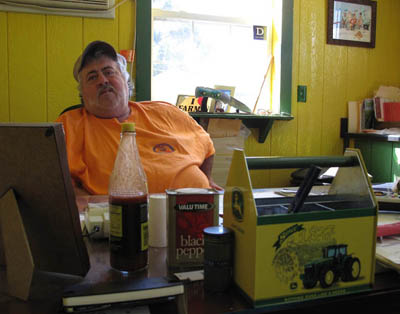 Farmer Keith Smith says HB 56 will put him out of business.The previous Monday, he and other farmers had met with lawmakers, including state Sen. Paul Bussman, at a restaurant in nearby Good Hope to air their grievances over HB 56, making clear their farms were at risk. Bussman, a Republican, had himself publicly expressed concern over aspects of the bill, but he voted for it nonetheless. As for Smith, he’d expected little relief from the meeting—he’d already lost eight workers due to fears about the law’s impending passage—and wasn’t too optimistic about his future as a farmer, either.
He did not mince words about the circumstances. “Majority of people that works for me,” he said in a deep, marbled drawl, “with the kind of jobs I got, they’re illegal. There ain’t no use in beating around the bush saying they ain’t or whatnot. That’s just the way it is.” Fake papers, no papers, tax-filing mysteries—”I’ve worried about all this stuff and done it for years, and I just go to where I throwed my hands up and said, ‘To hell with it. I’ll just work ’em, pay ’em, and forget about it.'”
The problem, of course, is that anyone here legally refuses to do the kind of backbreaking work Smith has to offer. It stands to reason that anyone with good papers—even well-faked papers—would make the most of them. Agriculture is a grueling, billion-dollar industry in Alabama. A third of that business is poultry, the rest driven by small farms like Smith’s. Wages range from the $7.25-an-hour state minimum wage to about $14 an hour (other jobs are paid as “piecework”—30 cents a bucket of potatoes, say, or a couple bucks per thousand chickens for chicken catchers). And while anti-immigration arguments hang on the idea that if illegal workers were barred from these jobs Americans would be enticed onto these fields and into these chicken houses, Smith and other farmers don’t give it a second thought. Most of the non-Latinos that Smith has hired over the years last maybe a couple of hours at most, he says, before they quit.
Smith told me that none of the farmers he knew supported HB 56 as it stands—which was not to say they didn’t support some type of immigration reform. Every employer you talk to who relies on illegal labor would prefer to find some simpler process to hire one of America’s most motivated workforces. But the argument has long been one of reform versus enforcement, and in the case of HB 56, enforcement is written to the extreme. “All of us would like to see an immigration law we can deal with,” Smith said. He mentioned fee-based work permits, background checks, tracking numbers, some of which Sen. Bussman had recommended. “But the way this bill is now,” Smith said, “if you have anything to do with them whatsoever, you’re breaking the law. If you see ’em and they’re hungry, or if they out here run over by an automobile layin’ in a ditch, and you help ’em, you’re breakin’ the law.” He swung to smash a fly on his desk, and missed. “It’s just not right.”
Though it comes off as exaggeration, the scenarios Smith mentioned do fall within the purview of HB 56. The law is alarmingly tough, eclipsing Arizona’s SB 1070 by several measures—including, among other punishments, incarceration and fines for anyone who knowingly employs, harbors, or transports illegal immigrants. Giving an undocumented immigrant a ride to work, offering them shelter, offering them sacrament: All of these acts are, with just the slightest interpretation, criminalized in the bill. 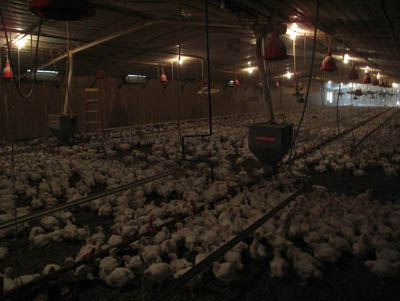 Chicken houses on Smith’s farmThe language is that sweeping and vague. One of the more incendiary measures of the law requires the Department of Education to “accurately measure and assess the population of students who are aliens not lawfully present in the United States”—a provision that flirts with undermining the Supreme Court’s 1982 ruling in Plyler v. Doe, which guarantees an education to undocumented immigrant children. State Sen. Scott Beason insisted that the measure was simply a matter of accounting: “That is where one of our largest costs come from,” he told the Montgomery Advertiser. “It’s part of the cost factor. Are the parents here illegally, and if they were not here at all would there be a cost?” But it doesn’t require too much extrapolation to figure out that by this simple head count, teachers could become unwitting, harboring accomplices if they fail to turn a family in.
 Workers at Smith’s farmHB 56 was authored by state Rep. Micky Hammon, for whom immigration has long been a platform issue, and was guided to the governor’s desk by Sen. Beason (recently caught on a wiretap referring to blacks as “aborigines”). That HB 56 shares provisions with similar laws in Arizona and Georgia is no coincidence: All three are part of a larger anti-immigration effort orchestrated by the Federation for American Immigration Reform and its legal arm, the Immigration Reform Law Institute. (While Hammon is the official author of HB 56, its architect is Kansas Secretary of State Kris Kobach, who is also of counsel to IRLI and has crafted Arizona’s SB 1070 and scores of anti-immigration laws and ordinances across the country). Both Hammon and Beason promoted the bill with the kind of hyperbole that whips a crowd up, calling out to the counties “most heavily hit by illegal immigration,” as if the arrival of the Latino workforce were a natural disaster. To give HB 56 some push, Hammon adopted some alarmist data, claiming that Alabama has “the second fastest growing population of illegal immigrants in the United States,” even though only 120,000 of the estimated 11 million undocumented immigrants in the US live in Alabama, according to the Pew Hispanic Center. In June, he told the Anniston Star that illegal immigrants cost Alabama between $600 and $800 million annually, an estimate that combined the fiscal impacts of unemployment, health care, education, and lost tax revenue. When the Star fact-checked his figures, it discovered that he’d simply extrapolated from a study done on Arizona by the Federation for American Immigration Reform. FAIR had included Alabama in the study, but with a burden of $298 million.
But it isn’t really about the math—it’s about the zeitgeist. It’s about infuriated factions of an already angry middle class seeking an easy target, which is what made the cheering at last Monday’s Rainy Day Patriot rally in Veterans Park sound less celebratory than embittered and led this tea party crowd to accept the supposed economic motive behind HB 56 at face value. It’s what allowed Beason to take the stage and say with a straight face that HB 56 “is about putting Alabamians back to work,” and that it promised to be “the biggest jobs program for Alabamians that has ever been passed.”
If anything, opponents say, the bill promises to place an even greater fiscal burden on the agencies charged with enforcing it. Just this week, Jefferson County Sheriff Mike Hale warned that he may have to lay off more than 100 of his deputies and close several substations in order to meet the $6.5 million in budget cuts proposed by the county commission. In the last two years alone, the sheriff’s budget has been chopped by $18 million. Considering such fiscal emergencies, Hale and other law enforcement officials insist, the enforcement of a federal immigration law is a rather low priority, especially since it treads questionable grounds of jurisdiction and legal authority.
In Tuscaloosa County, even before the bill was signed by Gov. Bentley, Sheriff Ted Sexton questioned its practicality, saying that while he supported the concept of HB 56, he had serious concerns about whether local law enforcement could afford to train deputies to double as immigration officers. (The bill includes no funding for the six weeks of training required.) Then there are the more impractical realties, such as incompatible fingerprinting systems on the local and federal levels and a county jail with a capacity for 540 inmates that is already packed with some 600.
 Tornado destruction in Cullman County, AlabamaTuscaloosa was one of the towns hardest hit by April’s tornadoes, which flattened most of the cottages along University Avenue and in areas like Alberta and Hope, both largely Latino. In the days following the storm, Tuscaloosa Police Chief Steve Anderson realized that very few Latinos had shown up at various aid stations that had been set up around town, despite the damage done to the neighborhoods where they lived. “We realized they were largely unaccounted for,” Anderson said. He and Sexton sent officers and deputies into Alberta and Hope, and discovered people nursing their own injuries, including broken bones, for fear of seeking help at hospitals and being deported. Rather than respond to FEMA’s outreach, many sought shelter at Holy Spirit Catholic Church, a charity HB 56 will potentially criminalize.
In many ways, across the spectrum of community service, HB 56 puts those who serve the public in awkward positions between their community and the law. “The bottom line is,” Anderson said, “we’re trying to help people. But we’d be doing more damage than helping them. We’d be making them prone to avoiding us, even if they needed help. In a way, there is a possibility of being torn between following the letter of the law and helping a person in need. The law doesn’t give law enforcement a whole lot of discretion.”
 Churches like this one could be prosecuted for aiding immigrants. Also, the town needs these workers now more than ever, says Anderson: “For our city to get back on track and get back to what our new normal will be, Hispanics will play a vital role. But if this bill passes, it’s going to hamper our rebuilding effort. A lot of skilled labor is going to be forced to leave Tuscaloosa and Alabama in general. It’s a real possibility.”
Back in Cullman County, farmers like Keith Smith have no illusions about the impact of this bill, economic or otherwise. He’s lost eight workers already and stands to lose several more if HB 56 passes—including those we could see out in his field on that game day, eight of them planting collards as the sun angled on them, so that the men bowed their heads to let the brims of their hats cast a little shade on their faces. The sweet potato crop alone is worth half a million dollars, employs about 20 out in the field, another 20 during harvest. “If I lose this crop, I’m out,” he said. “I’ll just have to do something else.”
Did he have a plan? “They ain’t no plan,” he said, and kept tugging at his T-shirt, as if it stuck to his shoulders. “If Blackburn rules in favor of the state and all the help leaves, then that’s pretty much it. I’ll try and find people. But I’m fighting a losing battle.”
Worse, it seemed to me, was a less quantifiable loss. Earlier that day I’d met with a Cullman couple named David and Sandra Bagwell, who run a couple of chicken catching crews, six men each, for the poultry giants. I’d sat in their kitchen while Sarah played a home video of a catch, pointing out the workers—who she called “her boys”—as they rounded up chickens in deceptively smooth, sweeping handfuls, with the relentless progression of a tide, 20,000 in an hour. She pointed to each figure as it moved across the screen, named him, and told me of his quirks and talents. She was, she admitted, “a nervous wreck” about HB 56, in part because wasn’t sure what her workers would do once the law went into effect. She had the documents they’d provided her, but that didn’t necessarily mean the documents weren’t faked. With HB 56 looming, she said, “I don’t know what I’m going to do Thursday morning.” She knew other crews who were going to stick it out, and she worried that her own might disappear by Thursday morning. Their legality is ultimately a mystery, an issue the Bagwells never pried too deeply into. HB 56 will force her hand. “If they don’t leave, I’m going to have to tell them we can’t work with them anymore. I’m going to be the one to tell them, ‘I can’t afford to be fined, I can’t afford to go to jail. I gotta let y’all go.’ That’s me puttin’ them out of work and hurtin’ their families. And at the same time, it’s gonna cost me and David to lose everything if I can’t find white boys to do this job.”
Letting her boys go will be a painful process, she said. These were more than laborers to the Bagwells—she didn’t refer to them as “her boys” for nothing. A genuine friendship would be shredded. Mind you, there was still a line of sorts—cultural, color—but it was subtle. Her anxiety over doing them any harm was real, as real as the smoke seeping from her lips as she puffed constantly, a habit she’d picked up over the summer.
Smith and his son had an even more profound attachment coming to an end. Shorty, who’d arrived years ago from Guanajuato, Mexico, was comically small standing next to his boss, but between them you could sense a genuinely relaxed fraternity. As we sat in the open warehouse—Keith in a jerry-rigged recliner on a hubcab, his son Casey, 26, on a bench, and Shorty and I side by side on a van seat—we talked about Shorty’s plans if HB 56 should pass. He’d known about the bill since its passage and had been saving ever since, in anticipation of September. “If the work ends, I’ll go back to Mexico,” he said. “I’m not going to stick around for a couple of weeks and burn through what I’ve saved up.” He arrived in 1992, he said, and had been working for Keith Smith ever since. Both of Keith’s sons, including Casey, who sat quietly across from us, grew up with Shorty—a fact that Casey made clear when he called me at my hotel later that night.”People like Shorty, who been working for us for all these years, they’re not just people we employ,” Casey said, “they’re family members. A lot of people don’t realize that. A lot of them who’ve been here for so long, it’s not that they’re just labor. It’s not that they’re just here to do the job. There’s a tie there. Shorty’s like an uncle. I’ll flat out tell you, I got family members in my bloodline I think less of than I do him. I been around him almost all my life. For eight years I spent 8-10 hours of my day knowing Shorty was going to be right there. And I was going to see him every day. It’s bigger than what people realize.”
“Yeah, that’s gonna be tough,” Keith said that afternoon, after we were quiet for a moment. “You know, somebody you’ve had a relationship with for 20 years, and all of a sudden they gotta haul ass just for a stupid reason.” But then he looked at Shorty, and as if on cue they both chuckled in a way that hinted at 20 years of cracking each other up. “Me and Shorty was planning on having our retirement party together. You know we was gonna retire at the same day. We was hoping one of these days we could get to where we could just ride around in the truck and tell everybody what to do. Make sure there’s work, chew everybody’s ass out, and go on about our business.”
When was that retirement supposed to have been?
“Well, it ain’t no time soon,” Keith said, and they laughed.
Update from the editor: US District Judge Sharon Blackburn has upheld many of the law’s provisions while strinking down others. From the AP:
She said federal law doesn’t prohibit checking students or suspects pulled over by police. She also refused to stop provisions that allow police to hold suspected illegal immigrants without bond; bar state courts from enforcing contracts involving illegal immigrants; make it a felony for an illegal immigrant to do business with the state; and make it a misdemeanor for an illegal resident not to have immigration papers.
She didn’t say when those and other parts of the law could take effect, but her previous order blocking enforcement expires on Thursday. Neither Gov. Robert Bentley nor Alabama Attorney General Luther Strange had any immediate comment on when the state would begin enforcing parts of the law.
Blackburn’s order temporarily blocked four parts of the law until she can issue a final ruling. Those measures would:
• Make it a crime for an illegal immigrant to solicit work.
• Make it a crime to transport or harbor an illegal immigrant.
• Allow discrimination lawsuits against companies that dismiss legal workers while hiring illegal immigrants.
• Forbid businesses from taking tax deductions for wages paid to workers who are in the country illegally.
Mother Jones will be following this story. Check back for more updates.
This story was reported with help from the Investigative Fund of the Nation Institute.