Photographs by Andrew Spear
The decor of Erin and Anthony Rodriguez’s guest room could really only happen in the United States. In fact, a European did lay eyes on it one time, and his superior brow furrowed instantly with disbelief as he said, “What…is THAT?” It isn’t just the powder-pinkness of the third bedroom in their Gahanna, Ohio, home. It’s more the hot pink stars stenciled along the ceiling border, and that between them alternate the words “Katie” and “an American Girl.” Erin, who’s 30, Ohio born and raised, Ohio for life, can’t decide herself if she should be excited—I mean, it’s not not funny—or mildly embarrassed to show it to people. Nobody named Katie lives here. This paint scheme was left by the previous owners. On the early June afternoon when I drop my suitcase by the bed, Erin exclaims, “You can be our Katie!”
We’ve been roommates before. But that was back when we went to Ohio State, from which we graduated almost 10 years ago. Now Erin has a grown-up job as a public school teacher and a husband who’s a public information specialist for the Ohio agency that keeps tabs on local utilities and makes sure they don’t go all Enron on consumers. They have a baby, Jocelyn, who is extremely cute and well behaved, as well as a gray cat named Princess Vespa and a black cat named Barack Obama. For a long time, my contact with Erin has been limited mostly to occasional phone check-ins during which we brief each other on, like, how adulthood is going. Now I’m taking up temporary residence here not as a fun former roomie but as a reporter. I write Erin a rent check for a third of the mortgage—$430. She says she’s really happy to see me, even though she knows the grown-up reporter reason I’m here is that she and her husband are state employees, so something bad is bound to happen to them in the next month. That $430, she tells me, might make an important difference in their finances soon.
If the sign at the edge of town is to be believed, Gahanna is one of the Top 100 Places to Live. The Columbus suburb is a lot like the Cleveland suburb I grew up in. Green. Sprawly. Solidly middle-class, chock-full of shopping centers. And Erin and Anthony’s house is a lot like a lot of houses around it, a modest split-level with a big front yard and a deck in the back. In the wedding pictures on the walls, Erin’s got short blond hair. Currently, her locks are chin length and closer in color to the chocolate corduroy couch on which we sit while, on the floor before us, Jocelyn makes herself the center of a four-foot radius of toys. Erin’s beaming in the photos, and that’s pretty much what she usually looks like, pretty teeth bared, shiny cheeks. She still feels warm and open even as her face creases with anxiety and she says, “When we bought our house, we basically wiped out our savings.” The only reason there’s any money left in the bank at all is because of the rebate from President Obama’s first-time homebuyer’s credit program. Because the house, like most people’s houses, isn’t paid for, and neither is Anthony’s car, like many people’s cars, the prospect that Anthony might have only three more paychecks coming is making Erin “not fine,” though she’s “trying to be fine.” When we were in college, we all had these fabulous plans. Or at least plans to be supersecure once we found careers. To make a living and then…live. Erin blames the governor for her doubts now. She calls him some unsavory names.
A lot of people are doing that. A couple of weeks ago, a poll showed the approval ratings of John Kasich, the newly elected Republican governor, at 33 percent. Once upon a time Kasich was a United States congressman, before he left in 2001 to become a managing director at Lehman Brothers, where he worked until it imploded and destroyed a bunch of lives in 2008. On the side, he hosted his own show on Fox News, as well as frequently guest-hosting The O’Reilly Factor and appearing on the Sean Hannity vehicles. He took office in January, and his approval ratings have been abysmal since March, something to do, no doubt, with the release of his proposed budget for fiscal years 2012-13.
 Anthony Rodriguez’s agency—which counsels Ohio utility consumers—faces devastating cuts.To Erin’s specific dismay, the governor’s plan slashes $3.1 billion from an estimated $58.8 billion state budget largely by cutting funding to city governments and services. Anthony’s state agency, the Ohio Consumers’ Counsel (OCC)—which advocates for customers in complaints, regulatory hearings, and court cases involving utility companies—is slated to lose 51 percent. The Department of Education loses 10.2 percent. A local think tank estimates that 51,000 state jobs are at stake. Local unions are panicking that the public employees who remain will have little control over their own futures, since Kasich effectively killed collective bargaining in a bill called SB 5 shortly after he took office. This is the manifestation of his campaign promise to “shine up the state.” In one of his campaign videos, he says that his parents used to say, “Johnny, make sure the place that you were is a little better off because of the fact that you were there.” He won the 2010 election, barely, on a job creation platform. His budget is called “The Jobs Budget.”
But for the differing accents and college football allegiances, this could be Florida, or Michigan, or Wisconsin. They’ve all got their own new Republican governors facing protests over public-sector job cuts or voter ID bills or union dismantling or destruction of public transportation projects or unemployment benefits. And those governors all have plummeting approval ratings.
Erin and Jocelyn have been going to these protests in Columbus. Neither one of us was really an activist or even especially politically minded in college, but lately, a phone conversation that starts about these amazing ice cream bars ends with news about what Kasich is doing or some kind of fretting, like she’s doing right now. With the news that Anthony will likely lose his job, she’s panicked that she missed the open enrollment period for her health insurance plan because she assumed, with the faith that professionals tend to default to when they’re employed, that no one in her family was about to be jobless. All three Rodriguezes are currently on Anthony’s insurance, because it’s much better, and cheaper. Luckily, it’s not too late to switch. By the end of the week, she’ll drive to the appropriate office to drop off the paperwork. And then she’ll cry in the car for an hour while Jocelyn’s asleep in the backseat, which she’ll confess to me when I tell her she’s handling her “freaking out” well.
Erin recognizes that she could do a lot worse; if her nightmare of losing her house ever did come close to a reality, her parents would likely rescue her, she knows, as much as she would hate to have to take their money. But her friend, for example, who had a baby at the same time, has been surviving with her husband on his teaching-assistant salary only because they fell into a situation with free rent. Now they have to move, and they have no idea what they’re going to do. And a parent of several of Erin’s former students had to choose between sending his kid to college and working, since the only job he could get didn’t pay enough to cover tuition—and financial aid would be available only if he were unemployed. Erin acknowledges that having to downgrade to a less-great health insurance plan is the sort of thing the upwardly mobile liberals of our generation like to refer to on the internet as “white people problems.” A layoff might knock her back an income class or two. But not everyone she knows has a spare income class to fall.
Now, Erin eyes her 11-month-old when she says, “Thank God I have a job. And a job with insurance. Anthony’s applying for jobs like crazy, but he’s not getting any bites.”
That’s what he does when he gets home. It’s late, almost dark out, at a time of year when the days are longest. There was a public meeting tonight about an impending rate hike from American Electric Power, the local utility, and he was there to look out for the OCC and consumers. Still, after he arrives in a tie and glasses only to get back to work on his laptop, he continuously flashes a grin that demands to be described as toothy. At his work, people are getting ready to move their desks because the office is consolidating from two floors to one; the state Senate has proposed softening the OCC’s cuts from 51 to 34 percent, but a lot of layoffs are still on the table. No one knows exactly what will happen when the budget is reconciled and signed at the end of the month, and right now Anthony is working on a freelance consulting project and looking for more of those and another job while the rest of us watch reality TV.
 A dunk-tank fundraiser in Mt. Sterling, which dissolved its police force due to lack of cash“We’re in that mode,” Anthony says of his 81 coworkers, shaking his head, “where we’re like, ‘What the hell are we going to do?'” And he can fit in only a few minutes of searching and overtime, because Jocelyn misses him and won’t stop pointing at him, so he picks her up to pace the carpet with her head against his shoulder, singing a soothing little song.
At 4:41 in the morning, Barack Obama finds his cat-magic way through a closed door and enters my bedroom. The Rodriguez house is as dark as the sky. But within an hour, lights are on, Jocelyn’s burbling, and Anthony’s walking around in shorts. As I am somewhat unaccustomed to this waking time, I’m looking sad about it under the kitchen fluorescents, I guess, since Anthony walks in and laughs at me.
It’s one of Erin’s last days of teaching before school lets out for the summer. It’s a 40-minute drive out to her rural district, plus a quick stop to drop Jocelyn off at day care. Out here, there are a lot of long, empty roads and farmland. Out here, the public schools spend nearly 20 percent less per student than the national average. It’s so hot outside that a school in a city nearby actually had to shut down the other day when its air conditioning broke, but Erin’s middle school never has had AC. Her seventh- and eighth-graders are restless, sweating. She spends even more time than usual vying for their attention, especially in the computer class that has access to internet games.
I’m exhausted just watching her by third period, but she loves, loves, loves her job as a writing teacher, she tells me when we lock the door between classes so she can pump breast milk. Still, she’d prefer to be a stay-at-home mom to Jocelyn for a while. She’s heartbroken every time she leaves her at day care, maybe even more than she is over the prospect of becoming a single-income family.
Actually, she’s not totally free from worrying about becoming a no-income family; the Ohio Education Association says Kasich’s budget will cost 10,000 public education jobs—nearly 5 percent of such jobs in the state. Already, Erin’s school recently laid off a couple of teachers and cut a few more to half time. While her salary after eight years of teaching would normally be protected by a long-standing experience- and education-based pay schedule, a provision in the budget would require many schools—including hers—to move to a more merit-based pay system. Which sounds great and all, but what it means is this: Unless organizers get 231,147 signatures to put a repeal of anti-collective-bargaining SB 5 on the ballot in November, and then voters indeed vote to repeal it, her union will have far less power to help her if her cash-strapped school district decides she should make some arbitrary number of thousands of dollars less.
It’s not like she’s in it for the money. American middle school teachers work more hours than those in any other leading industrialized nation except one, but they rank near the bottom in terms of pay. Erin knew that going in, but still.
“How many of you have summer jobs?” Erin asks her afternoon batch of about 30 eighth-graders. Lots of them put their hands up. When she asks them how many have jobs because they’re working for family farms or businesses, most of those with their hands up keep them raised. Job growth in this county is -0.16 percent. One 14-year-old without those kinds of family connections explains he’s been looking, he’s looking, but no, he doesn’t have a job. When I ask him why, he pauses, surprised for a second, then says, “No jobs to be had.”
When Erin and I were in college, I worked summers for a moving company. Before and after jobs, my coworkers and I hung around the cavernous warehouse full of cardboard boxes, the smell of heavy paper landing in the back of our throats in a thick and lingering way.
 Erin Rodriguez and her daughter JocelynMy college girlfriend now works in a warehouse, too, as a supervisor—in a quieter, sadder warehouse, where people ship merchandise for big online companies everyone has heard of but that can’t be named here. The company running it, which I also can’t name, is a temp agency that provides staffing for a nationwide logistics contractor that handles getting those internet purchases from their origins—many of them Chinese factories—to people’s doorsteps.
My ex’s name is not Susie, but let’s call her that so we don’t get her in trouble. The first stop on the tour she gave me of her workplace: workers standing at tables, taking items out of a bulk box and putting them into smaller boxes with shipping labels on them. And…that’s pretty much it. For efficiency purposes, every step of every process here has been broken down and separated out so that almost everyone does the exact same motion over and over. Like the people at the next stop, who are standing at tables and putting the labels on the boxes. Over and over. Sweating.
“It’s hot in here,” I say unhelpfully. It’s 90 degrees outside, and the Midwestern humidity concentrates itself in this giant metal-and-cement cube. “Don’t you guys have air conditioning?”
“We do, but it’s controlled by the big guys in the suits.” It is not, Susie adds, equally unpleasant for everyone. We pass by the loading docks, where a semi is backed up to the open door. A guy standing inside the cramped metal trailer bed catches taped-up, ready-to-ship boxes off the conveyor belt and stacks them in the truck. “That job sucks,” she says. She shakes her head. “There’s no circulation in there.” She says in the winter, everybody in the warehouse wears hats and coats because it’s freezing inside.
The workers on this shift all make about $9 an hour. That’s a dollar less than I made at the moving company when I started there in 1998, but it’s a lot more than the state minimum wage of $7.40 and way more than nothing, which is what 8.6 percent of Ohio workers currently earn.
These workers are all hired as temps by Susie’s company. If they make it 90 days, they have the opportunity, in theory, if there’s an opening, to become full employees of the logistics company, which means better benefits and about an extra dollar an hour. It has been six months since the logistics company graduated someone here from temp to employee status. At one of the other locations Susie manages, no one has been hired as a real employee for two years. One of the workers in this warehouse has been a temp for a year and a half.
After we walk past workers stuffing inflated plastic air pockets in boxes and a guy continuously taping shut the bottoms of just-made cartons, we go to Susie’s office. “Hold on, I gotta fire somebody real quick,” she says, picking up the phone. She calls a man who’s been working for her for two months. She’s sorry, she tells him, but she has to let him go because one of the supervisors caught him talking on the floor. The man, who she thinks is in his late 40s or early 50s, protests that he only asked a new guy where he was from. That’s just not the culture, Susie tells him. You know the rules. The logistics company sets them, and she has no choice but to enforce them.
 In The Bottoms, just west of downtown Columbus, neighbors paint a mural.It does say in the new-employee handout that there are no personal conversations allowed on the warehouse floor. Also, no cell phones are permitted. Like a high school teacher, Susie has a pile of phones she’s confiscated in a plastic bowl on her desk. Two sick days are allotted per year, and workers must be excused to take them without penalty; after that, the temp is terminated, doctor’s note or no. Every temp is allowed one 30-minute break per day, and it must be taken on company premises. Every temp is required to have an ID badge. The cost of this badge, more than an hour’s worth of wages, is deducted from the temp’s first paycheck.
I haven’t finished the orientation packet when Susie picks up the phone to hear instructions from another supervisor that I can tell are bad news for a worker. “You’re not really about to fire somebody else, are you?” I ask.
“Yeah.”
“You just fired somebody less than 10 minutes ago.”
“Yeah, but he’s been taking too many breaks.”
“Are you kidding? Is anybody going to ask him why he’s taking breaks? Maybe he’s sick.”
“No, they said he’s been doing it all week. He’s a bigger dude, so they think he’s doing it”—the break room and the bathroom are in the air-conditioned part of the warehouse where the suits have offices—”because it’s too hot for him on the floor.”
Later, when I tell my father about this, he groans. Coincidentally, he works with the CEOs of logistics companies sometimes. “Somebody did studies and spreadsheets and crunched those numbers,” he says, “and figured out that the cheapest way to get that job done is to treat people like that.” Which is important, because “the profit margins on those contracts are razor thin.” Naturally. A lot of the internet retailers’ merchandise is nearly worthless—Ice Princess Star-Shaped Ice Cube Tray with Straws, anthropomorphic stuffed bacon toys—and is sold for nearly nothing, often with free or reduced-price shipping.
“When I was a kid working in a warehouse, I made $10 an hour,” my father says.
That can’t be right, I tell him. As proof that he’s mistaken, I point out that that’s the same wage warehouses pay now.
“Exactly,” he says. “That’s the problem. The cost of living has gone way up, but wages have just been”—and here he makes sort of a Tupperware-closing sound—”locked in.” In 1980, he got his first professional job with a high school diploma in Cleveland for $28,000 a year. In 2007, I got my first professional job with a master’s degree in San Francisco for $27,000. A hundred dollars in my pocket today was the equivalent of $274 in his then. “And wages are exactly the same.” It’s not always true, of course, that the actual wages for the same job are actually the same. But it is true that in 2010 the average full-time male worker earned $47,715. In 1980, after adjusting for inflation, he earned $46,889.
“When you were six, I was driving a brand new Chevy station wagon and paying $125 a month,” he says. “I remember seeing Cadillac commercials on TV saying, ‘Drive away today with little money down and $450 a month,’ and I remember thinking, ‘I’ll never be able to afford that.’ And today that’s a totally common car payment. We lived in a three-bedroom condo with two full baths for $280 a month. Nothing”—except the kind of crap boxed up in Susie’s warehouse—”is cheaper now than it was then.”
My father did ultimately lease a string of Cadillacs when I was older. Now he drives a Lexus SUV. Now he works at a firm that companies hire to headhunt the managers and VPs and CEOs they need, generally people in the $130,000 range but often much more. At the moment, my father has been tapped by a company to find the right candidate for a position that pays $600,000. Last year he placed someone who made $1.4 million annually, and another who made $1.5 mil. He bills enough that at the office, where I’ve had occasion to use the nap room, his is one of the faces etched in bronze on the plaques for people who’ve earned the firm a million or more.
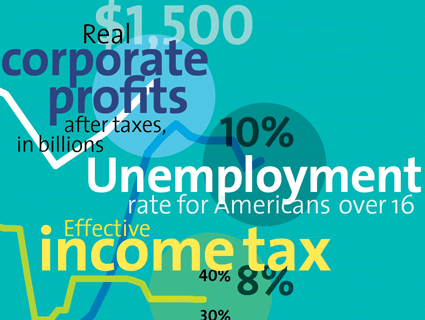
“You know, you used to be able to survive blue collar,” he says. “Now, the blue-collar guy, they just crush the life out of him. It’s very depressing.” Unemployment has doubled since the beginning of the recession, and home equity has fallen by more than a third, but Wall Street profits are up more than 700 percent. Profits at his firm, which is part of a global group with more than 4,000 employees, have remained steady. “Recessions,” as my father sometimes puts it, “don’t affect people like me.”
It’s June 16, the day after Erin’s birthday, and even from inside my pink room, I can hear the stress in her voice as she says into the phone, “Why are you yelling at me?”
When she slumps to the floor in the hallway outside my door, she tells me Anthony lost his job. The budget is still being reconciled in committee, but even the best-case version slashes OCC funding by more than 30 percent. And the cut looks mostly like a favor to utility companies, rather than a money-saving measure; the OCC isn’t funded out of the state’s general revenue fund but rather via a surcharge on utility companies. It’s one of several exciting bits of a non-cost-cutting agenda slipped into the cost-cutting budget, which also, for example, makes it extremely difficult to get an abortion. Anthony has been given two weeks’ notice. After that, their income will be cut in half.
Erin and I frown quietly at each other for a while. “How are you doing?” I ask.
“I don’t know.”
Jocelyn crawls across her knees.
“What are we gonna do, monkey?” Erin asks her, then, with effort, puts on a goo-goo voice. “I’m going to have to start entering you in pageants.”
When Anthony comes home, there’s a save-the-date card on the dining room table. Erin calls his attention to it, says Kristi and Scott are getting married. The Rodriguezes wouldn’t have to travel. But they’d have to bring a present, and Anthony begins to sigh heavily, and Erin says quickly, “We don’t have to go; we don’t have to talk about it now,” at the same time that he says, “Now’s not the time.” Tonight, while he works on his portfolio, to use in interviews “if I ever get one,” he dips into the bottle of Johnnie Walker Green Label someone bought them for their wedding.
At the Columbus Metropolitan Library a few days later, there’s a career workshop courtesy of Ohio State University’s Office of Continuing Education, which doesn’t restrict its job services to recent alumni, or even to alumni at all. “A lot of the people I’m working with have been laid off or find their field is shrinking,” adviser Jeff Robek tells the audience. In 2008, librarians became overwhelmed with requests for job search assistance. So now all of CML’s 20 branches run assistance programs. For as long as is feasible, anyway: Ohio libraries are in line for a 5 percent cut in Kasich’s budget, in addition to the 30 percent they lost under the previous governor, while demand for services went up more than 20 percent during the same period. CML’s website is the second most visited in the whole county, and the Job Help Center page is one of the most visited within it. As Robek speaks, yet another presentation is going on in a different conference room, about LinkedIn. Just before that, there was a volunteer available to help guide people through online applications. “I work with a lot of older job seekers,” Robek says to a crowd ranging from twentysomethings to the AARP set. He is most perfectly Midwestern, with clean manners and khakis. “Fifty-plus, sixty-plus.” Career counselor Jeff Robek says in this job market, employers can demand and get whatever they want.
In the middle of this Monday afternoon, Robek warns us that it’s a hirer’s market: “With the job market as tight as it is right now, employers are picky.” He has a slide with statistics reinforcing the adage that it’s not what you know, but who you know: 70 percent of jobs come from networking. Only 11 percent of people land a position through staffing agencies, 5 percent through sending résumés, and 14 percent through advertised jobs. The latter is how Anthony has been applying with increased fervor. The other day he had an interview, his first after sending out dozens of applications. Though he was lucky to get that far with 150 total applicants, he’s still up against 11 other interviewees. He put on a purple shirt, and I complimented him on it. “I don’t like to be bland,” he said.
The experienced laid-off like Anthony, plus the “encore career” crowd, which seems to be a euphemism for professionals who are old but can’t afford to retire, are creating challenges for the branch of Ohio State’s career offices that tries to place another huge population: OSU graduates. Stephanie Ford, the director of the university’s Arts and Sciences Career Services Office, explains to me that the shrinking number of jobs and swelling number of applicants are “a double whammy” for Ohio State’s 6,702 graduating seniors. “Overall,” she says, “it’s harder to find students employment in their field” than it was when I graduated 10 years ago. I can’t tell if I feel worse for them, for myself and my fellow 2002 graduates who might be competing with them, for the warehouse workers whose jobs they might be forced to take because they can’t get “real” jobs, or for the encore career people who are up against the lot of us but have more responsibilities, probably less energy, and the handicap of cultural ageism. Christ.
According to Robek, there used to be a general rule in job searching: For every $10,000 in annual salary earned, it took one month of looking. I schedule an advising session with him, and he explains that nobody has fingered the standard for the new economic order yet, but anecdotally, what used to take 3 to 6 months often now takes 6 to 12. “Or even longer sometimes!” he says.
Given the state of the journalism industry, statistically it would surprise no one if I got laid off. Indeed, fairly recently, Robek advised a local journalist alum who was about my age. He had worked in media for years but lost his job due to cutbacks. He searched and searched for work. Committed to staying a reporter, in the end, Robek tells me, he moved to DC and took an unpaid internship. This is a terrible story, and at this point in the economy and the industry, I have concerns about whether I could even compete for that internship. If the most recent batch of interns at my own magazine is any indication, college graduates are listening to the advice people like Ford give them about going up against people like me: Build rock-solid résumés. Among them, Mother Jones‘ eight interns speak Farsi, French, Hebrew, Italian, Russian, Spanish, and Thai and have worked at PBS’s Frontline—two of them—NPR, NBC, New York Press, the Miami Herald, Washington Monthly, The Nation, Sierra, Bangkok Post, the American Prospect, the ACLU, the Federal Trade Commission, and for the Special Inspector General for Iraq Reconstruction.
“If the field you’re working in has no opportunities, it might be time to find something else you’re passionate about,” Robek tells me. A career compatibility chart shows me to have some important values for moving to France and becoming a goat farmer—tradition, practicality, common sense—but to be lacking in crucial skills like mechanical competence. Robek says that to find a job in a new field, I’d need to do a lot of information gathering, talking to current professionals about what it’s really like before stalking sites like Monster and LinkedIn to try to find a way in on the ground level. Which, as it does for many of Robek’s clients, would likely involve going back to school, especially since I very pragmatically spent two years of my life obtaining a master’s degree in fine arts. In an employer’s market, Robek emphasizes, employers can demand exactly whatever they want.
 Roz Gadd (in pink), a retired teacher, and another volunteer collect signatures to repeal SB 5.Back at the Rodriguezes’, I’m not sure how long I’ve been sitting on my bed staring down an encroaching panic when voices call up from the family room downstairs.
“Katie!” they are yelling. It’s time for the weekly family tradition of watching MasterChef. Erin and I will gently attempt and fail to distract Jocelyn from pulling the cord out of Anthony’s laptop (“Could you not, uh,” Anthony will say, waving her baby fingers away, and when she makes a mad-baby face, apologize: “I know. I’m sorry. But I’m kinda trying to find a job.”) or throwing pieces of his portfolio on the floor or taking pages of a job description he’s studying in each hand and repeatedly slamming them together. Anthony announces he’s just been rejected for a job he applied for—at Ohio State, as it happens—without even making it to the interview stage. Susie calls and says he can work for her if he gets desperate. She’s hired five of her friends straight out of college to work that shit warehouse job while they struggle to find something they went to school for. Though it isn’t much, it is still a favor. She has applications from hundreds of people who want it; “I could fire every person in here right now” without costing her bosses a dime of lost profits, she told me when I visited. There’s no need for the logistics clients to invest in a better or more sustainable work culture. Quite literally, her workers are as disposable as the products they’re shipping.
I’m not too young to remember Cleveland as a place of industrial productivity. Or rather, I remember the transition between that time and now, when a lot of those factories were getting shut down, when a laid-off steel worker started yelling at me after I knocked on his door to collect for some nonprofit. Now when I come home my father shows me big blank spots on the bank of the Cuyahoga River where they tore down an entire entertainment district, a thriving strip of restaurants and bars where I used fake IDs. The population implosion that revved back up again a decade ago hasn’t stopped. The city’s down to its lowest number of people since 1900.
The Cleveland neighborhood my sister lives in has its own abandonment issues. After I drive north from Columbus to visit her in her new place, she tells me to look for the rusted-out couch frame on the porch. It’s there to keep her pit bull from wandering out into the yard, Jessica says when I arrive. She’s got less of an explanation for what exactly happened to the kitchen, with its walls all ripped up. It’s not her house, after all. She just squats here with three other people since the owners were foreclosed on and walked away.
 A Labor Day event in downtown Columbus“There’s not much to see,” she says of the spacious two-story. In lieu of furniture, the family room has piles of discarded clothes and boxes along the walls and in the corners. Upstairs in the bedrooms there are mattresses on the floor, marker scrawlings on the walls (NIETZSCHE SUCKS), clothes hanging from a pull-up bar jerry-rigged out of wood and bolted to the ceiling. One of the downstairs rooms has a couch in it, and that’s where Jessica’s boyfriend, Randal, is sitting.
This house used to belong to his parents. They bought it 10 years ago. Now, though it’s big and has nice albeit filthy wood floors, it’s valued at $40,000, which is less than they still owed on it, so they packed up and moved out last year. By that time, Randal had been looking for jobs as a line cook for months with no luck. Some of the positions he applied for had more than 100 other applicants. Eventually he gave up on the prospect of using his skills and shot for low-paying jobs like dishwashing. He applied all over town, but gave up on that, too, shortly after he asked the person in charge of hiring for a $7.25-an-hour job if they’d gotten a lot of applicants, and the guy said, “Oh, yeah. Seventy.”
Jess and Randal, 35 and 33, respectively, have been living here since September of last year. During the day, she puts on a nice white shirt and serves people $20 appetizers at a restaurant in Shaker Heights, one of the ritziest Cleveland suburbs and once the wealthiest city in the country. At night, she goes back home to an area she calls “the hood.” Crime statistics seem to support this description; Cleveland is currently ranked one of the most dangerous cities in America.
While we’re sitting around chatting, the back door slams and footsteps approach. “Is someone HERE?” my sister asks, and there’s so much edge in her voice that I instinctively brace myself, and we both start to get to our feet. There’s the pit bull, but he’s a pussycat. A 23-year-old unemployed and strong-looking Navy vet who was discharged for depression and anxiety also lives here, but he is very, very high. Anyway, it’s just Randal’s sister stopping by to say hello. “Do you want to see my gun?” my sister asks me, and she takes me upstairs to show me where she keeps it in her room and explains she’s got fucking throwing knives in her car.
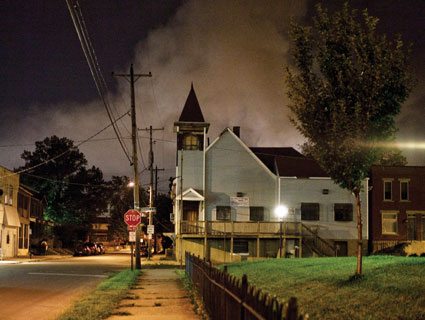
Before this, they were renting half of a duplex at a reasonable $400 a month. But Randal has been out of work for a long time now, and there’s not much point in paying rent when this house is just standing here empty. It’s something of a trend to occupy abandoned homes in the post-housing-crash world, and Randal’s sort of a pro at this point. His grandmother also lost her house a little while back. She was disabled; when she worked at an auto plant in her 30s, a piece of sheet metal that flew off a rack sliced off both her feet. She took out a mortgage on her paid-for house after her husband died; later, she couldn’t keep up with the payments and had to leave. It was foreclosed on and emptied, but Randal stayed on. “They probably won’t get around to coming and throwing anybody out for a long time,” he says. “At the rate houses foreclose around here, they can’t keep up.”
It doesn’t matter anyway. My sister and Randal and the vet are all talking about getting out of town, moving someplace where there might be opportunities—the West, Oregon. They’ll become part of Ohio’s population problem. Growth here over the last decade was 1.6 percent. Nationwide, it was 9.7 percent.
“We need people to stay here, and to come here,” Kathleen Clyde tells me over coffee back in Columbus. This is a battleground state. It’s the heart of the country, geographically—nay, spiritually—and the next presidential election probably won’t be won without it. But, as Clyde says, “Who’s gonna wanna move here?” At 32, Democratic state Rep. Clyde is the youngest elected woman in the Ohio legislature, charming, exceedingly tall, of the same age and politics as most of the people I know but actually working in politics. She’s not just stressing over the recession. She’s talking about a sea change. “It really feels like Ohio’s at an important crossroads,” she laments, “and we’re headed in the wrong direction.” The Ohio General Assembly is passing legislation that allows guns in bars. Drilling in state parks. Giveaways to big businesses. Privatization of the state’s revenues (PDF) from liquor sales. A 53 percent cut (PDF) to the Alzheimer’s Respite program and an 85 percent cut (PDF) to the Department of Aging. And, simultaneous to the cuts, lawmakers have extended a $1 billion income tax break, 40 percent of which goes to the wealthiest 5 percent of Ohioans, and suspended an estate tax that only applied to the top 10 percent of estates. Ohio, which lost 600,000 private-sector jobs in the first decade of the millennium, where the percentage of working men is the lowest in its recorded history, and where median wages have declined (PDF) more than in any other state since 2000, is about to seriously downsize its public sector too.
 Lindsay and her familyBecause many of these policies are being pushed through the Ohio General Assembly by “70-year-olds,” Clyde says, because the Ohio House was taken over by Republicans last year, when they were promising to fix the recession’s problems with fiscal conservatism, Clyde urges me to move back to my home state and consider going into politics. Because engaging and energizing our generation and the one behind it might be Ohio’s only shot.
This is just one more in a long series of highly depressing conversations I’ve had over the last month. I’m reporting from Ohio, for God’s sake, not the Third World, yet still my interviewees are sweating over how they’ll manage to survive despite living in the richest country in the history of the world. Because some politicians are passing some greedy and indecent and inhumanely neglectful and inconsiderate laws. “Is it really so dire?” I ask Clyde.
She hesitates. She opens her mouth and winces, before finally saying: “I think it is. Being in this legislature makes it hard to sleep at night.”
On a Wednesday in late June, Wisconsin Gov. Scott Walker’s Wisconsin Act 10, which stripped most public-sector unions of most of their collective-bargaining rights, went into effect. On the same hot day in Ohio, Erin almost runs down Columbus Mayor Michael Coleman with Jocelyn’s stroller.
“I was just trying to shake his hand!” she says breathlessly after regaining control of the unwieldy carriage. And Mayor Coleman was trying to shake hers, and thousands of other people’s, standing on the sidelines of a massive parade marching through the capital. Shirts and flags identify the participants as firefighters, transit workers, teachers, electricians, bikers, state troopers; residents of Columbus, Cleveland, Findlay, Toledo; members of the SEIU, UAW, AFL-CIO. A drum line accompanied their chanting: Hey hey. Ho ho. SB 5 has got to go. Workers’ rights are human rights. This is what democracy looks like. This swell of people has a delivery for the secretary of state. To keep SB 5 from becoming law and get it on the ballot for repeal in November, they need 231,147 signatures. They are turning in 1.3 million.
“We can’t guarantee anything,” says a spokeswoman for We Are Ohio, the group driving the effort, “but we’re confident with the amount of signatures we’ve collected that we have a lot of support on our side.” In polls, Ohioans heavily favor the repeal, and most also say now, just months after the Republican majority they elected to the legislature took office, that if a congressional election took place today, they’d vote for the Democratic candidate—like angry constituents in Florida have hollered for the recall of Rick Scott, and in Michigan, of Rick Snyder. Wisconsin’s Walker has an approval rate of 43 percent. Next year, Ohio will indeed be a battleground, one where the GOP finds out how much it can get away with.
 After this boy’s parents were both laid off, their household income fell from $160,000 to what unemployment benefits provide; they’ve since divorced, citing financial strain.This year, anyway, SB 5 has the potential to be forestalled. Another one of our college friends, Lindsey, is also looking to that for job and wage and general security. She teaches middle school English in rural Logan, about an hour outside Columbus, and she stops by Erin’s with her two-month-old one day. After she and Erin have a very lengthy discussion about breast-feeding, they worry together.
“I don’t want to take any“—Lindsey’s got this lovely southern Ohio drawl, so she says it a little bit like ayny—”money out of our savings” until the repeal passes, or doesn’t, this fall. Her and her husband’s livelihoods could both depend on the outcome, since he also teaches in the same school district. “We don’t know what‘s gonna happen.” Until she knows for sure how it will play out, she won’t let her husband buy a couch though they’ve got two kids now and not enough places to sit.
White people problems. Like that. And that, like the rest of the Americans holding the $873 billion in outstanding student loans, Lindsey and her husband also have to figure student-loan debt into their monthly budget. There’s $50,000 of it between them. “We joke that we have to pay $450 a month in loans just to make our crappy teacher pay,” she says. Yes. Hilarious, for all of us. Rep. Clyde also mentioned that it’s an effort to make her roughly $500-a-month loan payment on her $60,500 legislative salary. And the other day, another college roommate pointed to $120,000 in outstanding loans as the reason she can’t leave her law firm, even though she’s discovered she doesn’t like her profession. When I asked her what she’s going to do, she said, “What everybody does. Be a lawyer and hate it until I die.”
Erin and Anthony owe $26,000. They both went to Ohio State, which raised tuition every year we were there, in all but one of the nine years since, and will again this year after its 15 percent cut in the final budget. This debt isn’t insignificant for the Rodriguezes, especially coupled with the mortgage and the car payment, but it’s quite manageable—if both of them are employed.
At home, the day of the parade, Erin pops into my room. “I’m shaking,” she says. Anthony just called. The conference committee reconciling the House and Senate versions of the budget adopted the slightly smaller of the proposed massive cuts to the OCC. Kasich would sign it into law the next day. Anthony’s boss has given him the news that he is very, very lucky. Forty OCC employees are being laid off. But Anthony’s position is now in the 42 that remain.
“He’s just really worried about what this year is gonna be like,” Erin says, “because they have no money, no support staff.” She’s worked up, breathing shallow, talking fast. “But I was like, I don’t care what your workload is—you have a job.”
She sticks a finger into Jocelyn’s diaper through the leg hole and, wetness confirmed, takes her to the baby’s room next door. On my first day here, I heard Anthony call down from this room to Erin in the family room: “Come here. Fast.” She went tearing up the stairs and, when she arrived to find he wanted only to show her how cute their baby was, started to chastise him for making it sound like an emergency, but then they were both looking at the baby on the changing table, and then nobody was mad. Jocelyn’s on the table again now, in the jungle-themed room, and Erin is chatting her up like always as she changes her. “Jocelyn, are you so excited that Mommy doesn’t have to force you into pageant work now?” she asks. Jocelyn stares at her, the two of them below the window valance printed with happy cartoon monkeys. “Now we can just do it for fun.”