MOTHER JONES BY E-MAIL

Virgin Airlines: Powered by Pond Scum?

Washington Dispatch: Virgin founder Richard Branson has set out to create a viable biofuel. Will his ecofriendly venture take off?

January 22, 2008


TOOLS

EmailE-mail article
PrintPrint article


BACKTALK

E-mail the editor


Google


RELATED ARTICLES

Before meeting with Al Gore over breakfast in 2006, Richard Branson, the swashbuckling founder of Virgin Ltd., an amalgam of over 200 companies sharing the Virgin brand, was long a global warming skeptic. But then the former vice president (and recent recipient of the Nobel Peace Prize for his work to combat climate change) spent two hours at the billionaire entrepreneur's home laying out his case. "Sadly, I'm now convinced that the world has a serious problem," he told ABC's Good Morning America that September with Gore at his side. Joining the former vice president in his environmental crusade, Branson pledged to funnel all profits from his rail and airline holdings over the next 10 years—an estimated $3 billion—into developing a non-ethanol-based, sustainable biofuel to power the world's cars, trains, and airplanes. Last fall, he and Gore went on to establish the Virgin Earth Challenge, a $25 million award for the development of technology that can suck greenhouse gases from the atmosphere for 10 consecutive years and "contribute materially to the stability of Earth's climate."

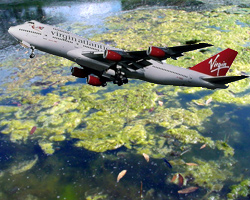
Since his green awakening, Branson's flagship airline, Virgin Atlantic, has partnered with Boeing and General Electric to turn its owner's vision into reality. Last week, Virgin announced plans to test fly a Boeing 747-400 from London to Amsterdam using a blend of about 20 percent biofuel and 80 percent jet fuel. The flight, set for late February, will be the world's first in-air test of a biofuel by a commercial jet. The composition of the fuel remains a mystery—though some have suggested it could be anything from tree nuts to pond algae—and it remains to be seen whether this is an another Branson PR stunt or a true precursor to an industry-wide change.

According to Virgin spokeswoman Polly Durant, the company "sees this demo flight as the first step on the road toward a more sustainable fuel source for aviation" and hopes that in the future it will allow Virgin's fleet "to operate more efficiently."

"Efficiency" is a buzzword in the aviation business, shorthand for cutting costs and increasing profits. There are different ways to approach it, explains Steve Lott, a spokesman for the Montreal-based International Air Transport Association (IATA), an industry trade group. "With fuel flirting with $100 per barrel, it's in the airline industry's best interest to reduce fuel consumption as much as possible," he says. Many airlines now taxi on one engine and use external power sources at the gate. Others have invested in fuel-efficient ground vehicles and have installed winglets (short, vertical wing extensions) to reduce drag and fuel consumption at altitude. Commercial fleets have also begun replacing aging aircraft with newer, "gas-sipping" models.

Nevertheless, Branson's gamble to replace traditional jet fuel with an organic substitute ventures beyond what most other airlines have been willing to undertake. (Air New Zealand plans to conduct a similar biofuel test later this year.) After all, the industry is a relatively minor greenhouse offender. At the current rate of growth, aviation could produce 3 percent of global CO2 emissions by 2050 and today accounts for 2 percent, according to the UN's Intergovernmental Panel on Climate Change. IATA claims the industry can become 25 percent more fuel efficient by 2020 simply by tweaking airline operations, improving existing infrastructure, and streamlining air traffic control. The group has set a 50-year goal for the industry to become carbon neutral.

Branson wants to do it sooner than that and has committed himself to halting global warming with all the zeal of a recent convert. According to Lott, Branson also sees an opportunity to do well by doing good. "He wants to start his own fuel company," Lott says. "There has to be an economic incentive…because there's a huge R&D investment in this stuff."

The challenge is to move beyond what scientists call "first generation biofuels," such as corn, soy, or palm oil. "If you're going to make fuel from those types of sources, you're competing with food and freshwater resources, and potentially [causing] some deforestation in order to clear ground to plant those crops," says Boeing spokesman Terrance Scott. Instead, in its work with Branson and Virgin Atlantic, Boeing has sought to identify "second generation biofuels," which would step beyond the food-based alternative fuels currently in use, like corn-derived ethanol, toward a more sustainable, long-term substitute for petroleum. The idea is to build a stable of different biofuel sources from around the world—what Boeing calls "regional solutions"—that would work interchangeably and within the existing aviation infrastructure. "It has to perform in the same manner that current jet aviation fuel performs in," says Scott.

Neither Virgin nor its partners, Boeing and GE, will say what biofuel the airline plans to use. Scott attributed the silence to "customer preference," indicating that more information could be released in the coming weeks. For now, he would say only that Boeing is investigating more than 20 different "feedstocks" for the production of biofuels, including a flowering plant called jatropha, canola, and the Brazilian babassu nut—all of which yield oils when crushed.

Another potential fuel source, one that Scott alluded to several times, is algae. "The biggest thing you get out of going to biofuels is the ability to reduce CO2 as the plants are growing," he explained. And along those lines, perhaps more than any other feedstock, algae represents a kind of holy grail to biofuel researchers. It's a fast-growing, hardy, single-celled organism that takes in carbon dioxide and nitrous oxide and releases oxygen, producing oil, sugar, and protein in the process. It's biodegradable, can grow in harsh weather, and holds an estimated thirty times more energy per acre than land-based feedstocks. The Energy Department estimated it would require 15,000 acres (an area about the size of Maryland) to grow enough algae to replace all of America's petroleum needs; it would require half the continental United States to accomplish the same with soy.

"It's incredible, partly because you get a twofer out of it," explains Deron Lovaas, director of the Move America Beyond Oil Campaign at the Natural Resources Defense Council, an environmental watchdog group. "You grow the algae thanks, in part, to carbon dioxide captured from smoke stacks, so you reduce pollution in the smoke stack. And you get a bunch of fuel derived from algae, so you end up displacing oil."

Pond scum as fuel is not a new concept. The federal government first invested in developing the technology in the mid-1970s in response to an oil crisis that sparked a sudden rise in the price of gas for American drivers. But as prices came down, so did the political dividends of pushing alternative fuels, and by 1996, federal budget cuts killed the program. Since then, as oil prices have resumed their upward climb, algae research has transferred to the private sector, where a dozen companies are now racing to transform muck into fuel. Just last year, Boeing demonstrated in a laboratory that, unlike ethanol, algae-derived fuel does not freeze at high altitudes, removing an important obstacle to future airborne testing. Another important difference from ethanol, says Scott, is that "you're not taking food off the table if you're talking about pond scum."

Would it be unrealistic to expect that Virgin Atlantic might test an algae-derived fuel next month? "No," Lovaas said. "That would not shock me. That would be amazing! It would be a breakthrough development if they were able to do this…a big step forward, even a leap forward, and a tribute to Lord Branson." But even if it turns out not to be algae, "what Virgin and Boeing are doing deserves praise," he added. "This is exactly what the whole industry should be looking at."

Bruce Falconer is a reporter in Mother Jones' Washington, D.C., bureau.


Post a Comment

Your Name: 

Your Comment: 
 
Please press "Submit" only once to avoid double-posting.
All HTML formatting is removed from comments.
Read the Mother Jones community rules here.

Comments:

Branson is well meaning, but terribly misguided. Biofuels are causing a world food crisis, and second generation biofuel plants will not be much better. Biofuel production displaces normal agricultural activity, causes water shortages, and actually speeds global warming because fertilizers unleash huge amounts of nitrous oxide, a greenhouse gas 296 times more potent than carbon dioxide. If Branson wants to help, he should have his jets run on clean hydrogen fuel made from the electricity generated by nuclear power plants, which release no greenhouse gas at all. The carbon cycle based solutions will only make matters worse. Biofuels will starve the world, not save the world. For the full biofuel story, see "The biofuel hoax is causing a world food crisis!" at: http://home.att.net/~meditation/bio-fuel-hoax.html For links to shocking biofuel hoax news stories see: http://home.att.net/~meditation/biofuel-news.html
Posted by:Christopher CalderJanuary 22, 2008 12:30:04 PMRespond ^
In response to Christopher Calder's comment - nuclear power is a whole other can of chemical worms. Consider the long term and short term biological, medical, and genetic dangers of nuclear technology. The problems with disposal of radioactive waste, control and the coal based energy used for uranium enrichment alone make nuclear power another "unclean" option.
Posted by:LoliJanuary 22, 2008 2:39:18 PMRespond ^
So glad that that the man took the chance. Capitalism can be progressive. I hope to anticipate data coming out on how this plays out in passenger-miles. I also hope investors and industry will work to improve the efficiency of our travel network; for instance, air travel may be best for the longest distances. Short hops people take seem to consume time and energy as well as the fact most fuel is consumed getting off the ground and landing.
Posted by:Frank LornitzoJanuary 23, 2008 6:26:42 PMRespond ^
This is a silly public relations effort. Aviation biofuels will make a negligible contribution in the future due to a host of difficulties. If airlines want to reduce their emissions they will have to fly less.
Posted by:747400 CaptainJanuary 23, 2008 8:18:18 PMRespond ^
Well done Virgin waste biomass and algaculture represent excellent prospects for biofuels. Not the least advantage, apart from the substantial amount of fuel from algae is that the proteins can be used as low grade feedstock for animals, and the phospate residues from the biodiesel production processes can be returned as fertiliser. Fabulous
Posted by:Fran BarlowJanuary 24, 2008 6:52:40 PMRespond ^
Capitalism isn't being progressive here. Boeing, about as dynamic and innovative as GM, is experiencing the worst case scenario of every corporate welfare queen: the expiration date on its product has arrived, and wouldn't you know, the boss is out playing golf! The aviation industry as we know it today emerged in the late 50's. It has changed little since then and benefited much from the plain-dumb transportation policies created by Big Oil's buddies in Washington. They had a long, relatively free ride. But more than any other oil- dependent technology, aviation is threatened by increasing demand for oil and the consequences of climate change. Until very recently there was no alternative to Jet-A fuel. The alternative now, FT synthetic fuel is worse for the climate than Jet-A. The automobile industry can re-engineer and survive. Trains are electric and boats can go solar. But how are you going to move 100 tons through the air at 500 mph without kerosene? You bet your ass algae sounds good!
Posted by:o'scrodJanuary 26, 2008 2:19:54 PMRespond ^
Branson's one of the Rich Kids I would not mind working for. I think he's a dreamer, in terms of wanting to REALLY try and do something with his money, his airline's done really well, but his airline is just as oil-dependent as grampa's Buick, and if you read the news a lot, that's not a circumstance that really helps anyone. If he's got the coin to sink into a make-your-own-jet fuel thing, I say 'more power to him'. I think you could operate a jet turbine off of ethanol also, but I don't know about the weight and stuff, they have to fill up once for an airplane to cross long distances, and by weight, you might not get as much energy value compared to kerosene. But, if they can successfully develop a biodiesel equivalent, and utilize it in their fleet, AND cut emissions, well that'd just be outstanding. They might also try a B10, B20 mixture, the truckers cut their fuel with ethanol to prevent it from gelling, I have Great Faith that somewhere in there, they'll get to the right mixture. Maybe also in the future they'll work on extending the wings wider, give more lift and altitude and all that whiz-bang stuff, be tooling along at 45,000 feet or something on one engine...with one foot on the dashboard...
Posted by:BertJanuary 27, 2008 10:50:03 AMRespond ^
Branson is grandstanding, as 747 captain noted. It's his competitive advantage. Does Virgin Atlantic even own any airplanes? Technology is the competitive advantage of GE and Boeing. Why are they now doing Branson a favor? The USAF made it clear several years ago that they were betting on alternatives to Jet-A. Let's assume that GE and Boeing have already run the test with the USAF, the one they're about to do with Branson, flying for an hour or two with algae-kerosene mix. Were they waiting for a commercial airline to ask them to dance, and it just happens that Branson is the first one to step forward? Or had all of the major airlines been informed about the USAF tests and did Branson, the owner of something less than a major airline, get in a huff and demand something for himself? It doesn't hurt GE and Boeing to have their names next to his for this one, especially if there is virtually no risk of failure - because the test has already been done with convincing success.
Posted by:o'scrodJanuary 28, 2008 5:24:46 AMRespond ^
i think that this is a great idea. it takes less of an area to grow the fuel and its not harmful, the "waste" products can even be reused as fertilizers.&&with money comes power,so maybe he has just enough money to change the whole market. if you can do it...
Posted by:brittaFebruary 14, 2008 6:35:28 AMRespond ^
In response to Christopher Calder, it is naive to believe there is a "magical" clean energy solution. They all have costs and benefits (economic and environmental). The solution will be a combination of energy sources that optimizes the strengths of each. Energy "snobbery" is getting us nowhere. By the way, is bio fuel really creating a world food crisis? Are current prices high because of biofuel? Or are they high because of demand from developing countries? Why has rice risen in proportion to corn? Lettuce? Further, the last I heard is that an abundance of cheap grain was creating a world poverty crisis. High prices stimulate development and investment in under performing third world agriculture, reversing the devastation of regions left behind by agricultural advancements. IT HAS THE POTENTIAL to go too far - as do all of the solutions - that's why an optimized mix of technologies is the most prudent.
Posted by:Michael ShubeckFebruary 24, 2008 6:52:22 AMRespond ^
There are others that are working on using the algae to make biofuel and use it to clean the filthy water supply ..... at the same time. This "fuel" also burns about as clean as hydrogen.

You think gas is expensive, wait til you need a drink of clean water in the future. There are already cities looking for ways to convert salt water to drinking water.... algae can do it.
Posted by:BillMarch 8, 2008 6:03:57 AMRespond ^
Hi, I am the owner of a Company called, Cool Earth Trading Enterprises CC. We specialize in Bio Diesel and we are already selling our diesel in Europe and African Countries. Now we are very interested in Mr Branson's Airlines as he has an eye for the future and the environment.
I would really like to get in contact with him or the people working for him concerning the Bio Fuel. My details are : lerebiz@gmail.com
Cell no. +27 82 7799 571
Posted by:GJ LambrechtsMarch 25, 2008 7:26:25 AMRespond ^

Jail.org - Inmate Search
Criminal records, instant public records & people search & current court records. www.jail.org

U.S. Public Records Search
Search County & State Court Records, Criminal records, Vital and Adoption Records www.PublicRecordsInfo.com

Records.com - People Search
Public Records and Background Checks. Instantly Search Criminal Records, Addresses and Court Records www.Records.com

Court Records & County Records
Find Instant Public Records, Criminal Records as Well as County Property Records Search. www.PublicRecordsIndex.com


bookIN PRINT

CLICK HERE
for more great reading

headphones IN TUNE
New music every issue

CLICK TO LISTEN


This article has been made possible by the Foundation for National Progress, the Investigative Fund of Mother Jones, and gifts from generous readers like you.

© 2008 The Foundation for National Progress

About Us   Support Us   Advertise   Ad Policy   Privacy Policy   Contact Us   Subscribe   RSS