How Do You Teach Your Kids About Climate Change?

We asked how you have the climate change chat with kids. Here’s what you said.

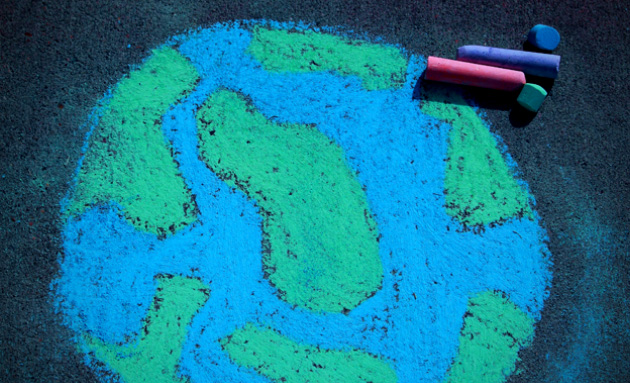
Flickr / Pink Sherbet PhotographyFlickr / Pink Sherbet PhotographyOne of the more unsettling items from the recent leak of an internal fundraising document from the conservative Heartland Institute think tank was a plan laying out how K-12 schools could adopt “educational materials” criticizing the notion of man-made global warming. According to the document, “principals and teachers are heavily biased toward the alarmist perspective.”

Here at the Climate Desk, it got us thinking: How do our readers engage with kids about climate change, not just in the classroom, but also at home? We put out a call, and here’s what we heard back.

A few readers shared their thoughts with Climate Desk‘s Tim McDonnell via video chat:

Parents also shared insights with us via social media:

If it wasn’t already hard enough to talk about climate change, parents are now fighting a battle on another front: children’s books. According to a new study [PDF], America’s finest illustrated books for kids are teaching less and less about the natural world. The study analyzed nearly 8,100 images from 296 kids’ books awarded medals or honors in the annual Caldecott prize from 1938 through 2008. Climate Desk‘s James West spoke with coauthor Chris Podeschi from Bloomsburg University of Pennsylvania about the findings:

With pictures of trees, toads, and other flora and fauna on the decline in kids’ books these days, author Lynne Cherry is taking a different approach. Cherry’s 1990 book The Great Kapok Tree is widely used in schools to teach about the value of preserving rainforest. But a few years ago, she swapped out her paintbrushes for a video camera to combat what she sees as a growing sense of powerlessness among kids. Her rationale, she told Tim, was that film has the potential to reach more kids.

You can get involved in more Climate Desk conversations by following us on Twitter, and liking us on Facebook.

More Mother Jones reporting on Climate Desk

From the desk of Mother Jones CEO, Monika Bauerlein...

Newsrooms can be funded in many ways. One of the most controversial (and volatile) ways is by a for-profit corporation or a billionaire owner. We see it across the headlines on a weekly basis: the claw backs in public media, the gutting of The Washington Post, the bending over backwards to appeal to Trump and his allies.

But not here.

When Mother Jones first started publishing 50 years ago, our founders made a critical decision: to be a reader-supported nonprofit. They knew that no corporate owner would be interested in a muckraking newsroom; they also knew that no muckraking newsroom would be interested in following the agenda of a corporate owner.

And so, we’ve been reader-funded for half a century. We rely on contributions from our readers—readers like you—whether it’s $50, or $15 a month, or whatever fits your budget. People give what they can, and every donation makes a difference for our newsroom, which has grown tremendously—in size and reach and renown—since its inception in 1976.

You may be wondering: What does it take to publish an investigation? And what does my donation actually fund? The answers are one and the same: It takes people, resources, and time. And that’s what your donation funds directly.

Every donation Mother Jones receives from readers fortifies our newsroom, whether we’re covering underreported scandals out of Washington, DC, or the most important news of the day. And right now, each donation will be doubled because of our $50,000 match. So when you make a donation—$5, $50, any amount—it’ll go twice as far.

Your support keeps us going. If you’re able, donate today.

Thanks for reading.

—Monika

From the desk of Mother Jones CEO, Monika Bauerlein...

Newsrooms can be funded in many ways. One of the most controversial (and volatile) ways is by a for-profit corporation or a billionaire owner. We see it across the headlines on a weekly basis: the claw backs in public media, the gutting of The Washington Post, the bending over backwards to appeal to Trump and his allies.

But not here.

When Mother Jones first started publishing 50 years ago, our founders made a critical decision: to be a reader-supported nonprofit. They knew that no corporate owner would be interested in a muckraking newsroom; they also knew that no muckraking newsroom would be interested in following the agenda of a corporate owner.

And so, we’ve been reader-funded for half a century. We rely on contributions from our readers—readers like you—whether it’s $50, or $15 a month, or whatever fits your budget. People give what they can, and every donation makes a difference for our newsroom, which has grown tremendously—in size and reach and renown—since its inception in 1976.

You may be wondering: What does it take to publish an investigation? And what does my donation actually fund? The answers are one and the same: It takes people, resources, and time. And that’s what your donation funds directly.

Every donation Mother Jones receives from readers fortifies our newsroom, whether we’re covering underreported scandals out of Washington, DC, or the most important news of the day. And right now, each donation will be doubled because of our $50,000 match. So when you make a donation—$5, $50, any amount—it’ll go twice as far.

Your support keeps us going. If you’re able, donate today.

Thanks for reading.

—Monika

We Recommend

Latest

Sign up for our free newsletter

Subscribe to the Mother Jones Daily to have our top stories delivered directly to your inbox.

Get our award-winning magazine

Save big on a full year of investigations, ideas, and insights.

Subscribe

INDEPENDENT. BECAUSE OF YOU.

Mother Jones has no billionaires calling the shots—just readers like you making fearless reporting possible

Donate