<a href="http://earthobservatory.nasa.gov/IOTD/view.php?id=76127">NASA</a>
This story originally appeared in The Atlantic Citylab and is republished here as part of the Climate Desk collaboration.
People who bought property on Lake Erie for the view of the limpid waters must be getting frustrated. Forecasters are now predicting that billowing blooms of toxic algae will overrun Erie this summer, making 2014 the latest in a line of years that have seen the lake looking like a big, slimy putting green.
This gloopy assessment comes from Jeffrey Reutter, director of the Ohio Sea Grant, who recently spoke at an Ohio State University conference on climate change. Reutter previewed NOAA’s annual Harmful Algal Bloom report, which isn’t officially released until July, and says that locals will likely soon encounter larger-than-average blooms of blue-green algae.
Partly to blame for this expected algal assault are more severe storms, which wash vast amounts of phosphorous into the lake to feed the microorganisms. Once there, the algae can cause nausea and vomiting and skin irritations in humans, kill dogs that eat it, and possibly induce fish to change sexes.
It’s already too late to ward off this year’s sliming of Erie, says Reutter. And if past years are any indication, the dying blooms will also create an oxygen-poor “dead zone” spanning thousands of square miles. Eliminating the blue-green algae that cause the [blooms] would require a 40 percent reduction in phosphorus and other nutrients draining into the lake,” he says. “Even with a 75 percent reduction, we could still experience a dead zone. Algae levels in the Great Lakes have been on the rise since the 1990s. With the warming atmosphere generating more severe storms, harmful algae could be in for a looming boom time. That’s not great news for Erie’s fishing industry, as the lake produces more fish for our plates than all of the other Great Lakes combined, nor for the national economy, which suffers at least $82 million in damages each year from toxic blooms, according to NOAA. The agency explains:
Harmful algal bloom (HAB) events can be very bad for us. People who eat shellfish from waters experiencing toxic blooms can become very ill and can even die. Does that mean that the seafood you eat may be unsafe? Not at all. Rigorous state shellfish monitoring programs ensure that legally harvested seafood is safe for human consumption. HABs also have economic and cultural implications, especially in coastal communities dependent on harvesting seafood and tourism. They frequently disrupt the commercial, recreational and subsistence seafood harvesting and cause some to cancel beach vacations. As a result HABs cost coastal communities a substantial amount.
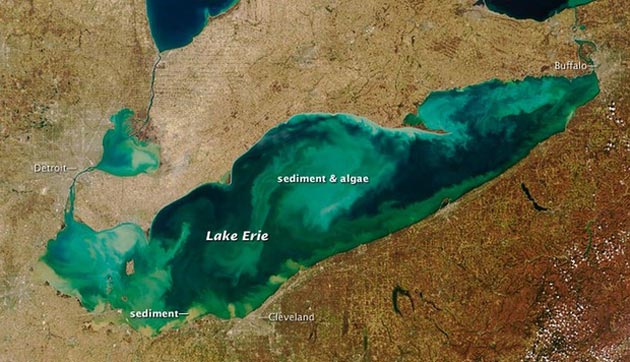
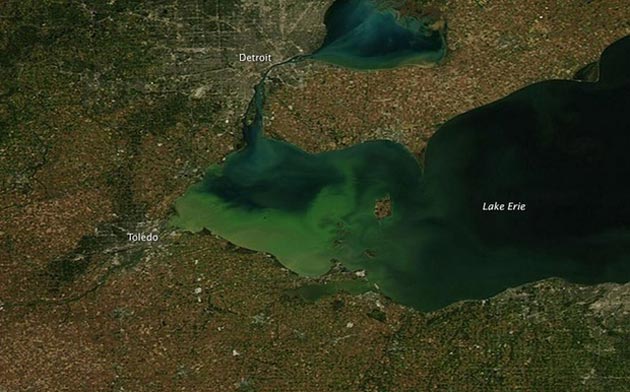
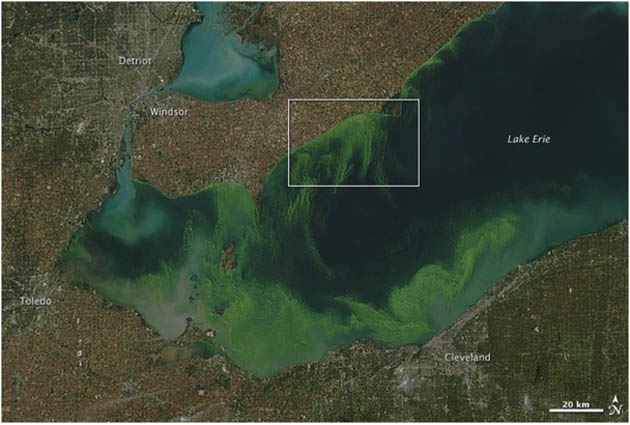
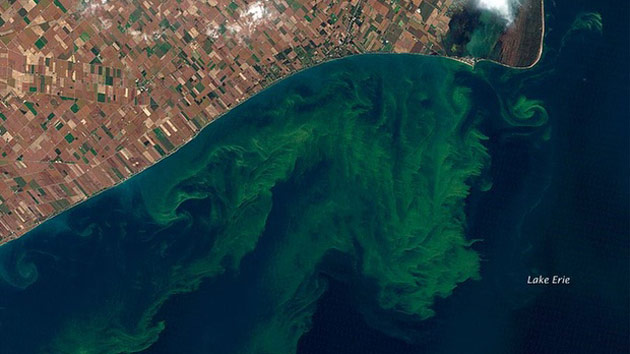
It’s hard to tell yet whether 2014’s bloom could balloon up to the size of the gigantic one in 2011, says Reutter. For those who don’t recall that nasty event, take a look at the scummy image above showing the lake’s worst bloom in decades. That year’s bloom was followed by other fun ones in 2012 and 2013, respectively shown here: