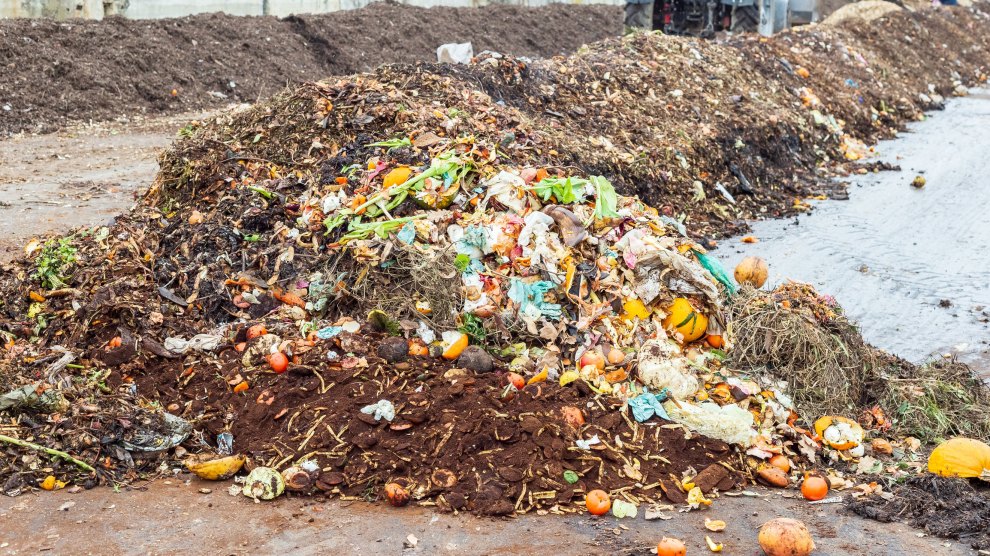
Collection point for organic waste at industrial compost plant.Getty
This story was originally published by Grist and is reproduced here as part of the Climate Desk collaboration.
The global food system is a climate mess, from the widespread use of greenhouse gas-emitting fertilizers to the methane-spewing livestock to all the food that gets tossed into the trash. In the United States, a staggering one-third of all food—something like 130 billion meals annually—gets thrown out. Each year, that discarded stuff represents an estimated 170 million metric tons of carbon emissions—the equivalent of 42 coal-fired power plants.
But there’s a simple solution, beyond simply reducing waste. According to a new study in the Nature journal Scientific Reports, composting food scraps results in 38 to 84 percent fewer greenhouse gas emissions than tossing them in landfills. Unlike trash in landfills, compost heaps are watered and turned, which aerates the decomposing waste and prevents bacteria from churning out as much methane, a powerful greenhouse gas.
“Composting still has some methane emissions, but it’s much, much lower because most landfills aren’t turned as frequently,” said Whendee Silver, an ecologist at the University of California Berkeley and a co-author on the study.
Landfills are a big climate culprit. Garbage dumps generate one-third of all methane emissions in the US, in part because the most common item in them is food. The organic matter in landfills breaks down through a process called anaerobic decomposition, in which bacteria feast on it and burp out methane. Food scraps often end up at the bottom of landfills, where it gets compacted and “creates the perfect storm for methane emissions,” Silver said.
Silver’s group measured emissions of three greenhouse gasses—carbon dioxide, nitrous oxide, and methane—at a commercial compost facility in California. They continuously tracked emissions over the course of the composting process. Although other studies have done similar landfill-compost emissions comparisons, Silver said this one stands out because it used a new method that “allowed us to figure out exactly when and where and under what conditions the greenhouse gas emissions were occurring” and didn’t alter the conditions of the compost while taking measurements.
The big range in the findings—an emissions reduction of 38 to 84 percent—is a result of uncertainty around estimates of greenhouse gas pollution from landfills, which is “a really difficult thing to measure,” Silver said.
The researchers wrote that “fine tuning” the composting process, like turning the pile more and adding water more frequently but in lower quantities, could further lower emissions. Silver said that new tools like aeration tubes below compost heaps could also help slash methane emissions.
The study didn’t account for the climate benefits of applying compost as fertilizer. Other research has shown that laying compost on agricultural fields is key to storing carbon in soil. Some estimates suggest that adding compost to an acre of land can sequester enough carbon to offset 75 percent of a car’s annual emissions.
A handful of states and cities have passed laws to mandate curbside compost pickups and to prevent food scraps from entering landfills. Two years ago, President Joe Biden set a target of capturing 70 percent of methane emissions from landfills nationwide through a voluntary program. In 2015, the Department of Agriculture and the Environmental Protection Agency announced a goal of cutting food waste in half by 2030. But the country hasn’t tacked toward that target. Between 2016 and 2019, the amount generated in the US actually increased by 6 percent, from 328 to 349 pounds per person each year. And only about 5 percent of that waste gets composted.