The First GMO Animal Was Just Approved. But You Probably Won’t be Eating It Anytime Soon.

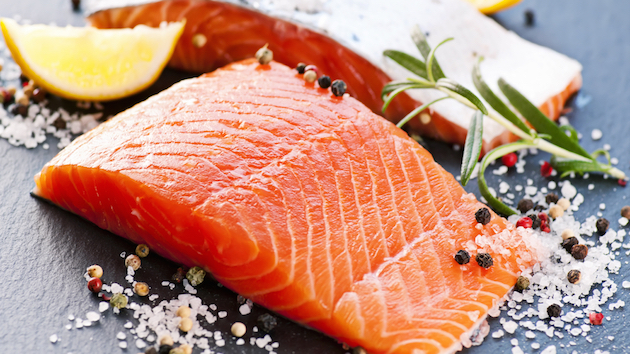
<a href="http://www.shutterstock.com/pic-91610936/stock-photo-fresh-salmon-with-spices.html?src=HpLjfWnnBNBTMcc2SzPxNw-1-3">HL Photo</a>/Shutterstock

Get your news from a source that’s not owned and controlled by oligarchs. Sign up for the free Mother Jones Daily.


Since the mid-1990s, a US company called AquaBounty Technologies—now partially owned by the synthetic biology company Intrexon—has been trying to get the Food and Drug Administration to approve a salmon variety genetically engineered to put on weight faster. On Thursday, the FDA finally did so. Theoretically, at least, US retailers can now stock the fast-growing fish, and they don’t have to label it.

The only GM salmon that makes it onto US store shelves will come from eggs produced in Prince Edward Island, which will be shipped and raised in Panama, only to be shipped back to North America as filets.

But don’t expect it to take over the seafood counter of your local supermarket anytime soon. We import about two-thirds of the salmon we eat, the great bulk of it grown on large farms in Chile, Canada, and Norway. But the FDA is hyper-specific about where AquaBounty’s engineered salmon can be grown:

The AquAdvantage Salmon may be raised only in land-based, contained hatchery tanks in two specific facilities in Canada and Panama. The approval does not allow AquAdvantage Salmon to be bred or raised in the United States. In fact, under this approval, no other facilities or locations, in the United States or elsewhere, are authorized for breeding or raising AquAdvantage Salmon that are intended for marketing as food to U.S. consumers.

Why the caution? Standard salmon farming takes place directly in the ocean in net cages. Escapes are inevitable. In areas like the North American west coast from California to Alaska—home to some of the globe’s last remaining wild salmon runs—escaped fast-growing salmon could out-compete and displace their wild peers. A highly detailed 2013 risk assessment from Canada’s Department of Fisheries and Oceans found that, without strict containment, the AquaAdvantage super-salmon presents a “high” risk to wild populations. 

So for now, until the FDA approves other facilities, the only GM salmon that makes it onto US store shelves will come from eggs produced in one approved facility on Canada’s Prince Edward Island, which will be shipped and raised into fish at another approved facility in Panama, only to be shipped back to North America as filets. That one facility in Panama is not likely to pose much competition to, say, Norway‘s vast salmon farms.

Meanwhile, the biotech-watchdog group the Center for Food Safety has vowed to sue the FDA to reverse the decision, claiming that “the review process by FDA was inadequate, failed to fully examine the likely impacts of the salmon’s introduction, and lacked a comprehensive analysis.”

Add limited supply and a legal challenge to the fact that several regional grocery powerhouses—including Kroger, Safeway, and HEB—have pledged not to sell GM salmon, and it seems unlikely that many consumers will be savoring AquaBounty’s bounty anytime soon.




Take the next step: Help us fight for the truth.

Investigative journalism, like the story you just read, takes time to do. Months of research. Weeks of writing, editing, and fact checking—and putting together the photography, art, video, and audio that tell the stories in a new way, illuminating new perspectives and voices.

We can afford to take that time because we don’t report to an oligarch or corporation with a special agenda. We report to you, and for you. That’s why we unabashedly pursue the truth and relentlessly shine a light into the darkness.

In this month’s Summer Membership Drive, we’ve got to raise $200,000 to support more crucial investigations. This is a pivotal moment in our nation, with democracy on the line, and we can only do this work because readers like you step up. Every donation, of any amount, makes a difference here. We cannot do this work without you.

So, we’re asking: Will you support independent journalism that demands those in power answer for their actions?

Take the next step: Help us fight for the truth.

Investigative journalism, like the story you just read, takes time to do. Months of research. Weeks of writing, editing, and fact checking—and putting together the photography, art, video, and audio that tell the stories in a new way, illuminating new perspectives and voices

We can afford to take that time because we don’t report to an oligarch or corporation with a special agenda. We report to you, and for you. That’s why we unabashedly pursue the truth and relentlessly shine a light into the darkness.

In this month’s Summer Membership Drive, we’ve got to raise $200,000 to support more crucial investigations. This is a pivotal moment in our nation, with democracy on the line, and we can only do this work because readers like you step up. Every donation, of any amount, makes a difference here. We cannot do this work without you.

So, we’re asking: Will you support independent journalism that demands those in power answer for their actions?

We Recommend

Latest

Sign up for our free newsletter

Subscribe to the Mother Jones Daily to have our top stories delivered directly to your inbox.

Get our award-winning magazine

Save big on a full year of investigations, ideas, and insights.

Subscribe

INDEPENDENT. BECAUSE OF YOU.

Mother Jones has no billionaires calling the shots—just readers like you making fearless reporting possible

Donate