Get your news from a source that’s not owned and controlled by oligarchs. Sign up for the free Mother Jones Daily.

Does fiscal stimulus work when the economy is in a deep recession?  There’s no way to definitively “prove” that it does, but we can certainly amass evidence for it.  Via Tim Fernholz, here’s a chart from a talk CEA chair Christina Romer gave today.  The question she’s addressing is whether countries that applied bigger stimulus packages have recovered more quickly:
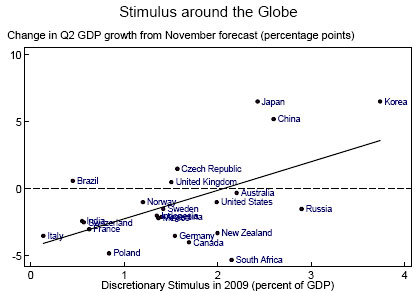
To get evidence about this, we started with a set of forecasts of growth in the second quarter of this year that were made last November — after the crisis had hit, but before countries had formulated their policy response. We then collected analysts’ recent best guesses for what second-quarter growth will be in those countries. This figure shows the relationship between how countries’ second-quarter growth prospects have changed from what was expected back in November, and the countries’ discretionary fiscal stimulus in 2009.

The fact that the observations lie along an upward-sloping line shows that, on average, things have improved more in countries that adopted bigger stimulus packages. And, the relationship is sizable: on average, a country with stimulus that’s larger by 1% of GDP has expected real GDP growth in the second quarter that’s about 2 percentage points higher relative to the November forecast.

Italics mine. This is, obviously, hardly ironclad proof about how well fiscal stimulus works.  For one thing it’s based on estimates, not final data, and if those November forecasts were systematically overoptimistic they might also have been systematically useless.  What’s more, eyeballing that line doesn’t suggest to me that Romer’s correlation is very strong — especially since it mostly seems to rely on three Asian outliers.

Still, it’s up and to the right, and that’s a data point in favor of using fiscal stimulus during an economic crisis.  There’s more evidence in the talk too, all of which is suggestive though not conclusive.

Of course, you wouldn’t expect anything conclusive at this point.  Overall, though, I expect data from 2008-2011 to become a rich field for economists to study in the future.  We haven’t had a worldwide recession like this since the Great Depression, and it presents a unique opportunity to study what worked and what didn’t.  There are enough variables that drawing firm conclusions will always be hard, but it’s nonetheless the best chance we’ve had in decades to get meaningful comparative data on macroeconomic policy responses to an economic crisis.  This paper is a start.
From the desk of Mother Jones CEO, Monika Bauerlein...

Newsrooms can be funded in many ways. One of the most controversial (and volatile) ways is by a for-profit corporation or a billionaire owner. We see it across the headlines on a weekly basis: the claw backs in public media, the gutting of The Washington Post, the bending over backwards to appeal to Trump and his allies.

But not here.

When Mother Jones first started publishing 50 years ago, our founders made a critical decision: to be a reader-supported nonprofit. They knew that no corporate owner would be interested in a muckraking newsroom; they also knew that no muckraking newsroom would be interested in following the agenda of a corporate owner.

And so, we’ve been reader-funded for half a century. We rely on contributions from our readers—readers like you—whether it’s $50, or $15 a month, or whatever fits your budget. People give what they can, and every donation makes a difference for our newsroom, which has grown tremendously—in size and reach and renown—since its inception in 1976.

You may be wondering: What does it take to publish an investigation? And what does my donation actually fund? The answers are one and the same: It takes people, resources, and time. And that’s what your donation funds directly.

Every donation Mother Jones receives from readers fortifies our newsroom, whether we’re covering underreported scandals out of Washington, DC, or the most important news of the day. And right now, each donation will be doubled because of our $50,000 match. So when you make a donation—$5, $50, any amount—it’ll go twice as far.

Your support keeps us going. If you’re able, donate today.

Thanks for reading.

—Monika

From the desk of Mother Jones CEO, Monika Bauerlein...

Newsrooms can be funded in many ways. One of the most controversial (and volatile) ways is by a for-profit corporation or a billionaire owner. We see it across the headlines on a weekly basis: the claw backs in public media, the gutting of The Washington Post, the bending over backwards to appeal to Trump and his allies.

But not here.

When Mother Jones first started publishing 50 years ago, our founders made a critical decision: to be a reader-supported nonprofit. They knew that no corporate owner would be interested in a muckraking newsroom; they also knew that no muckraking newsroom would be interested in following the agenda of a corporate owner.

And so, we’ve been reader-funded for half a century. We rely on contributions from our readers—readers like you—whether it’s $50, or $15 a month, or whatever fits your budget. People give what they can, and every donation makes a difference for our newsroom, which has grown tremendously—in size and reach and renown—since its inception in 1976.

You may be wondering: What does it take to publish an investigation? And what does my donation actually fund? The answers are one and the same: It takes people, resources, and time. And that’s what your donation funds directly.

Every donation Mother Jones receives from readers fortifies our newsroom, whether we’re covering underreported scandals out of Washington, DC, or the most important news of the day. And right now, each donation will be doubled because of our $50,000 match. So when you make a donation—$5, $50, any amount—it’ll go twice as far.

Your support keeps us going. If you’re able, donate today.

Thanks for reading.

—Monika

We Recommend

Latest

Sign up for our free newsletter

Subscribe to the Mother Jones Daily to have our top stories delivered directly to your inbox.

Get our award-winning magazine

Save big on a full year of investigations, ideas, and insights.

Subscribe

INDEPENDENT. BECAUSE OF YOU.

Mother Jones has no billionaires calling the shots—just readers like you making fearless reporting possible

Donate