Balls and Strikes and the Roberts Court

Get your news from a source that’s not owned and controlled by oligarchs. Sign up for the free Mother Jones Daily.

During his confirmation hearings for the Supreme Court in 2005, John Roberts assured senators that his job as a judge was merely “to call balls and strikes.” It was a familiar, homey allusion, deliberately designed to suggest that ideology didn’t — or anyway, shouldn’t — play a role in deciding cases. He would be interpreting the plain meaning of the law, not making up his own.

But as fond as conservatives are of this kind of imagery, it’s mostly a myth. Recently the Constitutional Accountability Center took a look at Supreme Court rulings during the Roberts era, but instead of looking at hot button social issues they looked at the kinds of rulings that, although they get less attention, actually take up the bulk of the court’s time: those involving business and corporate law. The results were pretty startling.

A good guidepost to these rulings is the position taken by the United States Chamber of Commerce, which bills itself as the “voice of business.” Roberts’s record? In the past five years he’s sided with the Chamber 70% of the time. In close cases he’s sided with the Chamber a stunning 90% of the time. As an umpire, it turns out that if you’re filing a case against the business community Roberts has declared a strike zone only a few inches wide.
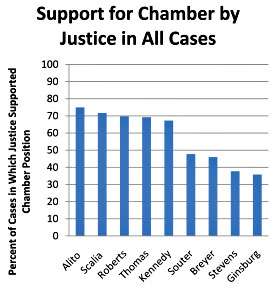
And Roberts isn’t alone. Samuel Alito and Antonin Scalia also sided with the Chamber over 70% of the time. (Alito sided with the Chamber a stunning 100% of the time in close cases.) Clarence Thomas took their side 68% of the time. And “centrist” Anthony Kennedy? He clocked in around 66%.

The kinds of regulatory issues involved in these cases are, in the long run, more important than all but the most explosive culture war cases. They include things like Citizens United, which allowed corporations to spend unlimited sums in political campaigns; Ledbetter v. Goodyear, which effectively eliminated the right to sue for race or gender pay discrimination; and Exxon v. Baker, which slashed the damage award in the Exxon Valdez oil spill case by 80%. And those are only the big ones. You can add in hundreds of other, smaller cases that have slowly but steadily chipped away at the right to hold corporations accountable over the past three decades.

And what about liberals on the court? Well, Souter and Breyer sided with the Chamber nearly half the time, and even Stevens and Ginsburg favored business interests more than a third of the time. The lesson here is that, contrary to what conservatives want everyone to think, they don’t just “call balls and strikes” or “rely on the plain meaning of the constitution.” Ideology matters. In fact, when it comes to business issues, conservative judges make far more fervent ideologues than liberals. Caveat emptor.

UPDATE: Want to read more about the whole “balls and strikes” analogy? Sure you do! Check out Aaron Zelinsky’s Yale Law Journal essay, “The Justice as Commissioner: Benching the Judge-Umpire Analogy,” where he says Supreme Court justices aren’t like umpires, they’re more like the commissioner of baseball.
 

I'm hopeful because of readers like you. Will you pitch in today?

We see the headlines on a weekly basis: the claw backs in public media, the gutting of The Washington Post, the bending over backwards to appeal to Trump and his allies.

But not here.

When Mother Jones started publishing 50 years ago, our founders made a critical decision: to be a reader-supported nonprofit. They knew that no corporate owner would be interested in a muckraking newsroom; they also knew that no muckraking newsroom would be interested in following the agenda of a corporate owner.

And so, we’ve been reader-funded for half a century. We rely on contributions from our readers—readers like you—whether it’s $50, or $15 a month, or whatever fits your budget. People give what they can, and every donation makes a difference for our newsroom, which has grown tremendously—in size and reach and renown—since its inception in 1976.

You may be wondering: What does it take to publish an investigation? And what does my donation actually fund? The answers are one and the same: It takes people, resources, and time. And that’s what your donation funds directly.

Every donation Mother Jones receives from readers fortifies our newsroom, whether we’re covering underreported scandals out of Washington, DC, or the most important news of the day. And right now, each donation will be doubled thanks to a $50,000 match. So when you make a donation, it’ll go twice as far.

Your support keeps us going. If you’re able, donate today.

Thanks for reading.

—Monika Bauerlein, CEO

I'm hopeful because of readers like you. Will you pitch in today?

We see the headlines on a weekly basis: the claw backs in public media, the gutting of The Washington Post, the bending over backwards to appeal to Trump and his allies.

But not here.

When Mother Jones started publishing 50 years ago, our founders made a critical decision: to be a reader-supported nonprofit. They knew that no corporate owner would be interested in a muckraking newsroom; they also knew that no muckraking newsroom would be interested in following the agenda of a corporate owner.

And so, we’ve been reader-funded for half a century. We rely on contributions from our readers—readers like you—whether it’s $50, or $15 a month, or whatever fits your budget. People give what they can, and every donation makes a difference for our newsroom, which has grown tremendously—in size and reach and renown—since its inception in 1976.

You may be wondering: What does it take to publish an investigation? And what does my donation actually fund? The answers are one and the same: It takes people, resources, and time. And that’s what your donation funds directly.

Every donation Mother Jones receives from readers fortifies our newsroom, whether we’re covering underreported scandals out of Washington, DC, or the most important news of the day. And right now, each donation will be doubled thanks to a $50,000 match. So when you make a donation, it’ll go twice as far.

Your support keeps us going. If you’re able, donate today.

Thanks for reading.

—Monika Bauerlein, CEO

We Recommend

Latest

Sign up for our free newsletter

Subscribe to the Mother Jones Daily to have our top stories delivered directly to your inbox.

Get our award-winning magazine

Save big on a full year of investigations, ideas, and insights.

Subscribe

INDEPENDENT. BECAUSE OF YOU.

Mother Jones has no billionaires calling the shots—just readers like you making fearless reporting possible

Donate