Get your news from a source that’s not owned and controlled by oligarchs. Sign up for the free Mother Jones Daily.

Ezra Klein notes today that U.S. healthcare costs, which are projected to skyrocket over the next few decades, are by far the biggest driver of long-term deficits:

If you wanted to be optimistic about this, you could say that this represents a sort of opportunity. In sharp contrast to, say, France’s health-care sector, our health-care sector is dramatically, joyously, wildly inefficient. We pay so much more than anyone else and get so much less that it’s easy to imagine a world in which we have a drastically different health-care system that’s both better than the one we have now and that’s wiped out our deficit.

Austin Frakt links to a David Cutler paper today that describes just how inefficient our healthcare sector is: at the same time that, for example, the durable goods industry has been increasing its productivity by 7% per year, and retail trade by about 4% per year, healthcare has actually been going backward. It’s been getting less efficient:
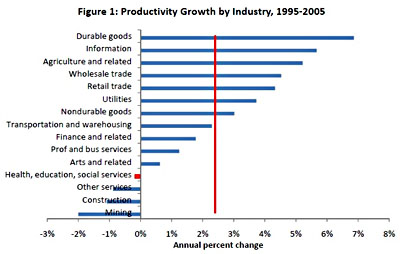
Cutler’s paper explains why productivity and productivity growth are low in health care and what can be done about it. He hypothesizes why we see so little innovation in health care and suggests ways to promote it. It’s a familiar set of problems (asymmetric information, inability of plans and providers to capture long-term returns on short-term investments, plan turnover, third-party payment, etc.) and solutions (bundling, provider integration, pay-for-performance, etc.).

So: we need to figure out how to make healthcare more productive. “But we don’t know for sure how best to foster it,” says Frakt. “So, we first need innovation in health policy.” Indeed. But go ahead and read this op-ed too for the other side of the story. Doctors need to change the way they do business, but we patients really need to change the way we do business too.

What’s independent journalism worth to you?

Our news will always be free to read, watch, and listen to online. But what is its value?

Unbiased reporting on the issues that billionaire-owned newsrooms won’t touch. Fearless research into the dark corners of government and corporations. Ferociously fact-checked news that focuses on the facts, and the facts alone.

It IS free for you and every reader, viewer, and listener to utilize. But it’s not free for our team to make. So, what’s it worth to you? Let us know by making a donation: Make a one-time donation today to support this work. Or make a monthly sustaining donation to help us plan for the future.

Whatever you choose, know that you’re supporting more independent, investigative journalism in a time when we need it most.

What’s independent journalism worth to you?

Our news will always be free to read, watch, and listen to online. But what is its value?

Unbiased reporting on the issues that billionaire-owned newsrooms won’t touch. Fearless research into the dark corners of government and corporations. Ferociously fact-checked news that focuses on the facts, and the facts alone.

It IS free for you and every reader, viewer, and listener to utilize. But it’s not free for our team to make. So, what’s it worth to you? Let us know by making a donation: Make a one-time donation today to support this work. Or make a monthly sustaining donation to help us plan for the future.

Whatever you choose, know that you’re supporting more independent, investigative journalism in a time when we need it most.

We Recommend

Latest

Sign up for our free newsletter

Subscribe to the Mother Jones Daily to have our top stories delivered directly to your inbox.

Get our award-winning magazine

Save big on a full year of investigations, ideas, and insights.

Subscribe

INDEPENDENT. BECAUSE OF YOU.

Mother Jones has no billionaires calling the shots—just readers like you making fearless reporting possible

Donate