Get your news from a source that’s not owned and controlled by oligarchs. Sign up for the free Mother Jones Daily.

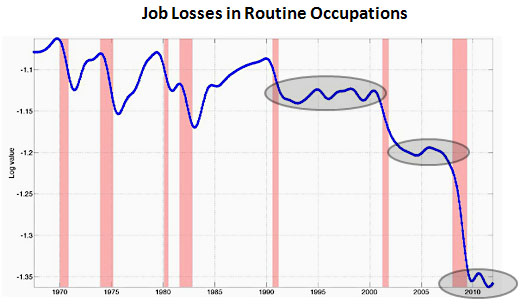
Mark Thoma draws my attention today to a paper by Henry Siu and Nir Jaimovich that tries to explain why recent recessions have prominently featured jobless recoveries. They break down jobs into three categories: non-routine cognitive jobs, non-routine manual jobs, and routine jobs. What they show is two things:

  • Most of the job losses during the past three recessions have come from the ranks of occupations coded as routine.
  • And unlike previous recessions, these jobs don’t come back during the subsequent recoveries. The chart below shows the permanence of these job losses in the aftermath of our last three recessions.
So why is this happening? Siu and Jaimovich conclude that it’s the machines, stupid:

Automation and the adoption of computing technology is leading to the decline of middle-wage jobs of many stripes, both blue-collar jobs in production and maintenance occupations and white-collar jobs in office and administrative support. It is affecting both male- and female-dominated professions and it is happening broadly across industries — manufacturing, wholesale and retail trade, financial services, and even public administration.

This is only the tip of the iceberg, and better education can only make a small dent in it. I suspect that over the next several decades, this is going to be one of our most serious economic issues, but it’s one that we’ll mostly try to deny because the solution is so intractable. So instead we’ll make up other explanations and continue to flail around. But like it or not, machines are going to get more and more competent over time, and they’re going to perform more and more of the work. Eventually we’ll have to face up to it.

UPDATE: A regular reader emails in a comment:

Have you ever watched “How It’s Made”? The extent of factory automation, even in places you wouldn’t expect, like food production, is mind-boggling. It’s impossible to watch even one episode and come away wondering where the manufacturing jobs went. It almost doesn’t matter if they went overseas — the bigger issue is that they don’t require humans anymore. All that’s left is for us to automate the factory automation factory and we’ll be all done….

This comment, of course, would have been delivered to me by an actual human being 20 years ago.
I'm hopeful because of readers like you. Will you pitch in today?

We see the headlines on a weekly basis: the claw backs in public media, the gutting of The Washington Post, the bending over backwards to appeal to Trump and his allies.

But not here.

When Mother Jones started publishing 50 years ago, our founders made a critical decision: to be a reader-supported nonprofit. They knew that no corporate owner would be interested in a muckraking newsroom; they also knew that no muckraking newsroom would be interested in following the agenda of a corporate owner.

And so, we’ve been reader-funded for half a century. We rely on contributions from our readers—readers like you—whether it’s $50, or $15 a month, or whatever fits your budget. People give what they can, and every donation makes a difference for our newsroom, which has grown tremendously—in size and reach and renown—since its inception in 1976.

You may be wondering: What does it take to publish an investigation? And what does my donation actually fund? The answers are one and the same: It takes people, resources, and time. And that’s what your donation funds directly.

Every donation Mother Jones receives from readers fortifies our newsroom, whether we’re covering underreported scandals out of Washington, DC, or the most important news of the day. And right now, each donation will be doubled thanks to a $50,000 match. So when you make a donation, it’ll go twice as far.

Your support keeps us going. If you’re able, donate today.

Thanks for reading.

—Monika Bauerlein, CEO

I'm hopeful because of readers like you. Will you pitch in today?

We see the headlines on a weekly basis: the claw backs in public media, the gutting of The Washington Post, the bending over backwards to appeal to Trump and his allies.

But not here.

When Mother Jones started publishing 50 years ago, our founders made a critical decision: to be a reader-supported nonprofit. They knew that no corporate owner would be interested in a muckraking newsroom; they also knew that no muckraking newsroom would be interested in following the agenda of a corporate owner.

And so, we’ve been reader-funded for half a century. We rely on contributions from our readers—readers like you—whether it’s $50, or $15 a month, or whatever fits your budget. People give what they can, and every donation makes a difference for our newsroom, which has grown tremendously—in size and reach and renown—since its inception in 1976.

You may be wondering: What does it take to publish an investigation? And what does my donation actually fund? The answers are one and the same: It takes people, resources, and time. And that’s what your donation funds directly.

Every donation Mother Jones receives from readers fortifies our newsroom, whether we’re covering underreported scandals out of Washington, DC, or the most important news of the day. And right now, each donation will be doubled thanks to a $50,000 match. So when you make a donation, it’ll go twice as far.

Your support keeps us going. If you’re able, donate today.

Thanks for reading.

—Monika Bauerlein, CEO

We Recommend

Latest

Sign up for our free newsletter

Subscribe to the Mother Jones Daily to have our top stories delivered directly to your inbox.

Get our award-winning magazine

Save big on a full year of investigations, ideas, and insights.

Subscribe

INDEPENDENT. BECAUSE OF YOU.

Mother Jones has no billionaires calling the shots—just readers like you making fearless reporting possible

Donate