The Optimal Tax Plan Is Also the Least Likely Tax Plan

Get your news from a source that’s not owned and controlled by oligarchs. Sign up for the free Mother Jones Daily.

What would be the best thing to do with the Bush tax cuts? Letting them expire on December 31 is a bad idea because the economy is still in fragile shape and a big tax increase would probably send the U.S. back into recession. Extending them permanently is a bad idea because we need to raise more revenue in the future and reduce the medium-term deficit. Letting only the high-end tax cuts expire is OK, but it’s not optimal either. It doesn’t raise enough money in the long term and it feeds the fiction that middle-class taxes will never have to go up.
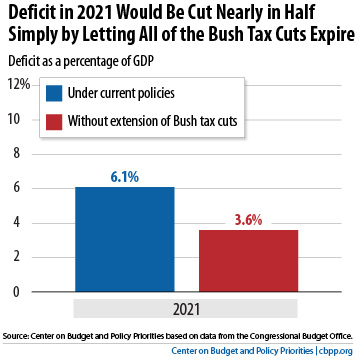
The best option is to let everything expire, and then pass a new tax cut that phases out over time. The new tax cut might be a reduction in rates equal to the Bush tax cuts, or it might be some other set of reductions. It doesn’t matter very much. What does matter is that one-quarter of the cuts should expire in 2014, another quarter in 2015, another in 2016, and another in 2017. This would have a gradual effect on the economy, it would require no further congressional action, it would improve our medium-term deficit problem, it would take effect primarily while the economy is recovering, and it would do no more than eventually return us to the tax levels of the Clinton era. There are more complicated approaches you could think of—tagging the expiration dates to economic benchmarks, for example—but in this case, simpler is better. Just phase out the cut over four years and be done with it. That’s easy for people to plan for.

So why won’t this happen? Because there’s no constituency for it. Republicans won’t get behind it because they want permanent tax cuts. Obama won’t get behind it because it’s effectively a tax increase on the middle class, something he’s promised to oppose. Independents might get behind it, but their political influence is approximately zero.

So that’s the situation we’re in. The best solution is probably the least likely to be enacted. Welcome to Washington.


I'm hopeful because of readers like you. Will you pitch in today?

We see the headlines on a weekly basis: the claw backs in public media, the gutting of The Washington Post, the bending over backwards to appeal to Trump and his allies.

But not here.

When Mother Jones started publishing 50 years ago, our founders made a critical decision: to be a reader-supported nonprofit. They knew that no corporate owner would be interested in a muckraking newsroom; they also knew that no muckraking newsroom would be interested in following the agenda of a corporate owner.

And so, we’ve been reader-funded for half a century. We rely on contributions from our readers—readers like you—whether it’s $50, or $15 a month, or whatever fits your budget. People give what they can, and every donation makes a difference for our newsroom, which has grown tremendously—in size and reach and renown—since its inception in 1976.

You may be wondering: What does it take to publish an investigation? And what does my donation actually fund? The answers are one and the same: It takes people, resources, and time. And that’s what your donation funds directly.

Every donation Mother Jones receives from readers fortifies our newsroom, whether we’re covering underreported scandals out of Washington, DC, or the most important news of the day. And right now, each donation will be doubled thanks to a $50,000 match. So when you make a donation, it’ll go twice as far.

Your support keeps us going. If you’re able, donate today.

Thanks for reading.

—Monika Bauerlein, CEO

I'm hopeful because of readers like you. Will you pitch in today?

We see the headlines on a weekly basis: the claw backs in public media, the gutting of The Washington Post, the bending over backwards to appeal to Trump and his allies.

But not here.

When Mother Jones started publishing 50 years ago, our founders made a critical decision: to be a reader-supported nonprofit. They knew that no corporate owner would be interested in a muckraking newsroom; they also knew that no muckraking newsroom would be interested in following the agenda of a corporate owner.

And so, we’ve been reader-funded for half a century. We rely on contributions from our readers—readers like you—whether it’s $50, or $15 a month, or whatever fits your budget. People give what they can, and every donation makes a difference for our newsroom, which has grown tremendously—in size and reach and renown—since its inception in 1976.

You may be wondering: What does it take to publish an investigation? And what does my donation actually fund? The answers are one and the same: It takes people, resources, and time. And that’s what your donation funds directly.

Every donation Mother Jones receives from readers fortifies our newsroom, whether we’re covering underreported scandals out of Washington, DC, or the most important news of the day. And right now, each donation will be doubled thanks to a $50,000 match. So when you make a donation, it’ll go twice as far.

Your support keeps us going. If you’re able, donate today.

Thanks for reading.

—Monika Bauerlein, CEO

We Recommend

Latest

Sign up for our free newsletter

Subscribe to the Mother Jones Daily to have our top stories delivered directly to your inbox.

Get our award-winning magazine

Save big on a full year of investigations, ideas, and insights.

Subscribe

INDEPENDENT. BECAUSE OF YOU.

Mother Jones has no billionaires calling the shots—just readers like you making fearless reporting possible

Donate