More Than Likely, President Obama Isn’t an Idiot

Get your news from a source that’s not owned and controlled by oligarchs. Sign up for the free Mother Jones Daily.


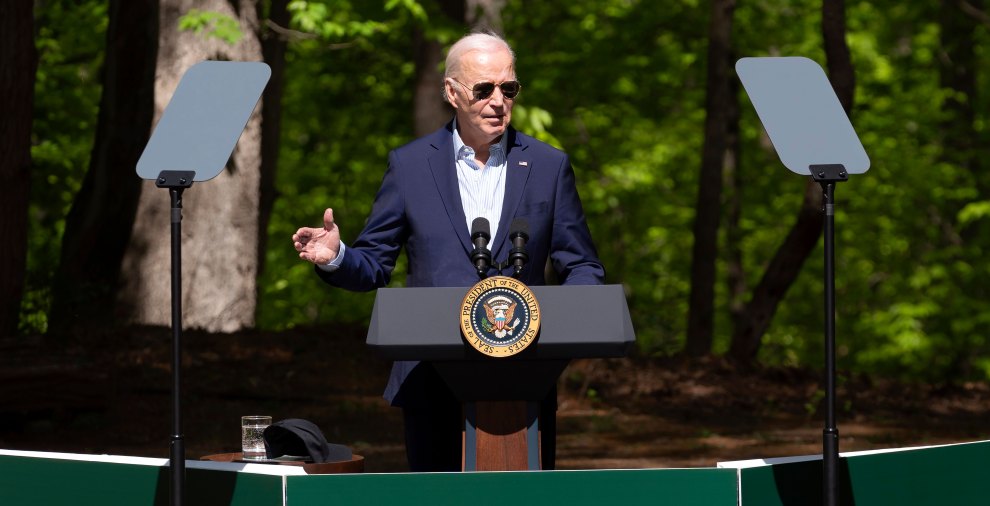
President Obama said today that he believes there are some Republicans in Congress who’d like to compromise with him to enact “common sense” solutions to America’s problems:

But they’re worried about their politics. It’s tough. Their base thinks that compromise with me is somehow a betrayal. They’re worried about primaries. And I understand all that. And we’re going to try to do everything we can to create a permission structure for them to be able to do what’s going to be best for the country. But it’s going to take some time.

Ed Kilgore isn’t impressed:

Good luck with that, Mr. President. I suppose “permission structure” means assembling enough conservative support, and/or framing legislation so that it addresses the concerns of “the base” (e.g., border enforcement on immigration) in a way that makes bipartisanship possible. But as we saw in the supreme example of the Affordable Care Act, even adopting conservative policy prescriptions right out of the Heritage Foundation playbook, as implemented by the man who would become the next GOP presidential nomination, didn’t prevent them from being demonized as representing the imposition of an alien “European-style” “government takeover of health care” aimed at totalitarianism and the slaughter of old people.

I’m sympathetic, because I agree. I don’t think that Republicans have declined to make a budget deal because Obama didn’t schmooze them enough, or because they didn’t understand what he was offering, or because Democrats haven’t framed their compromise proposals quite right. Republicans have declined to make a deal because they don’t like any of the deals Obama is willing to make. Full stop.

Unfortunately, I think Ed falls into the same trap when he suggests that Obama’s dinners with senators have gone quite far enough, thankyouverymuch. Instead, he says, “I’d recommend about four straight speeches about filibuster reform, followed by four straight speeches on what the sabotaging of the Affordable Care Act will actually mean for actual people. At a minimum, a Plan B to deploy if his umpteenth effort at bipartisanship fails is in order.”

The problem is that this almost certainly won’t work either. Obama made a full-court speechifying press on gun legislation, for example, and it had no effect at all. It wasn’t enough to pass even the watered-down Manchin-Toomey amendment, a bill that threw in so many goodies for gun owners that it might actually have been a net negative for gun control.

All of which gets us to the guts of the problem: most likely, nothing is going to work. But if you’re the president, you can’t say that. You can’t even act like it. You have to go out day after day after day insisting that progress is possible and deals can be made. This gets you lots of flak from fellow lefties who think it displays terminal naiveté, but what choice do you have? Obama pretty obviously understands everything that his lefty critics understand—he’s not an idiot, and this is hardly rocket science, after all—but he also understands one other thing: he can’t admit it. I imagine it’s frustrating as hell. But like it or not, presidents have to keep their chin up in public and keep trying to make things happen, even if they know perfectly well that success is unlikely. Welcome to hell.

From the desk of Mother Jones CEO, Monika Bauerlein...

Newsrooms can be funded in many ways. One of the most controversial (and volatile) ways is by a for-profit corporation or a billionaire owner. We see it across the headlines on a weekly basis: the claw backs in public media, the gutting of The Washington Post, the bending over backwards to appeal to Trump and his allies.

But not here.

When Mother Jones first started publishing 50 years ago, our founders made a critical decision: to be a reader-supported nonprofit. They knew that no corporate owner would be interested in a muckraking newsroom; they also knew that no muckraking newsroom would be interested in following the agenda of a corporate owner.

And so, we’ve been reader-funded for half a century. We rely on contributions from our readers—readers like you—whether it’s $50, or $15 a month, or whatever fits your budget. People give what they can, and every donation makes a difference for our newsroom, which has grown tremendously—in size and reach and renown—since its inception in 1976.

You may be wondering: What does it take to publish an investigation? And what does my donation actually fund? The answers are one and the same: It takes people, resources, and time. And that’s what your donation funds directly.

Every donation Mother Jones receives from readers fortifies our newsroom, whether we’re covering underreported scandals out of Washington, DC, or the most important news of the day. And right now, each donation will be doubled because of our $50,000 match. So when you make a donation—$5, $50, any amount—it’ll go twice as far.

Your support keeps us going. If you’re able, donate today.

Thanks for reading.

—Monika

From the desk of Mother Jones CEO, Monika Bauerlein...

Newsrooms can be funded in many ways. One of the most controversial (and volatile) ways is by a for-profit corporation or a billionaire owner. We see it across the headlines on a weekly basis: the claw backs in public media, the gutting of The Washington Post, the bending over backwards to appeal to Trump and his allies.

But not here.

When Mother Jones first started publishing 50 years ago, our founders made a critical decision: to be a reader-supported nonprofit. They knew that no corporate owner would be interested in a muckraking newsroom; they also knew that no muckraking newsroom would be interested in following the agenda of a corporate owner.

And so, we’ve been reader-funded for half a century. We rely on contributions from our readers—readers like you—whether it’s $50, or $15 a month, or whatever fits your budget. People give what they can, and every donation makes a difference for our newsroom, which has grown tremendously—in size and reach and renown—since its inception in 1976.

You may be wondering: What does it take to publish an investigation? And what does my donation actually fund? The answers are one and the same: It takes people, resources, and time. And that’s what your donation funds directly.

Every donation Mother Jones receives from readers fortifies our newsroom, whether we’re covering underreported scandals out of Washington, DC, or the most important news of the day. And right now, each donation will be doubled because of our $50,000 match. So when you make a donation—$5, $50, any amount—it’ll go twice as far.

Your support keeps us going. If you’re able, donate today.

Thanks for reading.

—Monika

We Recommend

Latest

Sign up for our free newsletter

Subscribe to the Mother Jones Daily to have our top stories delivered directly to your inbox.

Get our award-winning magazine

Save big on a full year of investigations, ideas, and insights.

Subscribe

INDEPENDENT. BECAUSE OF YOU.

Mother Jones has no billionaires calling the shots—just readers like you making fearless reporting possible

Donate