Five years after the Great Recession began, the US economy appears to be rebounding a bit. But two recent bits of evidence suggest that the impact of the recession on ordinary workers may have been even worse than we thought—and that the impact of future recessions might be worse too.
First off, a new paper by a trio of researchers confirms some old news: Adjusted for inflation, wages began stagnating for both men and women 10 years ago. Men’s wages have actually decreased slightly since 2000, while women’s wages, which had been rising steadily for decades, flattened out nearly to zero. But it could have been worse. Economists have long known that there’s a floor to wages because employers don’t like to reduce nominal wages. If you make $10 per hour, they won’t cut your wage to $9 per hour. They’ll just hold it at $10 and let inflation eat it away. This phenomenon is called wage stickiness.
But in “Wage Adjustment in the Great Recession,” these researchers have found that wage stickiness, which is driven mostly by social convention, not economic law, might be dying out. During the Great Recession, employers were increasingly willing to cut nominal wages. Among hourly workers, the usual number who experience wage cuts is around 15 percent. That had risen to 25 percent by 2011. Among nonhourly workers, the number rose from about 25 percent to nearly 35 percent. Increasingly, it seems, wage stickiness isn’t acting as a barrier against wage losses.
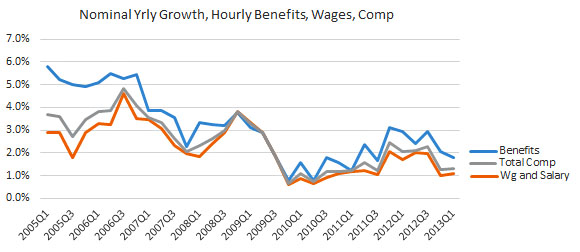
So what does this mean in the real world? Economist Jared Bernstein points us to the chart below. It shows growth in nominal wages, growth in benefits, and growth in total compensation (wages plus benefits). The news is grim. Total compensation (the gray line) grew at about 3 to 4 percent per year during most of the aughts. Since the Great Recession hit, that’s dropped to 1 to 2 percent. This is less than the inflation rate, which means that even when you account for benefits, real compensation has been declining since 2008.
Bottom line: Wage stickiness is disappearing, and with it a social convention that prevented wages from dropping too harshly even during recessions. As a result, wages are getting cut in bad times and never catching back up in good times. This is the world we live in today.