Word of the Day: Brinkmanship


Yesterday my copy editor objected to my use of the word brinksmanship, recommending that I replace it with brinkmanship. I prefer the version with the S, but I usually take his advice unless I have a pretty good reason not to. Since my dictionary lists both variants as acceptable, I did what I usually do next: I powered up the Google Ngram Viewer to see which version is in more common use. Here’s the result:
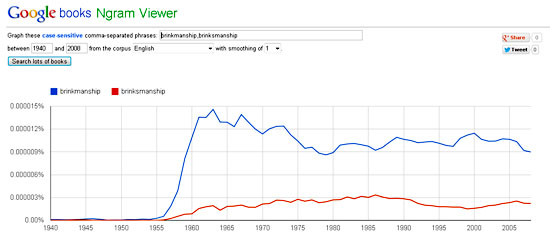
The version without an S is plainly the most common by a wide margin, so I went ahead and made the change. But I was intrigued that the word apparently first appears in 1955 and then shoots up the charts quickly, suggesting that it’s a child of the nuclear age. Sure enough, dictionary.com confirms that this is when it first appeared, coined by Adlai Stevenson during the 1956 presidential campaign:

Associated with the policies advocated by John Foster Dulles (1888-1959), U.S. Secretary of State 1953-1959. The word springs from Dulles’ philosophy as outlined in a magazine interview with Time-Life Washington bureau chief James Shepley early 1956:

“The ability to get to the verge without getting into the war is the necessary art. If you cannot master it, you inevitably get into war. If you try to run away from it, if you are scared to go to the brink, you are lost.”

The quote was widely criticized by the Eisenhower Administration’s opponents, and the first attested use of brinkmanship seems to have been in such a context, a few weeks after the magazine appeared, by Democratic presidential candidate Adlai Stevenson criticizing Dulles for “boasting of his brinkmanship, … the art of bringing us to the edge of the nuclear abyss.”

This is news to me, and since we’ve been playing budget brinkmanship for the past few months, I thought a brief refresher on the nuclear origins of the word might be in order.

Also (according to dictionary.com once again), the S in the alternate spelling is a “parasitic S.” What the heck is that? Can any linguists help out here?
Owned by no one—except you.

We just keep seeing it happen: Newsrooms owned by billionaires and corporations are spinning their own narratives, overwriting the truth, following only stories that keep them in the pocket of those with even more power.

Not here. We’re not owned by anyone. We’re not part of any cult that demands our allegiance to a bottom line. We’ve spoken up and spoken out while other newsrooms changed their stories—or cut them altogether—to keep the C suite happy.

Our mission is to find the truth and amplify it. That’s why we’re independent, nonprofit, and, crucially, funded by readers. The investigations on our website will always be free to read, watch, and listen to, but our newsroom is powered by readers who pitch in what they can so we can keep asking the hard questions.

Can you chip in today?

Owned by no one—except you.

We just keep seeing it happen: Newsrooms owned by billionaires and corporations are spinning their own narratives, overwriting the truth, following only stories that keep them in the pocket of those with even more power.

Not here. We’re not owned by anyone. We’re not part of any cult that demands our allegiance to a bottom line. We’ve spoken up and spoken out while other newsrooms changed their stories—or cut them altogether—to keep the C suite happy.

Our mission is to find the truth and amplify it. That’s why we’re independent, nonprofit, and, crucially, funded by readers. The investigations on our website will always be free to read, watch, and listen to, but our newsroom is powered by readers who pitch in what they can so we can keep asking the hard questions.

Can you chip in today?

We Recommend

Latest

Sign up for our free newsletter

Subscribe to the Mother Jones Daily to have our top stories delivered directly to your inbox.

Get our award-winning magazine

Save big on a full year of investigations, ideas, and insights.

Subscribe

INDEPENDENT. BECAUSE OF YOU.

Mother Jones has no billionaires calling the shots—just readers like you making fearless reporting possible

Donate