Texas Schools Are Performing Pretty Well. Surprised?

Get your news from a source that’s not owned and controlled by oligarchs. Sign up for the free Mother Jones Daily.


David Leonhardt:

When the Education Department releases its biennial scorecard of reading and math scores for all 50 states this week, Florida and Texas are likely to look pretty mediocre. In 2013, the last time that scores were released, Florida ranked 30th on the tests, which are given to fourth and eighth graders, and Texas ranked 32nd.

But these raw scores, which receive widespread attention, almost certainly present a misleading picture — and one that gives short shrift to both Florida and Texas. In truth, schools in both states appear to be well above average at teaching their students math and reading. Florida and Texas look worse than they deserve to because they’re educating a more disadvantaged group of students than most states are.

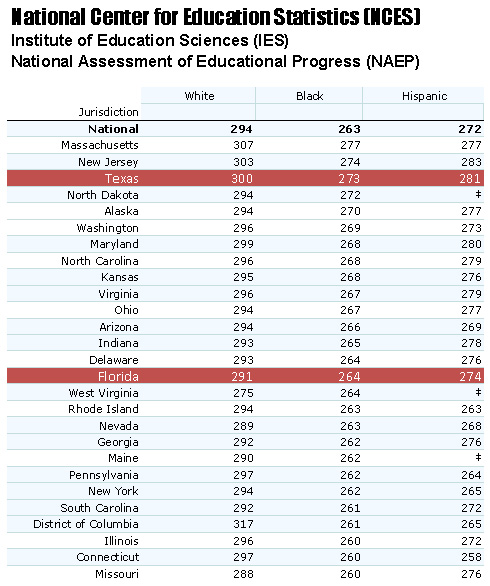
This conclusion is based on a new report by the Urban Institute. That’s fine, but we pretty much knew this already. Texas has large black and Hispanic populations, and they tend to do worse on academic tests than whites—which makes the overall scores for Texas look weak. But if you head over to the NAEP site and look at scores for each state disaggregated by race you can get the real story in about five minutes. The chart below is for 8th grade math, but you can do the same thing for any other test. It’s sorted by black test scores, and as you can see, Texas is 3rd in the nation. (Florida is 15th.) It’s also 3rd in Hispanic scores, and 5th in white scores.

The Urban Institute controls for other factors besides race (poverty, native language, special ed), and that makes Florida look even better than the disaggregated NAEP scores suggest. But Texas looks good no matter what. If education reporters would pay attention to this stuff, it might not come as such a big surprise. Like it or not, Texas has been scoring pretty well for quite a while.

BEFORE YOU CLICK AWAY!

December is make or break for us. A full one-third of our annual fundraising comes in this month alone. A strong December means our newsroom is on the beat and reporting at full strength. A weak one means budget cuts and hard choices ahead.

The December 31 deadline is closing in fast. To reach our $400,000 goal, we need readers who’ve never given before to join the ranks of MoJo donors. And we need our steadfast supporters to give again today—any amount.

Managing an independent, nonprofit newsroom is staggeringly hard. There’s no cushion in our budget—no backup revenue, no corporate safety net. We can’t afford to fall short, and we can’t rely on corporations or deep-pocketed interests to fund the fierce, investigative journalism Mother Jones exists to do.

That’s why we need you right now. Please chip in to help close the gap.

BEFORE YOU CLICK AWAY!

December is make or break for us. A full one-third of our annual fundraising comes in this month alone. A strong December means our newsroom is on the beat and reporting at full strength. A weak one means budget cuts and hard choices ahead.

The December 31 deadline is closing in fast. To reach our $400,000 goal, we need readers who’ve never given before to join the ranks of MoJo donors. And we need our steadfast supporters to give again today—any amount.

Managing an independent, nonprofit newsroom is staggeringly hard. There’s no cushion in our budget—no backup revenue, no corporate safety net. We can’t afford to fall short, and we can’t rely on corporations or deep-pocketed interests to fund the fierce, investigative journalism Mother Jones exists to do.

That’s why we need you right now. Please chip in to help close the gap.

We Recommend

Latest

Sign up for our free newsletter

Subscribe to the Mother Jones Daily to have our top stories delivered directly to your inbox.

Get our award-winning magazine

Save big on a full year of investigations, ideas, and insights.

Subscribe

Support our journalism

Help Mother Jones' reporters dig deep with a tax-deductible donation.

Donate