Weekend Follow-Up #2: The 1994 Crime Bill and Mass Incarceration

Get your news from a source that’s not owned and controlled by oligarchs. Sign up for the free Mother Jones Daily.


The 1994 crime bill has come in for a lot of attention lately, and even Bill and Hillary Clinton have said they now regret some of its provisions. But which ones?

Generally speaking, liberals still applaud several of its biggest accomplishments: the assault weapon ban, the Violence Against Women Act, and the COPS program that funded additional police and better community training.

But Republicans exacted a price for this. In particular, they wanted an expansion of the death penalty and several provisions that stiffened sentencing of felons. As it turns out, though, Republicans didn’t have a very good idea of what their own favorite policies would actually accomplish. Are you surprised? For example, here’s the death penalty:
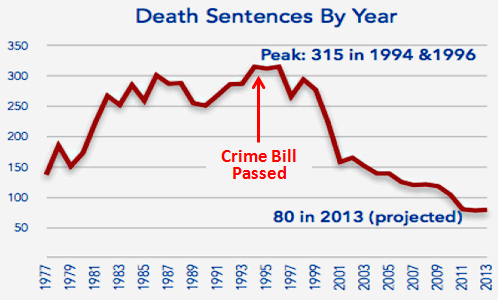
The crime bill created lots of new capital crimes, but its actual effect was nil. The death penalty was already losing support by 1994, and has been banned by an increasing number of states ever since. On the federal level, death sentences have always been a tiny fraction of the total (around four or five per year), and that didn’t change after 1994.

So what about sentencing? The crime bill did have an effect here, but it was generally pretty modest. Here are a couple of charts from an unpublished review of the law seven years after it passed:
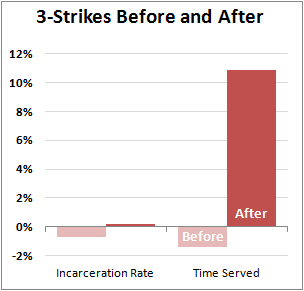
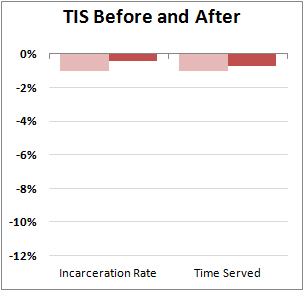
Why the small effect? In the case of 3-strikes, it simply didn’t affect very many people. It did increase average time served by several months, but that’s about it. And the much-loathed Truth-in-Sentencing provisions had even less effect. This is because more than half the states already had TIS requirements even before the 1994 bill passed, and not many passed new ones as a result of the law. It did push up the trend in incarceration and time served by a few tenths of a percentage point, but that had only a minuscule effect on overall incarceration rates.

The crime bill also included a few other witless measures, like reducing educational opportunities for inmates, and it unquestionably contributed to the crime hysteria that was prevalent at the time. Nonetheless, its most hated features never had a big effect.

Two years later Clinton also signed the Antiterrorism and Effective Death Penalty Act of 1996, which had some pretty objectionable changes to habeas corpus. This was arguably worse than anything in the 1994 bill, but it didn’t have a substantial overall effect on incarceration rates.
From the desk of Mother Jones CEO, Monika Bauerlein...

Newsrooms can be funded in many ways. One of the most controversial (and volatile) ways is by a for-profit corporation or a billionaire owner. We see it across the headlines on a weekly basis: the claw backs in public media, the gutting of The Washington Post, the bending over backwards to appeal to Trump and his allies.

But not here.

When Mother Jones first started publishing 50 years ago, our founders made a critical decision: to be a reader-supported nonprofit. They knew that no corporate owner would be interested in a muckraking newsroom; they also knew that no muckraking newsroom would be interested in following the agenda of a corporate owner.

And so, we’ve been reader-funded for half a century. We rely on contributions from our readers—readers like you—whether it’s $50, or $15 a month, or whatever fits your budget. People give what they can, and every donation makes a difference for our newsroom, which has grown tremendously—in size and reach and renown—since its inception in 1976.

You may be wondering: What does it take to publish an investigation? And what does my donation actually fund? The answers are one and the same: It takes people, resources, and time. And that’s what your donation funds directly.

Every donation Mother Jones receives from readers fortifies our newsroom, whether we’re covering underreported scandals out of Washington, DC, or the most important news of the day. And right now, each donation will be doubled because of our $50,000 match. So when you make a donation—$5, $50, any amount—it’ll go twice as far.

Your support keeps us going. If you’re able, donate today.

Thanks for reading.

—Monika

From the desk of Mother Jones CEO, Monika Bauerlein...

Newsrooms can be funded in many ways. One of the most controversial (and volatile) ways is by a for-profit corporation or a billionaire owner. We see it across the headlines on a weekly basis: the claw backs in public media, the gutting of The Washington Post, the bending over backwards to appeal to Trump and his allies.

But not here.

When Mother Jones first started publishing 50 years ago, our founders made a critical decision: to be a reader-supported nonprofit. They knew that no corporate owner would be interested in a muckraking newsroom; they also knew that no muckraking newsroom would be interested in following the agenda of a corporate owner.

And so, we’ve been reader-funded for half a century. We rely on contributions from our readers—readers like you—whether it’s $50, or $15 a month, or whatever fits your budget. People give what they can, and every donation makes a difference for our newsroom, which has grown tremendously—in size and reach and renown—since its inception in 1976.

You may be wondering: What does it take to publish an investigation? And what does my donation actually fund? The answers are one and the same: It takes people, resources, and time. And that’s what your donation funds directly.

Every donation Mother Jones receives from readers fortifies our newsroom, whether we’re covering underreported scandals out of Washington, DC, or the most important news of the day. And right now, each donation will be doubled because of our $50,000 match. So when you make a donation—$5, $50, any amount—it’ll go twice as far.

Your support keeps us going. If you’re able, donate today.

Thanks for reading.

—Monika

We Recommend

Latest

Sign up for our free newsletter

Subscribe to the Mother Jones Daily to have our top stories delivered directly to your inbox.

Get our award-winning magazine

Save big on a full year of investigations, ideas, and insights.

Subscribe

INDEPENDENT. BECAUSE OF YOU.

Mother Jones has no billionaires calling the shots—just readers like you making fearless reporting possible

Donate