
Here’s some potentially good news on the climate front. The most aggressive climate goal we have is to keep global temperatures from rising more than 1.5°C above their pre-industrial average. The most recent IPCC report suggests that to do this, we need to limit total future carbon emissions to about 250 billion tonnes of CO2 (GtCO2). This is all but impossible.
However, a team that includes some of the world’s leading experts on carbon budgets has published a new paper that resolves some contradictions in the IPCC figures and comes up with a much higher carbon budget: about 900 Gt. The following chart will make you cringe at first sight, but don’t worry. It’s fairly easy to explain.
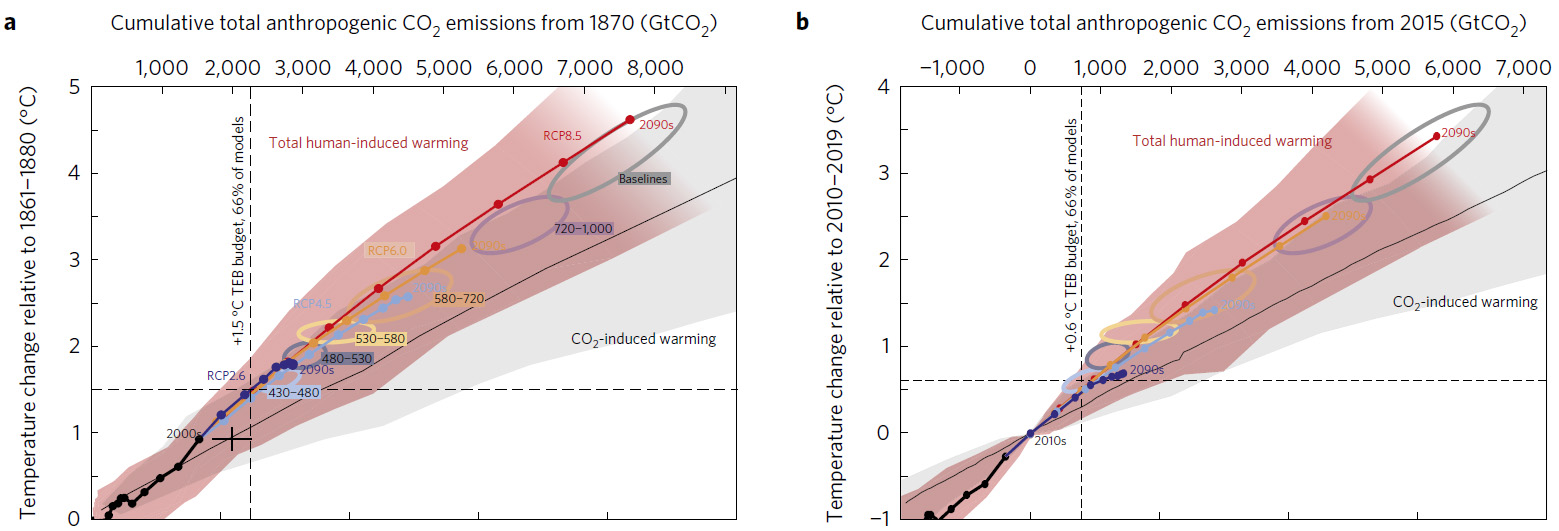
On the left is the IPCC approach. It starts at 1870 and shows how much carbon is required to reach different temperatures. The intersection of the dotted lines indicates that temperatures will rise 1.5°C from 1870 when cumulative carbon emissions hit 2,150 Gt. Since we’ve already emitted 1,900 Gt, that means we have only about 250 Gt to go.
However, this approach doesn’t really match what we see happening right now, so the authors of the new study took a different approach: they started at 2015 instead. Since temperatures have already risen 0.9°C since 1870, our new target is to keep further increases below 0.6°C.
That’s what the chart on the right shows. The intersection of the dotted lines indicates that temperatures will rise 0.6°C from 2015 when we’ve emitted an additional 900 Gt of carbon. The good news here is that this is achievable. It’s not easily achievable, but it’s certainly not impossible.
For more detail on this, Glen Peters has you covered here. He warns that the real-life carbon budget for staying under 1.5°C is probably lower than the theoretical estimate, and he also has some warnings about the whole concept of carbon budgets in general. This is primarily because multiple studies have come up with vastly different estimates of how much carbon we can afford to emit this century if we want to stay below 1.5°C. It’s better, he argues, to simply say that “we need net-zero emissions by 2050 to 2100, as specified in the Paris Agreement.”
Nonetheless, he also says, “The implications of this paper are breathtaking.” As always, this is only one paper, so don’t take it to the bank yet. But this is serious work by leading experts. If it pans out, it means that we actually have a shot at staying below 1.5°C.