After a bit of Twitter conversation about the state of rural America, I’ve completed a new version of my income chart from yesterday. This time I used a population density of 15 per square mile to define rural. Why? First, this is the approximate cutoff point for the bottom quartile, so these are pretty rural places. Second, counties with a density this low mostly don’t contain any cities with a population greater than 2,500—which is another common definition of rural. Generally speaking, these are places that everyone can agree are really rural. As a bonus, choosing a cutoff of 15 gives me a sample that’s completely different from my previous one.
I expanded my sample to 30 counties in order to get more precise averages, and I also reduced the bias in choosing them. This time, I just started at the first county with a population density of 15 and then chose the next 30. In the end, I removed three outliers: Mohave in Arizona, because it includes Kingman; plus Morgan (Utah) and Storey (Nevada), because they were income outliers (i.e., not truly rural, but sparse places where California refugees buy themselves big ranches). This was done to ensure that rural counties weren’t looking artificially buoyant due to a couple of weird outliers.
In the end, then, I constructed a sample of 27 counties. Here’s how income growth looks:
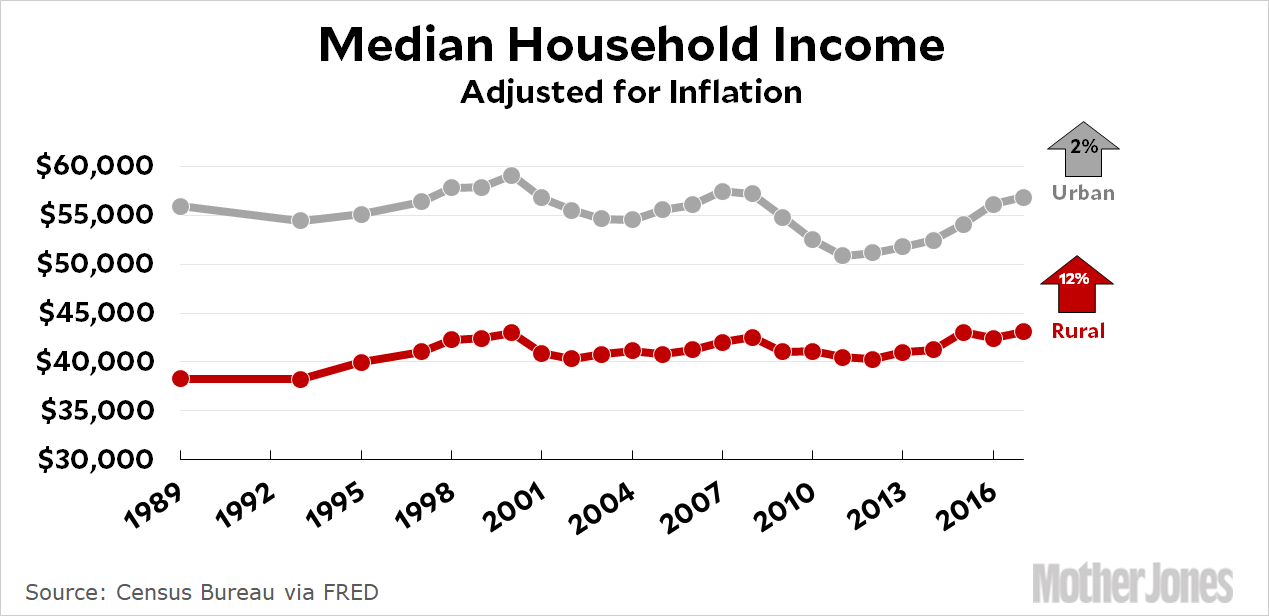
I’ll confess to being pretty surprised by this. The rural counties in my sample are really rural. More rural than the ones in my original chart. And with a sample of 27, it’s unlikely that these results are seriously skewed. What’s more, these are median incomes, so they aren’t affected by the possibility of a few rich people moving into the neighborhood. There’s not really any way around it: the Census Bureau tells us that rural income has increased 12 percent since 1989, and that’s probably true. This may not seem like much—and it isn’t—but it’s better than urban areas are doing. In both cases, median incomes are fairly stagnant because all the growth is in the top ten percent.
But what about population? If there’s one thing that appears to define “rural decline” more than anything else, it’s the fact that they’re losing population. So let’s take a look at that for the same sample of counties:
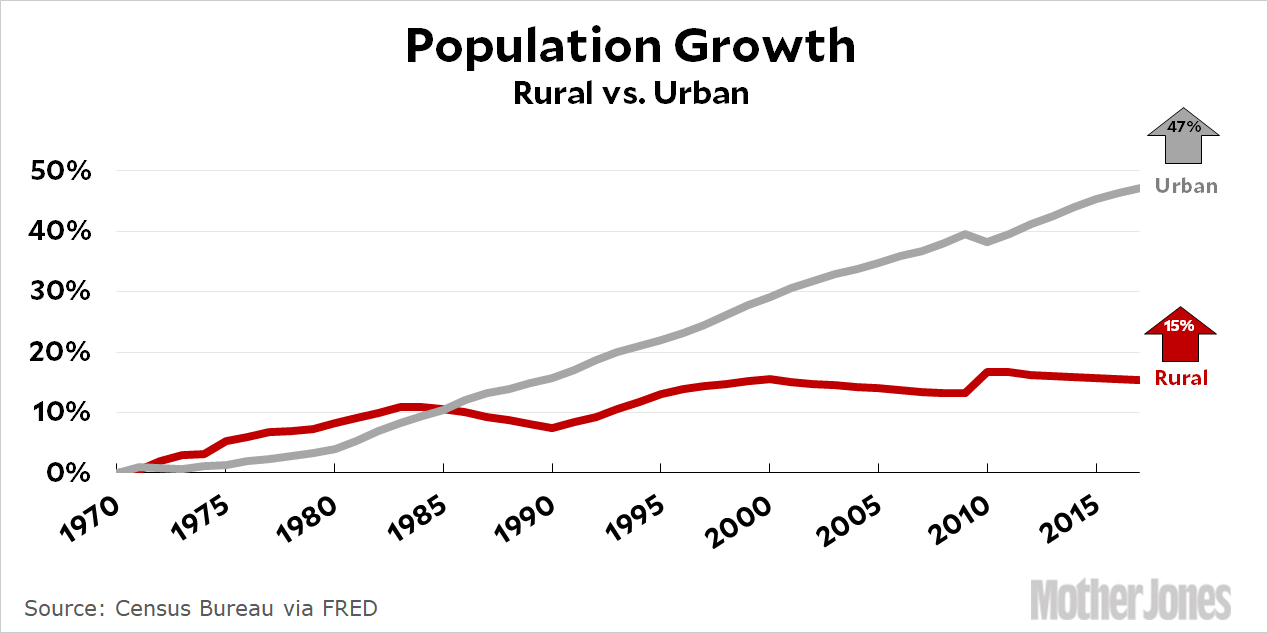
Rural counties haven’t been losing population. At the same time, it’s certainly true that they aren’t keeping up with the overall population growth of the country.
But I don’t think anyone denies that urban areas are considerably more vibrant than rural areas, on a whole bunch of different measures. This is no surprise: enterprising young kids have been leaving sleepy rural towns forever in hopes of making it in the big city. Big cities grow faster; they’re more diverse; they’re more educated; they have more cultural life; and they certainly have a much higher top end in terms of income. This is unquestionable, and it’s the way everyone likes it. People move to big cities because they want to live in a vibrant place. People stay in small towns because they prefer a slower, more traditional pace of life.
So where’s the decline? It’s certainly true that there are rural areas in trouble. Usually this is because they lost a manufacturing plant that served as their economic backbone. But that’s a very specific subset of rural areas, and tells us little about the vast bulk of them.
It’s also true that rural incomes are lower than urban incomes on an absolute basis. But this is nothing new. What’s more, when you incorporate the lower cost of living in rural areas (primarily in housing), their incomes probably maintain a standard of living pretty close to that of the average urban family.
That said, rural areas, on average, just don’t appear to be in big trouble. Their incomes are growing; their populations are stable; and their unemployment level is about the same as in urban areas. Unless I’m missing something—always a possibility!—we should stop pretending otherwise.
POSTSCRIPT: It’s worth noting the little spikes in the population chart following the 2010 census. What it shows is that the Census Bureau had been overestimating urban population and underestimating rural population from 2000-2010. So for ten years it really did look like rural areas were losing population. This spawned a lot of nail-biting commentary, but it was all based on a miscalculation. This is happening again right now, but we won’t know until after the 2020 census if it’s real, or just another miscalcuation.
In any case, there’s little question that rural population growth since 2000 has been flat or, possibly, slightly positive. That’s not great, but it’s not necessarily decline either.
A NOTE ON METHODOLOGY: My goal here was to avoid tautological definitions of “rural” that effectively define anyplace that’s growing as urban. At the same time, I wanted a sample of counties that were truly rural by anyone’s definition. I think I’ve done that here. These counties are truly rural and truly random. For the record, here are the 27 counties that made up my sample:
- Daviess County, MO
- Taos County, NM
- Callahan County, TX
- Wahkiakum County, WA
- Choctaw County, AL
- Sumter County, AL
- Richardson County, NE
- Frio County, TX
- Oscoda County, MI
- Red Willow County, NE
- Rolette County, ND
- Latimer County, OK
- Dawson County, TX
- Newton County, TX
- Val Verde County, TX
- Ashland County, WI
- Conecuh County, AL
- Van Buren County, IA
- Charlton County, GA
- Leon County, TX
- Craig County, VA
- Lowndes County, AL
- Noble County, OK
- Decatur County, IA
- Glades County, FL
- Kossuth County, IA
- Polk County, MN
And the ten urban counties are:
- Brooklyn, NY
- Los Angeles, CA
- Chicago, IL
- Houston, TX
- Phoenix, AZ
- Philadelphia, PA
- Columbus, OH
- Charlotte, NC
- Indianapolis, IN