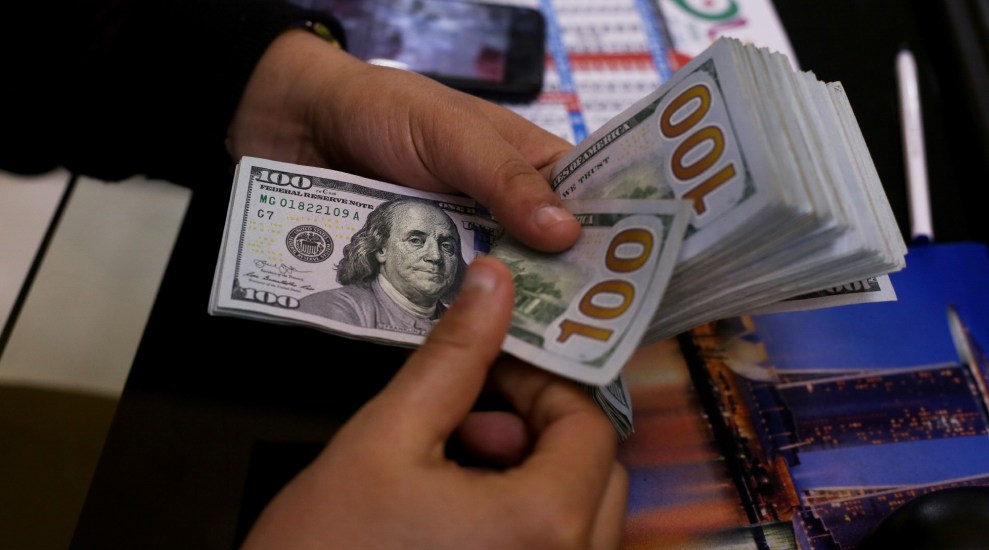
Samar Abu Elouf/IMAGESLIVE via ZUMA

Get your news from a source that’s not owned and controlled by oligarchs. Sign up for the free Mother Jones Daily.

We are, yet again, in danger of being consumed by the Chinese borg:

While much of the world is consumed by the COVID-19 crisis, the Chinese government is quietly unleashing a financial innovation that will reshape its economy and improve its strategic standing for decades to come. In April, China’s central bank introduced the “digital yuan” in a pilot program across four cities, becoming the world’s first major economy to issue a national digital currency.

….The digital yuan will eventually replace cash in circulation….The move from paper to bytes is more than just a sign of our digital times. Chinese leaders are making a strategic choice to achieve both a vastly more efficient administrative state, and the ability to dictate the terms of 21st century economic diplomacy by setting the standard for digital monetary systems.

Full disclosure: I’m only writing about this because I really, really need at least a short break from COVID-19 blogging. That said, what’s the deal with this? The dollar, after all, is a digital currency. There’s something like $15-40 trillion in dollars and dollar liabilities in the world today, and only $2 trillion of that is physical cash. The rest is all bits and bytes sitting on computers all over the globe.

So what’s the difference between that and a “digital currency”? Michael Casey explains:

As with an exchange of banknotes—the most common physical bearer instrument—both parties to a digital currency transaction recognize final settlement as soon as possession changes. With all other cashless payments, whether by card, wire, check, or digital app such as Venmo, the deal isn’t fully settled—meaning it could still be reversed—until their banks have recorded, reconciled, and settled their respective debits and credits.

This is why digital currencies are so revolutionary. In ending banks’ centuries-long intermediating role in our monetary system and allowing direct peer-to-peer exchange, they can imbue money with the power of software.

Huh. As someone who has a long history with software, I’m not sure I really want my money to be “imbued with the power of software.” Nor do I quite see the advantage of being a bearer instrument. Digital settlement is pretty fast already and can certainly be made almost instantaneous if we want to.

So that’s surely not it. Aside from replacing hundred dollar bills in drug deals, then, what’s the advantage? The big one, I’m guessing, is that it reduces the power of nation states to restrict the use of their own currency. And why would anyone care about that? Well, Iran might care. Maintaining our sanctions on Iran would probably be a lot harder if they could do business with digital dollars and yen and euros that were outside the control of US banking authorities.

In other words, this might look enticing to China, which would be happy to undermine the influence of the Federal Reserve. But more generally, why would the world’s central bankers be all that keen on a transformation that would reduce the power of the world’s central bankers? This remains a bit of a mystery to me.
From the desk of Mother Jones CEO, Monika Bauerlein...

Newsrooms can be funded in many ways. One of the most controversial (and volatile) ways is by a for-profit corporation or a billionaire owner. We see it across the headlines on a weekly basis: the claw backs in public media, the gutting of The Washington Post, the bending over backwards to appeal to Trump and his allies.

But not here.

When Mother Jones first started publishing 50 years ago, our founders made a critical decision: to be a reader-supported nonprofit. They knew that no corporate owner would be interested in a muckraking newsroom; they also knew that no muckraking newsroom would be interested in following the agenda of a corporate owner.

And so, we’ve been reader-funded for half a century. We rely on contributions from our readers—readers like you—whether it’s $50, or $15 a month, or whatever fits your budget. People give what they can, and every donation makes a difference for our newsroom, which has grown tremendously—in size and reach and renown—since its inception in 1976.

You may be wondering: What does it take to publish an investigation? And what does my donation actually fund? The answers are one and the same: It takes people, resources, and time. And that’s what your donation funds directly.

Every donation Mother Jones receives from readers fortifies our newsroom, whether we’re covering underreported scandals out of Washington, DC, or the most important news of the day. And right now, each donation will be doubled because of our $50,000 match. So when you make a donation—$5, $50, any amount—it’ll go twice as far.

Your support keeps us going. If you’re able, donate today.

Thanks for reading.

—Monika

From the desk of Mother Jones CEO, Monika Bauerlein...

Newsrooms can be funded in many ways. One of the most controversial (and volatile) ways is by a for-profit corporation or a billionaire owner. We see it across the headlines on a weekly basis: the claw backs in public media, the gutting of The Washington Post, the bending over backwards to appeal to Trump and his allies.

But not here.

When Mother Jones first started publishing 50 years ago, our founders made a critical decision: to be a reader-supported nonprofit. They knew that no corporate owner would be interested in a muckraking newsroom; they also knew that no muckraking newsroom would be interested in following the agenda of a corporate owner.

And so, we’ve been reader-funded for half a century. We rely on contributions from our readers—readers like you—whether it’s $50, or $15 a month, or whatever fits your budget. People give what they can, and every donation makes a difference for our newsroom, which has grown tremendously—in size and reach and renown—since its inception in 1976.

You may be wondering: What does it take to publish an investigation? And what does my donation actually fund? The answers are one and the same: It takes people, resources, and time. And that’s what your donation funds directly.

Every donation Mother Jones receives from readers fortifies our newsroom, whether we’re covering underreported scandals out of Washington, DC, or the most important news of the day. And right now, each donation will be doubled because of our $50,000 match. So when you make a donation—$5, $50, any amount—it’ll go twice as far.

Your support keeps us going. If you’re able, donate today.

Thanks for reading.

—Monika

We Recommend

Latest

Sign up for our free newsletter

Subscribe to the Mother Jones Daily to have our top stories delivered directly to your inbox.

Get our award-winning magazine

Save big on a full year of investigations, ideas, and insights.

Subscribe

INDEPENDENT. BECAUSE OF YOU.

Mother Jones has no billionaires calling the shots—just readers like you making fearless reporting possible

Donate