Capital Gains Cuts Are Just Another Con to Benefit the Rich

A few days ago President Trump said he was “seriously considering” a cut in the capital gains rate if he’s re-elected. Needless to say, Trump says a lot of things, and the fact that he said this probably doesn’t mean much. Still, he was backed up by longtime capital gains warrior Larry Kudlow, who told reporters “We’d like to take it back to 15%, where it was for quite a long time because it helps jobs, investment, productivity and wages.”

Is that true? First off, here’s the amateur view of whether capital gains rates have any effect on economic growth:
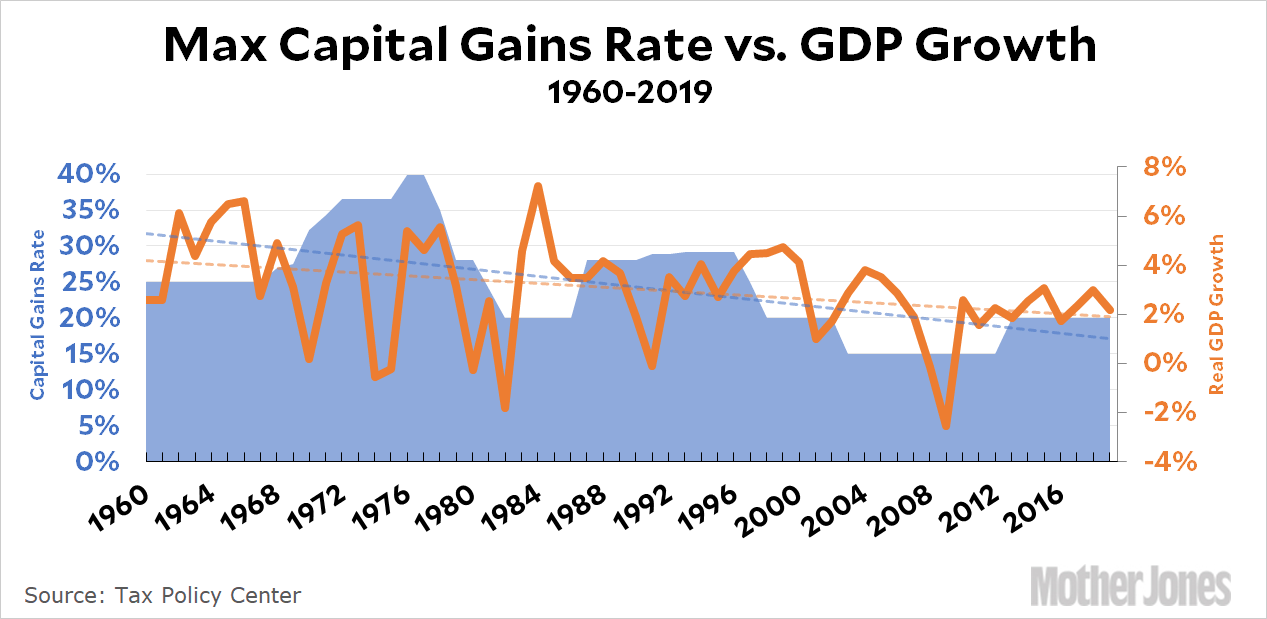
Hmmm. It sure doesn’t look like the capital gains rate has much correlation with real GDP growth. If anything, the trend lines are going in the wrong direction entirely: capital gains rates have been declining since 1960, but the only result has been a decline in GDP growth too. If low capital gains rates boost GDP, it sure doesn’t show up here.

But this is just playground stuff. Serious economists have far more sophisticated ways of figuring out if capital gains cuts lead to higher economic growth. So what do they say?

  • A Congressional Research Service report written in 2012 concludes that “neither the top marginal tax rate nor the top capital gains tax rate are strongly correlated with saving, investment, labor productivity, and GDP growth controlling for other covariates.”
  • Tax expert Joel Slemrod says “there is no evidence that links aggregate economic performance to capital gains tax rates.”
  • A policy brief from the Levy Economics Institute finds “little theoretical or empirical basis for the view that lowering the capital gains tax rate would have a substantial effect on economic growth or level of economic activity.”
  • The Penn Wharton Budget Model calculates that an increase in the capital gains rate would have no negative effect on economic growth.
  • A pair of researchers at the University of Groningen looked at capital gains rates worldwide and concluded that “Using a long cross-country panel data set going back to 1965 and employing a variety of econometric techniques, we document that greater reliance on capital taxation, measured in different ways, is not negatively associated with growth rates.”

I could go on, but why bother? There’s been a ton of research on this subject and it almost unanimously concludes that capital gains rates have a tiny effect at most on economic growth. On the other hand, when capital gains rates are different from ordinary tax rates they can cause serious mischief:

  • As Len Burman says, “Virtually every individual income tax shelter is devoted to converting fully taxed income into capital gains.”
  • Capital gains tax cuts are regressive, with the benefits going almost exclusively to the rich. The Tax Policy Center estimates that 71 percent of the benefits go to the top one percent.
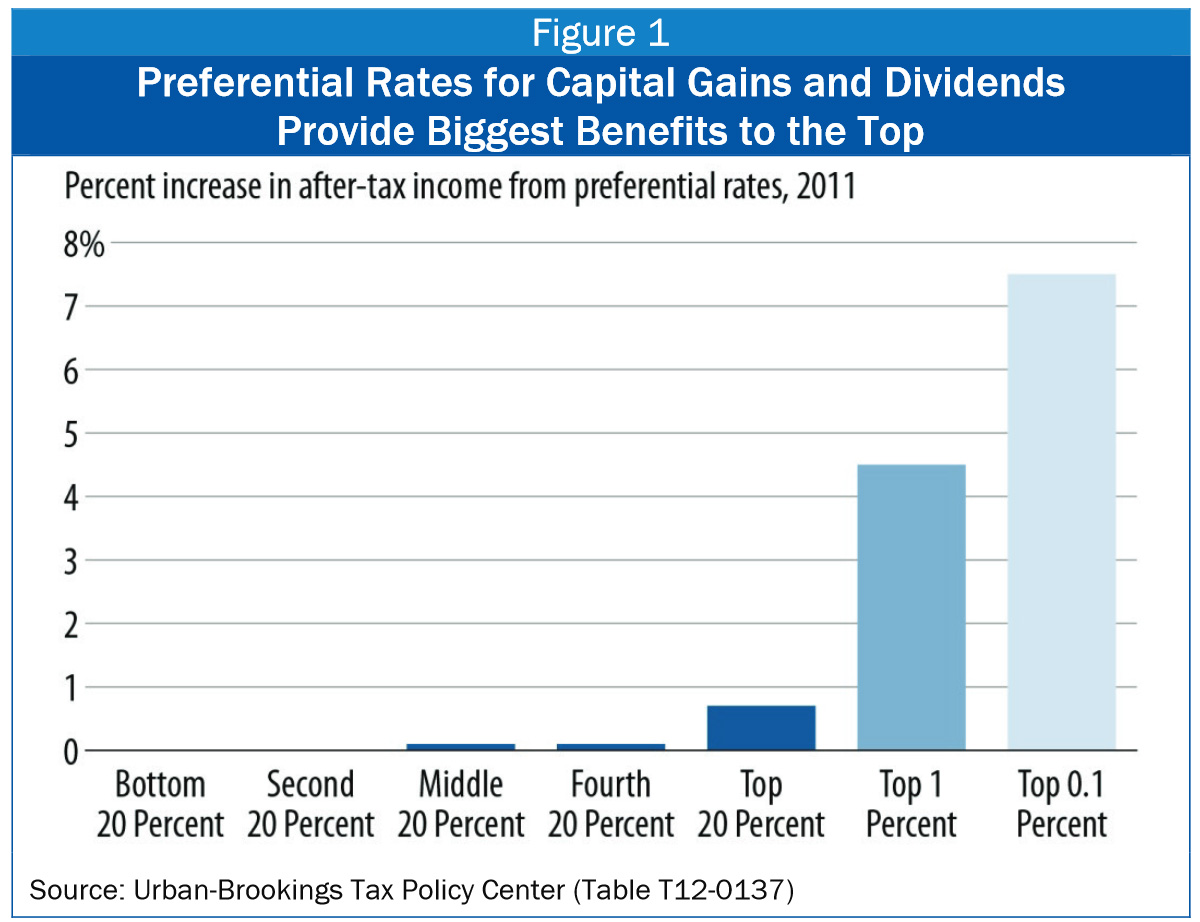
  • Many affluent households earn a majority of their income in capital gains. This means that some of them actually have lower overall tax rates than middle-class households, who have to pay the ordinary income tax rate. Lowering the capital gains rate would only make this worse.

So that’s that. It’s no surprise that rich people—and therefore the Republican Party—are in favor of reducing capital gains rates. Why wouldn’t they be? But there’s no reason for the other 99 percent of us to be in favor. It does the economy no good; it does us no good; and it motivates lots of inefficient gameplaying with taxes. It’s just another stupid con. Don’t fall for it if your income is anywhere below $200,000 or so.

From the desk of Mother Jones CEO, Monika Bauerlein...

Newsrooms can be funded in many ways. One of the most controversial (and volatile) ways is by a for-profit corporation or a billionaire owner. We see it across the headlines on a weekly basis: the claw backs in public media, the gutting of The Washington Post, the bending over backwards to appeal to Trump and his allies.

But not here.

When Mother Jones first started publishing 50 years ago, our founders made a critical decision: to be a reader-supported nonprofit. They knew that no corporate owner would be interested in a muckraking newsroom; they also knew that no muckraking newsroom would be interested in following the agenda of a corporate owner.

And so, we’ve been reader-funded for half a century. We rely on contributions from our readers—readers like you—whether it’s $50, or $15 a month, or whatever fits your budget. People give what they can, and every donation makes a difference for our newsroom, which has grown tremendously—in size and reach and renown—since its inception in 1976.

You may be wondering: What does it take to publish an investigation? And what does my donation actually fund? The answers are one and the same: It takes people, resources, and time. And that’s what your donation funds directly.

Every donation Mother Jones receives from readers fortifies our newsroom, whether we’re covering underreported scandals out of Washington, DC, or the most important news of the day. And right now, each donation will be doubled because of our $50,000 match. So when you make a donation—$5, $50, any amount—it’ll go twice as far.

Your support keeps us going. If you’re able, donate today.

Thanks for reading.

—Monika

From the desk of Mother Jones CEO, Monika Bauerlein...

Newsrooms can be funded in many ways. One of the most controversial (and volatile) ways is by a for-profit corporation or a billionaire owner. We see it across the headlines on a weekly basis: the claw backs in public media, the gutting of The Washington Post, the bending over backwards to appeal to Trump and his allies.

But not here.

When Mother Jones first started publishing 50 years ago, our founders made a critical decision: to be a reader-supported nonprofit. They knew that no corporate owner would be interested in a muckraking newsroom; they also knew that no muckraking newsroom would be interested in following the agenda of a corporate owner.

And so, we’ve been reader-funded for half a century. We rely on contributions from our readers—readers like you—whether it’s $50, or $15 a month, or whatever fits your budget. People give what they can, and every donation makes a difference for our newsroom, which has grown tremendously—in size and reach and renown—since its inception in 1976.

You may be wondering: What does it take to publish an investigation? And what does my donation actually fund? The answers are one and the same: It takes people, resources, and time. And that’s what your donation funds directly.

Every donation Mother Jones receives from readers fortifies our newsroom, whether we’re covering underreported scandals out of Washington, DC, or the most important news of the day. And right now, each donation will be doubled because of our $50,000 match. So when you make a donation—$5, $50, any amount—it’ll go twice as far.

Your support keeps us going. If you’re able, donate today.

Thanks for reading.

—Monika

We Recommend

Latest

Sign up for our free newsletter

Subscribe to the Mother Jones Daily to have our top stories delivered directly to your inbox.

Get our award-winning magazine

Save big on a full year of investigations, ideas, and insights.

Subscribe

INDEPENDENT. BECAUSE OF YOU.

Mother Jones has no billionaires calling the shots—just readers like you making fearless reporting possible

Donate