Seattle, One Year Later

The first anniversary of the massive anti-WTO protests in Seattle was only faintly echoed in Seattle’s streets — but the fallout continues to rain down on Seattle city officials.

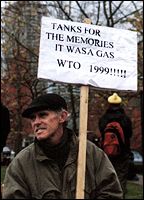
Image: Silja Talvi

Get your news from a source that’s not owned and controlled by oligarchs. Sign up for the free Mother Jones Daily.


The Battle of Seattle was recreated in miniature on Thursday as hundreds of demonstrators took to the streets to commemorate last year’s massive anti-WTO protests — and police hauled dozens of them off to jail.

Early in the day, an estimated 2,000 activists — including sea turtle-costumed environmentalists, sign-waving students, and a dozen topless Lesbian Avengers — marched peacefully through downtown. Seattle police, who last year worked the streets in full body armor, flashed a friendlier face this time, wearing regular uniforms and name tags despite the vandalization of nine Starbucks outlets the previous day and e-mailed death threats received at City Hall.

Seattle’s new police chief, Gil Kerlikowske, made a point of chatting up protesters and even provided a motorcycle escort for a cardboard anniversary cake dedicated to Mayor Paul Schell for “helping Seattle expose the WTO to the world.”

But tensions flared as evening approached, when riot gear-clad police attempted to force the dancing and singing activists off the streets near Fourth Avenue and Pine Street — ground zero of last year’s chaos. After negotiations, most protesters moved on to either a candlelight vigil or to a celebration-cum-public discussion at the Labor Temple.

A small group, however, soon returned, blocking a major intersection and reportedly throwing rocks and bottles at police. After three warnings, police moved in with pepper spray. Some 140 people were arrested, including an Associated Press photographer and a few people who said they were just innocent bystanders.

“Peaceful free speech is something we encourage in Seattle, but freedom of speech is not a grant to break the law,” said Dick Lilly, spokesman for Mayor Schell. “It’s fair to say that since Seattle, LA, Philadelphia, DC, and Prague, an element of the anti-globalization … groups is fairly deliberate in [its] attempts to provoke local government into police action in order to buy sympathy for their cause.”

Still, it was small-scale stuff compared to last Nov. 30, when Seattle’s streets erupted into chaos as police broke up clumps of protesters with tear gas and rubber bullets, and agitators smashed windows and defaced some downtown stores. Full-scale protests and mass arrests, abetted by the National Guard, continued for days, culminating in 600 arrests and an estimated $3 million in property damage.
~ ~

Since then, the Seattle police and Mayor Schell have had to defend themselves against a flurry of reports and investigations denouncing their response to the protests as excessively heavy-handed. A commission appointed by the Seattle City Council released a report in September which found that many demonstrators were not given adequate warning regarding the use of chemical irritants and other forceful methods, and that large-scale arrests — not chemical irritants — should have been the first tactic tried in response to “unlawful assemblies.” Amnesty International has also raised concerns about human rights violations of protesters in custody, while the American Civil Liberties Union issued a 95-page report blasting the city and the SPD for grossly mishandling WTO-related protests and violating demonstrators’ civil liberties.

(The SPD’s own assessment of its conduct admits some mistakes, but defends its use of chemical agents.)

More than 60 damage claims and lawsuits have been filed against the city, including a federal class-action case filed by Trial Lawyers for Public Justice in October. The suit charges that the city’s creation of a “no-protest zone” during the WTO conference constituted a violation of the First Amendment.

Yesterday, protesters converged at noontime, en masse, at the City Clerk’s office to file claims against the city for injuries and constitutional violations suffered during last year’s demonstrations.

“We’re asking for our city to make changes in the way that they respond to us when we speak out,” said Erica Kay, the group’s spokesperson.

From the desk of Mother Jones CEO, Monika Bauerlein...

Newsrooms can be funded in many ways. One of the most controversial (and volatile) ways is by a for-profit corporation or a billionaire owner. We see it across the headlines on a weekly basis: the claw backs in public media, the gutting of The Washington Post, the bending over backwards to appeal to Trump and his allies.

But not here.

When Mother Jones first started publishing 50 years ago, our founders made a critical decision: to be a reader-supported nonprofit. They knew that no corporate owner would be interested in a muckraking newsroom; they also knew that no muckraking newsroom would be interested in following the agenda of a corporate owner.

And so, we’ve been reader-funded for half a century. We rely on contributions from our readers—readers like you—whether it’s $50, or $15 a month, or whatever fits your budget. People give what they can, and every donation makes a difference for our newsroom, which has grown tremendously—in size and reach and renown—since its inception in 1976.

You may be wondering: What does it take to publish an investigation? And what does my donation actually fund? The answers are one and the same: It takes people, resources, and time. And that’s what your donation funds directly.

Every donation Mother Jones receives from readers fortifies our newsroom, whether we’re covering underreported scandals out of Washington, DC, or the most important news of the day. And right now, each donation will be doubled because of our $50,000 match. So when you make a donation—$5, $50, any amount—it’ll go twice as far.

Your support keeps us going. If you’re able, donate today.

Thanks for reading.

—Monika

From the desk of Mother Jones CEO, Monika Bauerlein...

Newsrooms can be funded in many ways. One of the most controversial (and volatile) ways is by a for-profit corporation or a billionaire owner. We see it across the headlines on a weekly basis: the claw backs in public media, the gutting of The Washington Post, the bending over backwards to appeal to Trump and his allies.

But not here.

When Mother Jones first started publishing 50 years ago, our founders made a critical decision: to be a reader-supported nonprofit. They knew that no corporate owner would be interested in a muckraking newsroom; they also knew that no muckraking newsroom would be interested in following the agenda of a corporate owner.

And so, we’ve been reader-funded for half a century. We rely on contributions from our readers—readers like you—whether it’s $50, or $15 a month, or whatever fits your budget. People give what they can, and every donation makes a difference for our newsroom, which has grown tremendously—in size and reach and renown—since its inception in 1976.

You may be wondering: What does it take to publish an investigation? And what does my donation actually fund? The answers are one and the same: It takes people, resources, and time. And that’s what your donation funds directly.

Every donation Mother Jones receives from readers fortifies our newsroom, whether we’re covering underreported scandals out of Washington, DC, or the most important news of the day. And right now, each donation will be doubled because of our $50,000 match. So when you make a donation—$5, $50, any amount—it’ll go twice as far.

Your support keeps us going. If you’re able, donate today.

Thanks for reading.

—Monika

We Recommend

Latest

Sign up for our free newsletter

Subscribe to the Mother Jones Daily to have our top stories delivered directly to your inbox.

Get our award-winning magazine

Save big on a full year of investigations, ideas, and insights.

Subscribe

INDEPENDENT. BECAUSE OF YOU.

Mother Jones has no billionaires calling the shots—just readers like you making fearless reporting possible

Donate