“It’s a big vote for small cetaceans.”

Get your news from a source that’s not owned and controlled by oligarchs. Sign up for the free Mother Jones Daily.


dolphin.gif

Welcome news for dolphins, porpoises, and all who wish them well: Japan today lost a vote to have the so-called “small cetaceans” (mini-whales) removed from the protective purview of the International Whaling Commission, which just began a five-day meeting in St. Kitts in the Caribbean.

If you haven’t been following this closely, Japan is pushing hard to persuade members of the 70-country IWC–whose remit is essentially to conserve whale populations–to agree to ending a 20-year old moratorium on commercial whaling. The 2/3 majority the Japanese need to overturn the ban outright seems beyond their reach for now, but there are plenty of proposals coming up for a vote short of full repeal that will loosen restrictions on whale hunting. The small-cetacean measure was one of these–another would ban groups like Greenpeace from snooping around whaling vessels–and the fact that Japan’s push failed suggests it lacks the strength to win on the others. (This despite Japan’s allegedly having bought the support of other countries with foreign aid.)

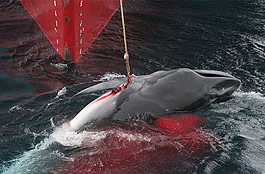
Three countries have kept on hunting whales despite the 1986 moratorium: Norway, which has ignored the ban entirely; Japan and Iceland, which have exploited a loophole that permits whaling for purposes of “scientific research.” (See photo below.)
harpoon_265x174.jpg

Why is Japan so hot to overturn the ban? Not clear. Whale meat from the “scientific” hunts is sold commercially and, thanks to the Japanese government, is a staple in school lunches; fact is, though, Japanese people don’t much care for whale meat, and the industry subsists in large part on government subsidies. Puzzled outsiders apparently put Japan’s whaling jihad down to “a small caucus of politicians who have turned the issue into one of ‘culinary imperialism,’ in which Japan is defiantly asserting that it will not be told what to eat, any more than Australians should be told not to eat kangaroo.” (LAT)

For more on whale-, dolphin-, and ocean-related developments, see Mother Jones’ recent special report on the state of our oceans, which includes this article on Japanese scientific whaling and this interview with filmmaker Hardy Jones, aka the “Dolphin Defender.” For up-to-the-minute coverage of the IWC meeting, see Greenpeace’s “Ocean Defender” blog. And to find out what you can do to protect our oceans and the critters and plants that live in them check out “Ocean Voyager“, Mother Jones‘ interactive online journey (video! photos! ocean sounds!) to defend our seas.


From the desk of Mother Jones CEO, Monika Bauerlein...

Newsrooms can be funded in many ways. One of the most controversial (and volatile) ways is by a for-profit corporation or a billionaire owner. We see it across the headlines on a weekly basis: the claw backs in public media, the gutting of The Washington Post, the bending over backwards to appeal to Trump and his allies.

But not here.

When Mother Jones first started publishing 50 years ago, our founders made a critical decision: to be a reader-supported nonprofit. They knew that no corporate owner would be interested in a muckraking newsroom; they also knew that no muckraking newsroom would be interested in following the agenda of a corporate owner.

And so, we’ve been reader-funded for half a century. We rely on contributions from our readers—readers like you—whether it’s $50, or $15 a month, or whatever fits your budget. People give what they can, and every donation makes a difference for our newsroom, which has grown tremendously—in size and reach and renown—since its inception in 1976.

You may be wondering: What does it take to publish an investigation? And what does my donation actually fund? The answers are one and the same: It takes people, resources, and time. And that’s what your donation funds directly.

Every donation Mother Jones receives from readers fortifies our newsroom, whether we’re covering underreported scandals out of Washington, DC, or the most important news of the day. And right now, each donation will be doubled because of our $50,000 match. So when you make a donation—$5, $50, any amount—it’ll go twice as far.

Your support keeps us going. If you’re able, donate today.

Thanks for reading.

—Monika

From the desk of Mother Jones CEO, Monika Bauerlein...

Newsrooms can be funded in many ways. One of the most controversial (and volatile) ways is by a for-profit corporation or a billionaire owner. We see it across the headlines on a weekly basis: the claw backs in public media, the gutting of The Washington Post, the bending over backwards to appeal to Trump and his allies.

But not here.

When Mother Jones first started publishing 50 years ago, our founders made a critical decision: to be a reader-supported nonprofit. They knew that no corporate owner would be interested in a muckraking newsroom; they also knew that no muckraking newsroom would be interested in following the agenda of a corporate owner.

And so, we’ve been reader-funded for half a century. We rely on contributions from our readers—readers like you—whether it’s $50, or $15 a month, or whatever fits your budget. People give what they can, and every donation makes a difference for our newsroom, which has grown tremendously—in size and reach and renown—since its inception in 1976.

You may be wondering: What does it take to publish an investigation? And what does my donation actually fund? The answers are one and the same: It takes people, resources, and time. And that’s what your donation funds directly.

Every donation Mother Jones receives from readers fortifies our newsroom, whether we’re covering underreported scandals out of Washington, DC, or the most important news of the day. And right now, each donation will be doubled because of our $50,000 match. So when you make a donation—$5, $50, any amount—it’ll go twice as far.

Your support keeps us going. If you’re able, donate today.

Thanks for reading.

—Monika

We Recommend

Latest

Sign up for our free newsletter

Subscribe to the Mother Jones Daily to have our top stories delivered directly to your inbox.

Get our award-winning magazine

Save big on a full year of investigations, ideas, and insights.

Subscribe

INDEPENDENT. BECAUSE OF YOU.

Mother Jones has no billionaires calling the shots—just readers like you making fearless reporting possible

Donate