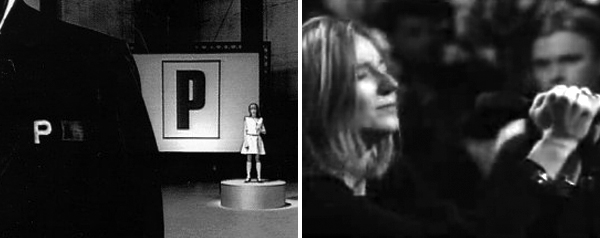
Neato Viddys on the Intertubes: Portishead

Get your news from a source that’s not owned and controlled by oligarchs. Sign up for the free Mother Jones Daily.


mojo-photo-portishead.jpg

Yesterday, news emerged that legendary (and legendarily unreliable) Bristol combo Portishead were “one day” from finishing their long-awaited third album. Could it be true? With the ‘head, one hesitates to get one’s hopes up, but just in case, perhaps this is a good time to familiarize ourselves with the band’s previous work, or remind you why you care.

While Portishead share a hometown with other so-called “trip-hop” artists Tricky and Massive Attack, their music has always been less “trippy” and technological than jazzy and, well, bleak. In a typically artsy move, the band’s first release was actually a short film, “To Kill a Dead Man,” a work that makes explicit the band’s fascination with the dark world of spies and assasins, accompanied by a soundtrack that’s both experimental and oddly retro.

Portishead – “To Kill a Dead Man” (1994)

The band’s first album, Dummy, spawned an unlikely mini-hit: “Sour Times,” a song whose lack of appearance in a James Bond film is downright criminal, although the dulcimer sound is, tellingly, sampled from the Mission: Impossible TV series.

Portishead – “Sour Times” (from Dummy, 1994)

Tellingly, “Sour Times” couldn’t even break the U.K. Top 40 until its second release: the band were too weird even for England. It took “Glory Box” to pave the way, a chilly number that echoed the cabaret era, but its mellow hip-hop beat and vinyl scratching at least gave listeners a contemporary entry point.

Portishead – “Glory Box” (live on “Nulle Part Ailleurs,” 1994)

As you can tell from that video, the band were unique among their contemporaries in the fact that they were even better live than on record. Their musicianship bordered on the obsessive: the band once described in an interview that the vinyl records the DJ was scratching with were in fact melodies composed by the band which they recorded, pressed to acetates, and then used in the performances. Psycho.

Their self-titled 1997 album both intensified and expanded upon the band’s sound, somehow becoming even more harrowing and hypnotic. Check out the Chris Cunningham-directed video for “Only You,” whose eye-popping effects were filmed underwater:

Portishead – “Only You” (from Portishead, 1997)

Eek. After another tour, excitement about the band’s live performances reached a fever pitch, culminating in the release of a live album, Roseland NYC, recorded mostly in New York, although “Sour Times” was recorded at the Warfield here in San Francisco, and if you listen closely, you can hear my jaw scraping the floor. There’s no video of that performance that I could find, but the Roseland show was put out on DVD, and the footage is awe-inspiring, showcasing the talents of each band member, with the frail-looking Beth Gibbons standing in the center, isolated.

Portishead – “Strangers” (from Roseland NYC, 1998)

After ten years, it’s hard to say what the band might have in store for us now, but no matter what, they can have my $10. And if you get wind of a tour, buy tickets even if you have to cancel a wedding or open-heart surgery.


From the desk of Mother Jones CEO, Monika Bauerlein...

Newsrooms can be funded in many ways. One of the most controversial (and volatile) ways is by a for-profit corporation or a billionaire owner. We see it across the headlines on a weekly basis: the claw backs in public media, the gutting of The Washington Post, the bending over backwards to appeal to Trump and his allies.

But not here.

When Mother Jones first started publishing 50 years ago, our founders made a critical decision: to be a reader-supported nonprofit. They knew that no corporate owner would be interested in a muckraking newsroom; they also knew that no muckraking newsroom would be interested in following the agenda of a corporate owner.

And so, we’ve been reader-funded for half a century. We rely on contributions from our readers—readers like you—whether it’s $50, or $15 a month, or whatever fits your budget. People give what they can, and every donation makes a difference for our newsroom, which has grown tremendously—in size and reach and renown—since its inception in 1976.

You may be wondering: What does it take to publish an investigation? And what does my donation actually fund? The answers are one and the same: It takes people, resources, and time. And that’s what your donation funds directly.

Every donation Mother Jones receives from readers fortifies our newsroom, whether we’re covering underreported scandals out of Washington, DC, or the most important news of the day. And right now, each donation will be doubled because of our $50,000 match. So when you make a donation—$5, $50, any amount—it’ll go twice as far.

Your support keeps us going. If you’re able, donate today.

Thanks for reading.

—Monika

From the desk of Mother Jones CEO, Monika Bauerlein...

Newsrooms can be funded in many ways. One of the most controversial (and volatile) ways is by a for-profit corporation or a billionaire owner. We see it across the headlines on a weekly basis: the claw backs in public media, the gutting of The Washington Post, the bending over backwards to appeal to Trump and his allies.

But not here.

When Mother Jones first started publishing 50 years ago, our founders made a critical decision: to be a reader-supported nonprofit. They knew that no corporate owner would be interested in a muckraking newsroom; they also knew that no muckraking newsroom would be interested in following the agenda of a corporate owner.

And so, we’ve been reader-funded for half a century. We rely on contributions from our readers—readers like you—whether it’s $50, or $15 a month, or whatever fits your budget. People give what they can, and every donation makes a difference for our newsroom, which has grown tremendously—in size and reach and renown—since its inception in 1976.

You may be wondering: What does it take to publish an investigation? And what does my donation actually fund? The answers are one and the same: It takes people, resources, and time. And that’s what your donation funds directly.

Every donation Mother Jones receives from readers fortifies our newsroom, whether we’re covering underreported scandals out of Washington, DC, or the most important news of the day. And right now, each donation will be doubled because of our $50,000 match. So when you make a donation—$5, $50, any amount—it’ll go twice as far.

Your support keeps us going. If you’re able, donate today.

Thanks for reading.

—Monika

We Recommend

Latest

Sign up for our free newsletter

Subscribe to the Mother Jones Daily to have our top stories delivered directly to your inbox.

Get our award-winning magazine

Save big on a full year of investigations, ideas, and insights.

Subscribe

INDEPENDENT. BECAUSE OF YOU.

Mother Jones has no billionaires calling the shots—just readers like you making fearless reporting possible

Donate