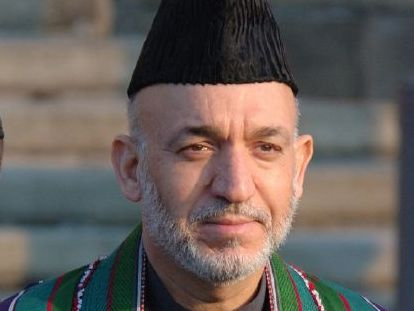
Karzai’s Survival Instinct

Get your news from a source that’s not owned and controlled by oligarchs. Sign up for the free Mother Jones Daily.


What’s up with Hamid Karzai? That’s the question on the minds of Afghan watchers in and outside of government following the resignations of two top officials who were respectively responsible for the country’s intelligence service and internal security apparatus. As I describe in my piece on this topic today, they weren’t just any bureaucrats. They were widely viewed as two of the most solid administrators in the Afghan government. Highly trusted, they had developed a strong rapport with US and NATO officials who are now understandably alarmed by their departures.

Officially, the cause for the resignations of Interior Minister Hanif Atmar and intelligence chief Amrullah Saleh was the failure of their agencies, and the collective security forces and operatives under their command, to prevent an attack targeting Karzai’s highly publicized peace jirga. Beyond two of the militants involved in the assault, who were killed by Afghan forces, there were no other casualties. As Karzai’s office has portrayed it, removing Atmar and Saleh was a matter of accountability (“Someone had to take responsibility for this,” Karzai’s spokesman, Waheed Omar, said.) But in a government where corruption and cronyism are rampant, you’d think Karzai could think of better people to make examples of. Karzai’s office insists that that attack was the sole reason why Atmar and Saleh resigned. But there were other issues at play. Among other things, both officials reportedly had disagreements with Karzai over his strategy for political reconciliation with the Taliban.

In today’s New York Times, Alissa Rubin has an interesting (and troubling) look at the psychology behind Karzai’s latest move—a move that certainly seems to run contrary to his goal of forging a strong central government:

To some, the forced departure of the two men is a troubling indication of the president’s mounting insecurity and his fear that even those closest to him are not looking out for him.

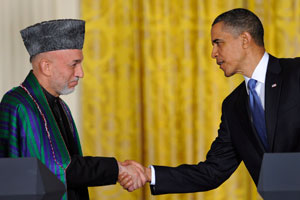
Compounding those fears is Mr. Karzai’s lack of faith in the Americans and his uncertainty about whether they will back him over the long term. That impression has been reinforced by President Obama’s pledge to start withdrawing troops in July 2011 and his administration’s arm’s-length relationship with President Karzai.

“The root of this is the perception that President Karzai got last year from the kind of cold reception that he got from the American administration, and that made him feel insecure,” said Ahmed Ali Jalali, who was Afghanistan’s interior minister from 2003 to 2005. He now teaches at the National Defense University in Washington.

The insecurity has left Mr. Karzai alternately lashing out in anger and searching for new allies, turning to Iran and elements within the Taliban. Both are antagonistic to American interests.

“He is trying to create new networks, new allies and contacts both inside the country and outside the country in case there’s a premature withdrawal, so a lot of this is more of a survival gesture,” Mr. Jalali said.

The bottom line, according Rubin’s piece, is that Karzai’s survival instinct has taken over. One question is how far he’s willing to go to ensure his own political survival. Another is the degree to which the Obama administration’s initial tough love approach to the Afghan president may have compounded an already difficult situation. 
From the desk of Mother Jones CEO, Monika Bauerlein...

Newsrooms can be funded in many ways. One of the most controversial (and volatile) ways is by a for-profit corporation or a billionaire owner. We see it across the headlines on a weekly basis: the claw backs in public media, the gutting of The Washington Post, the bending over backwards to appeal to Trump and his allies.

But not here.

When Mother Jones first started publishing 50 years ago, our founders made a critical decision: to be a reader-supported nonprofit. They knew that no corporate owner would be interested in a muckraking newsroom; they also knew that no muckraking newsroom would be interested in following the agenda of a corporate owner.

And so, we’ve been reader-funded for half a century. We rely on contributions from our readers—readers like you—whether it’s $50, or $15 a month, or whatever fits your budget. People give what they can, and every donation makes a difference for our newsroom, which has grown tremendously—in size and reach and renown—since its inception in 1976.

You may be wondering: What does it take to publish an investigation? And what does my donation actually fund? The answers are one and the same: It takes people, resources, and time. And that’s what your donation funds directly.

Every donation Mother Jones receives from readers fortifies our newsroom, whether we’re covering underreported scandals out of Washington, DC, or the most important news of the day. And right now, each donation will be doubled because of our $50,000 match. So when you make a donation—$5, $50, any amount—it’ll go twice as far.

Your support keeps us going. If you’re able, donate today.

Thanks for reading.

—Monika

From the desk of Mother Jones CEO, Monika Bauerlein...

Newsrooms can be funded in many ways. One of the most controversial (and volatile) ways is by a for-profit corporation or a billionaire owner. We see it across the headlines on a weekly basis: the claw backs in public media, the gutting of The Washington Post, the bending over backwards to appeal to Trump and his allies.

But not here.

When Mother Jones first started publishing 50 years ago, our founders made a critical decision: to be a reader-supported nonprofit. They knew that no corporate owner would be interested in a muckraking newsroom; they also knew that no muckraking newsroom would be interested in following the agenda of a corporate owner.

And so, we’ve been reader-funded for half a century. We rely on contributions from our readers—readers like you—whether it’s $50, or $15 a month, or whatever fits your budget. People give what they can, and every donation makes a difference for our newsroom, which has grown tremendously—in size and reach and renown—since its inception in 1976.

You may be wondering: What does it take to publish an investigation? And what does my donation actually fund? The answers are one and the same: It takes people, resources, and time. And that’s what your donation funds directly.

Every donation Mother Jones receives from readers fortifies our newsroom, whether we’re covering underreported scandals out of Washington, DC, or the most important news of the day. And right now, each donation will be doubled because of our $50,000 match. So when you make a donation—$5, $50, any amount—it’ll go twice as far.

Your support keeps us going. If you’re able, donate today.

Thanks for reading.

—Monika

We Recommend

Latest

Sign up for our free newsletter

Subscribe to the Mother Jones Daily to have our top stories delivered directly to your inbox.

Get our award-winning magazine

Save big on a full year of investigations, ideas, and insights.

Subscribe

INDEPENDENT. BECAUSE OF YOU.

Mother Jones has no billionaires calling the shots—just readers like you making fearless reporting possible

Donate