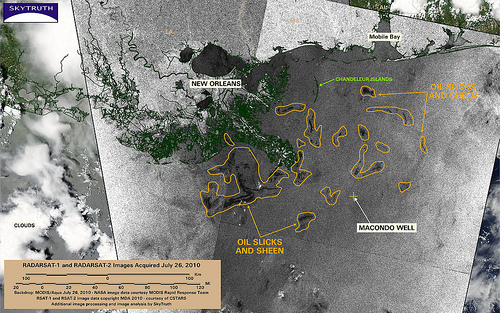
By now you’ve probably seen the headlines on a forthcoming government report that finds that three-quarters of the oil from the 4.9 million barrel Gulf spill has “evaporated, dispersed, been captured or otherwise eliminated.” The remaining oil, the government report says, is diluted and poses little threat. From the New York Times piece:
A government report finds that about 26 percent of the oil released from BP’s runaway well is still in the water or onshore in a form that could, in principle, cause new problems. But most is light sheen at the ocean surface or in a dispersed form below the surface, and federal scientists believe that it is breaking down rapidly in both places.
A few things to note. Most importantly, just because the oil has dispersed doesn’t mean it disappeared. It’s now spread under the water, thanks to the at least 1.8 million gallons of chemical dispersants used on the spill. This is what the dispersants were designed to do in the first place. But fact that the has dispersed doesn’t mean it poses no problems. While the headline and lead of the Times piece are rather rosy, Jane Lubchenco, head of the National Oceanic and Atmospheric Administration, which lead the work on this new report, noted that there are still many unanswered questions. Indeed, the unprecedented use of dispersants still leaves much to be studied. “I think we don’t know yet the full impact of this spill on the ecosystem or the people of the gulf,” said Lubchenco. The piece continues:
Among the biggest unanswered questions, she said, is how much damage the oil has done to the eggs and larvae of organisms like fish, crabs and shrimp. That may not become clear for a year or longer, as new generations of those creatures come to maturity.
Meanwhile, some researchers are finding evidence that oil and dispersants are making their way into the food chain, despite assurances from the Environmental Protection Agency earlier this week that they are not.
There was at least some good news on the dispersants this week, as the EPA announced that its own studies concluded that the oil-dispersant mix is not any more toxic than the oil alone. But as Richard Denison, senior scientist at the Environmental Defense Fund, points out, there’s still bad news:
So the good news is that the dispersant doesn’t appear to be increasing the acute aquatic toxicity of the oil released into the Gulf. The bad news is that the oil is pretty toxic, and the dispersant certainly doesn’t help directly with that. And of course, the bigger questions about longer-term effects of dispersants and dispersed oil are not addressed by the new data.
Yes, the dispersed oil is still toxic, and it’s still there, under the water, even if we can’t see it.