Drawn Together: Can Math Nerds Beat Gerrymandering?

How to spot a gerrymandered congressional district.

Illinois map: National Atlas, Texas map: Center for Range Voting

Get your news from a source that’s not owned and controlled by oligarchs. Sign up for the free Mother Jones Daily.


Read also: Can one Democrat hell-bent on revenge reverse Tom DeLay’s redistricting power grab?

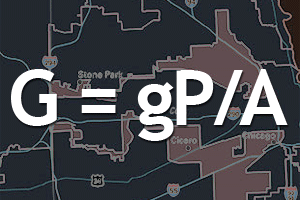
The art of drawing congressional districts to benefit one party or another goes back to the earliest days of the republic. Detailed census and election data have made it even easier to construct electorates with an all-but-guaranteed political leaning. You can usually spot a gerrymandered district by its wacky boundaries. Or you can use this formula (PDF), developed by John Mackenzie, a professor of resource economics and geographic information systems at the University of Delaware:
Map


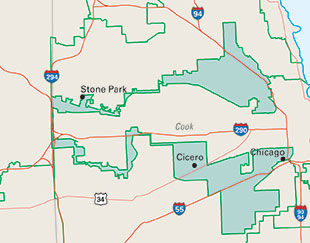
Mackenzie’s formula gives lower gerrymandering scores to districts with a low perimeter-to-area ratio (like the entire state of Wyoming). Higher scores go to irregularly shaped districts, like Illinois’ pincer-like 4th district (above).

The formula doesn’t take into account how a district got its odd contours. Take North Carolina’s 12th, which has the country’s third-highest gerrymandering score. Drawn as a majority-black district in 1992, the snaking “I-85 district” used to be barely wider than the interstate in some places. After being found unconstitutional by the Supreme Court, it was redrawn Texas in 1997 with a slight white plurality. But it’s kept its meandering shape, and its representative—Rep. Mel Watt, a black Democrat.
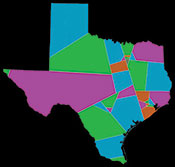
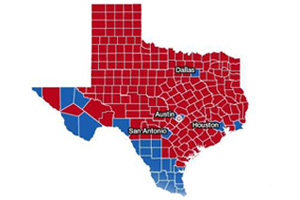
So what might an ungerrymandered nation look like? Mathematician Warren D. Smith, cofounder of RangeVoting.org, has used an algorithm to redraw every state’s districts in a geometrically precise manner that ignores party lines (left). Would his solution shake up the partisan or racial composition of Congress? Who knows. But it sure would look pretty.

YOUR GIFT DOUBLES THROUGH FRIDAY

Right now, every dollar you give goes twice as far—but only until Friday’s midnight deadline. This is the moment to make your support count double.

In a climate where journalists face mounting pressure to back down, stay silent, or soften their reporting, Mother Jones refuses to flinch. We’re pushing back against intimidation and delivering fierce, independent journalism that holds power accountable—no matter who’s trying to silence us.

But here’s the reality: We’re a nonprofit newsroom with zero corporate backing and no financial cushion. We depend entirely on readers like you to fund the investigations that matter most.

Friday’s 2X match deadline is coming soon. We need you on the team right now. Please chip in and double your impact.

YOUR GIFT DOUBLES THROUGH FRIDAY

Right now, every dollar you give goes twice as far—but only until Friday’s midnight deadline. This is the moment to make your support count double.

In a climate where journalists face mounting pressure to back down, stay silent, or soften their reporting, Mother Jones refuses to flinch. We’re pushing back against intimidation and delivering fierce, independent journalism that holds power accountable—no matter who’s trying to silence us.

But here’s the reality: We’re a nonprofit newsroom with zero corporate backing and no financial cushion. We depend entirely on readers like you to fund the investigations that matter most.

Friday’s 2X match deadline is coming soon. We need you on the team right now. Please chip in and double your impact.

We Recommend

Latest

Sign up for our free newsletter

Subscribe to the Mother Jones Daily to have our top stories delivered directly to your inbox.

Get our award-winning magazine

Save big on a full year of investigations, ideas, and insights.

Subscribe

Support our journalism

Help Mother Jones' reporters dig deep with a tax-deductible donation.

Donate