Big Changes in North Atlantic Currents

Get your news from a source that’s not owned and controlled by oligarchs. Sign up for the free Mother Jones Daily.


There’s an important paper in early view in PNAS describing profound changes in the dominant currents of the North Atlantic since the 1970s. What’s intriguing here—apart from the findings—is the method of determining these changes.

The authors used new technology to parse the story of ocean circulation from the story of ocean productivity using the skeletons of deepwater gorgonian corals. Specifically, they employed a process of amino acid analysis of nitrogen stable isotopes (δ15N-AA), as recorded in the growth rings of corals living between Newfoundland and Maine.

The technique promises to be a kind of Rosetta Stone for deciphering the ecological and physical history of the oceans.
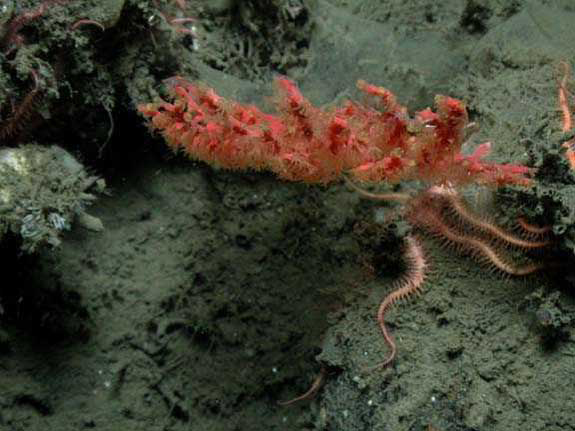
A deep-water gorgonian coral. Image courtesy of Sanctuary Quest 2002, NOAA/OER.A deep-water gorgonian coral. Image courtesy of Sanctuary Quest 2002, NOAA/OER.

The results reveal a sharply declining influence of the Labrador Current (colder, less saline, and nutrient-poor) in favor of Gulf Stream waters (warmer, saltier, nutrient-rich) since the 1970s, compared to the previous 1,800 years. Image courtesy PNAS.Image courtesy PNAS.
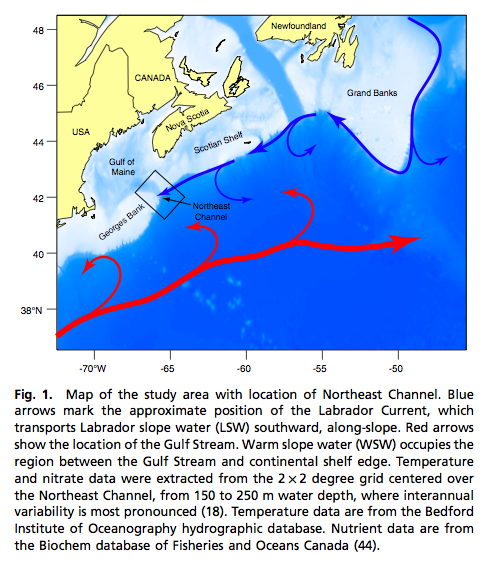
The interplay between the Labrador Current and the Gulf Stream is a crucial component of the North Atlantic Oscillation, one of the major climate drivers for North America and Europe.

We therefore conclude that changes in nitrate source partitioning may be tied to recent, human-caused changes in global climate. These results highlight the importance of novel and creative proxies like δ15 N-AA for investigating the links between climate change and ecosystem functioning beyond the last few decades of scientific observations.

The paper:

  • Owen A. Sherwood, Moritz F. Lehmann, Carsten J. Schubert, David B. Scott, and Matthew D. McCarthy. Nutrient regime shift in the western North Atlantic indicated by compound-specific δ15N of deep-sea gorgonian coral. PNAS. January 3, 2011. DOI: 

What’s independent journalism worth to you?

Our news will always be free to read, watch, and listen to online. But what is its value?

Unbiased reporting on the issues that billionaire-owned newsrooms won’t touch. Fearless research into the dark corners of government and corporations. Ferociously fact-checked news that focuses on the facts, and the facts alone.

It IS free for you and every reader, viewer, and listener to utilize. But it’s not free for our team to make. So, what’s it worth to you? Let us know by making a donation: Make a one-time donation today to support this work. Or make a monthly sustaining donation to help us plan for the future.

Whatever you choose, know that you’re supporting more independent, investigative journalism in a time when we need it most.

What’s independent journalism worth to you?

Our news will always be free to read, watch, and listen to online. But what is its value?

Unbiased reporting on the issues that billionaire-owned newsrooms won’t touch. Fearless research into the dark corners of government and corporations. Ferociously fact-checked news that focuses on the facts, and the facts alone.

It IS free for you and every reader, viewer, and listener to utilize. But it’s not free for our team to make. So, what’s it worth to you? Let us know by making a donation: Make a one-time donation today to support this work. Or make a monthly sustaining donation to help us plan for the future.

Whatever you choose, know that you’re supporting more independent, investigative journalism in a time when we need it most.

We Recommend

Latest

Sign up for our free newsletter

Subscribe to the Mother Jones Daily to have our top stories delivered directly to your inbox.

Get our award-winning magazine

Save big on a full year of investigations, ideas, and insights.

Subscribe

INDEPENDENT. BECAUSE OF YOU.

Mother Jones has no billionaires calling the shots—just readers like you making fearless reporting possible

Donate