Fight disinformation: Sign up for the free Mother Jones Daily newsletter and follow the news that matters.
 Photo by Fir0002, courtesy Wikimedia Commons.
Community-based cooperative management—wherein fishers, fisheries managers, and scientists work together to create sustainable fisheries—yields big catches. Now the authors of a new paper in Nature present their findings on what elements of co-management are most effective. They write:
The dominant theme in fisheries management has been that privatization is necessary to avoid Hardin’s tragedy of the commons, whereas Ostrom and others have argued that community-based co-management can often achieve sustainability.
In other words, how does that age-old divide in human thinking (capitalism v. socialism, by one set of labels) play out in the arena of the ocean?
 Photo by Diliff, courtesy Wikimedia Commons.
 The advantages of co-management, according to the authors:
- An enhanced sense of ownership that encourages responsible fishing
- Greater sensitivity to local socioeconomic and ecological restraints
- Improved management through use of local knowledge
- Collective ownership by users in decision making
- Increased compliance with regulations through peer pressure
- Better monitoring, control and surveillance by fishers
 Photo by Petr Ruzicka, courtesy Wikimedia Commons
In light of stark realities—1 billion people depend on seafood for protein, yet a third of fish stocks are depleted—the researchers asked: Exactly what part of co-management works to save fisheries? Here’s what they did to find answers:
- Identified 130 co-managed fisheries in 144 countries with a wide range of economic development, ecosystems, fishing sectors, and type of resources
- Conducted a systematic search of the peer-reviewed and grey literature (~1,168 documents) for evidence of the impacts of fisheries co-management practices
- Identified and evaluated the relative merits of 19 different co-management attributes across fisheries
- Used those 19 attributes to predict three kinds of success: ecological (increase in stock abundance); social (increase in social welfare); and economic (increase in unit price)
- Combined those predictors to reach a single holistic success score reflecting natural and human dimensions of fisheries
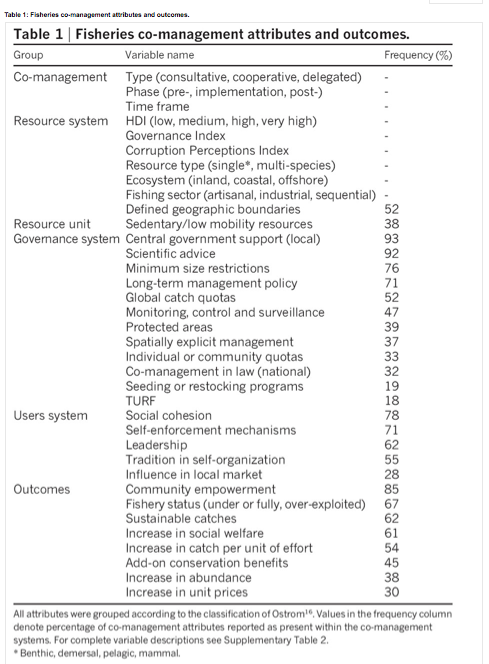 From Nature DOI: 10.1038/nature09689
All that enabled them to zero in on the aspects of community management that work best. Their findings:
- Strong leadership is the single most important predictor of success
- Next comes individual or community quotas, social cohesion, and protected areas
- Less important conditions include enforcement mechanisms, long-term management policies, and life history of the resources
- Fisheries are most successful when at least 8 co-management attributes are present, with a strong positive relationship seen between the number of attributes and success (i.e., redundancy in the system is good)

The authors write:
Our results demonstrate the critical importance of prominent community leaders and robust social capital, combined with clear incentives through catch shares and conservation benefits derived from protected areas, for successfully managing aquatic resources and securing the livelihoods of communities depending on them.
The paper:
- Nicolás L. Gutiérrez, Ray Hilborn, and Omar Defeo. Leadership, social capital and incentives promote successful fisheries. Nature (2011) DOI: 10.1038/nature09689
Crossposted from Deep Blue Home.