Up Close and Personal with the Korowai

Get your news from a source that’s not owned and controlled by oligarchs. Sign up for the free Mother Jones Daily.


This post courtesy BBC Earth. For more wildlife news, find BBC Earth on Facebook and Posterous.

When encountering persons of the same sex, you often wonder what natural similarities you may find. And it’s no different when you meet members of a remote tribe living in the dense vegetation of the jungle. BBC Earth researcher Rachael Kinley shares her intimate and humorous tale of what happened when the women of the Korowai Tribe in Papua invited her into their tree house.
 
By Rachael Kinley, Researcher, Jungles/Oceans team
Before filming begins, it’s important to spend time with the contributors without big cameras in their faces. It helps to strike up a friendly rapport and make the future weeks more productive and enjoyable for all. So, our first day in Papua with the Korowai is spent in their home, a tree house.
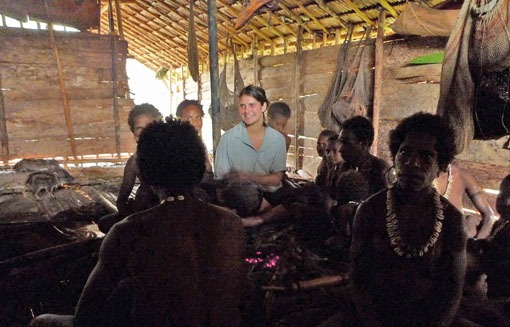
Making friends in the treehouse Korowai houses are communal and split into male and female sides, to avoid furtive touching in the evenings. So, as the rest of the crew, including the translator are men, I sit down with the women, while the crew all head outside to take in the view from the male balcony.
Friendship-forming begins inside the house. In the UK, we’d receive cups of tea and cake; here, it’s fire-charred lumps of sago palm, fresh from the flames. We start making net bags together, rolling lengths of rattan along our thighs, entwining the fibres to form a string which is then plaited together to create a bag that is strong enough to hold up to 70kg.


Whilst we are winding, I try to spark up a conversation. But with Jim, our translator, out of sight this gets to be a bit tricky. I only know one word in their language, and they know none in mine. I begin by pointing at items around us and learning the words for their shell necklaces, pet pig, and net bags. After we’ve exhausted everything on their person, the tables are turned and they start pointing and teaching me words for parts of my body: hair is “habianto” and breast, “am”. They seem to be extremely intrigued by my breasts.

A couple of children reach over and prod them. The older women giggle, encouraging the girls on. The next thing I know, they start to unbutton my shirt. The Korowai are amazed at the lifting properties of my Gossard Superboost bra. They begin to imitate its effect by cupping their own breasts in their hands with curious looks. It feels slightly surreal to be sitting, meters up in a jungle tree house, being communally undressed by several women and children. I help them to unfasten the clasp and the women stroke my breasts, smiling, giggling, repeating “am am am”.
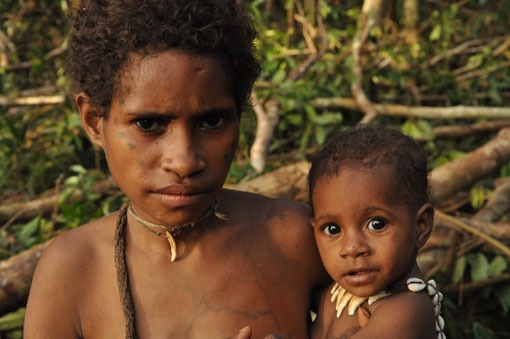
It’s lovely, it’s touching, we laugh together and are definitely bonding. But amidst all this, my mind is thinking why couldn’t this be at the end of the four weeks in the jungle when I’d definitely be much thinner? I guess that you can take your clothes off in the jungle, but it’s harder to get your head out of the UK.

 

From the desk of Mother Jones CEO, Monika Bauerlein...

Newsrooms can be funded in many ways. One of the most controversial (and volatile) ways is by a for-profit corporation or a billionaire owner. We see it across the headlines on a weekly basis: the claw backs in public media, the gutting of The Washington Post, the bending over backwards to appeal to Trump and his allies.

But not here.

When Mother Jones first started publishing 50 years ago, our founders made a critical decision: to be a reader-supported nonprofit. They knew that no corporate owner would be interested in a muckraking newsroom; they also knew that no muckraking newsroom would be interested in following the agenda of a corporate owner.

And so, we’ve been reader-funded for half a century. We rely on contributions from our readers—readers like you—whether it’s $50, or $15 a month, or whatever fits your budget. People give what they can, and every donation makes a difference for our newsroom, which has grown tremendously—in size and reach and renown—since its inception in 1976.

You may be wondering: What does it take to publish an investigation? And what does my donation actually fund? The answers are one and the same: It takes people, resources, and time. And that’s what your donation funds directly.

Every donation Mother Jones receives from readers fortifies our newsroom, whether we’re covering underreported scandals out of Washington, DC, or the most important news of the day. And right now, each donation will be doubled because of our $50,000 match. So when you make a donation—$5, $50, any amount—it’ll go twice as far.

Your support keeps us going. If you’re able, donate today.

Thanks for reading.

—Monika

From the desk of Mother Jones CEO, Monika Bauerlein...

Newsrooms can be funded in many ways. One of the most controversial (and volatile) ways is by a for-profit corporation or a billionaire owner. We see it across the headlines on a weekly basis: the claw backs in public media, the gutting of The Washington Post, the bending over backwards to appeal to Trump and his allies.

But not here.

When Mother Jones first started publishing 50 years ago, our founders made a critical decision: to be a reader-supported nonprofit. They knew that no corporate owner would be interested in a muckraking newsroom; they also knew that no muckraking newsroom would be interested in following the agenda of a corporate owner.

And so, we’ve been reader-funded for half a century. We rely on contributions from our readers—readers like you—whether it’s $50, or $15 a month, or whatever fits your budget. People give what they can, and every donation makes a difference for our newsroom, which has grown tremendously—in size and reach and renown—since its inception in 1976.

You may be wondering: What does it take to publish an investigation? And what does my donation actually fund? The answers are one and the same: It takes people, resources, and time. And that’s what your donation funds directly.

Every donation Mother Jones receives from readers fortifies our newsroom, whether we’re covering underreported scandals out of Washington, DC, or the most important news of the day. And right now, each donation will be doubled because of our $50,000 match. So when you make a donation—$5, $50, any amount—it’ll go twice as far.

Your support keeps us going. If you’re able, donate today.

Thanks for reading.

—Monika

We Recommend

Latest

Sign up for our free newsletter

Subscribe to the Mother Jones Daily to have our top stories delivered directly to your inbox.

Get our award-winning magazine

Save big on a full year of investigations, ideas, and insights.

Subscribe

INDEPENDENT. BECAUSE OF YOU.

Mother Jones has no billionaires calling the shots—just readers like you making fearless reporting possible

Donate