Map of the Day: Republicans for Austerity—in Voting

Get your news from a source that’s not owned and controlled by oligarchs. Sign up for the free Mother Jones Daily.


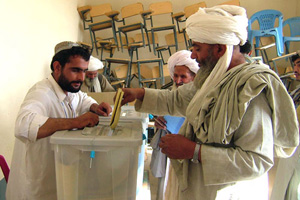
On Thursday, Senator Dick Durbin (D-Ill.) held a hearing on the rash of restrictive voter ID laws being pushed by Republicans all over the country. Voting rights activists have argued the laws will reduce turnout among minorities and the poor.

Republicans’ huge midterm victory last November translated into increased control of state legislatures, which they’ve used to pass new, more onerous restrictions on voting, sometimes explicitly for the purpose of suppressing votes from Democratic-leaning constituencies. Judith Brown Dianis of the Advancement Project called the wave of restrictions the largest effort to suppress the vote “since Reconstruction.”

The Lawyers’ Committee for Civil Rights has produced a map showing how many states are in the process of passing such laws:
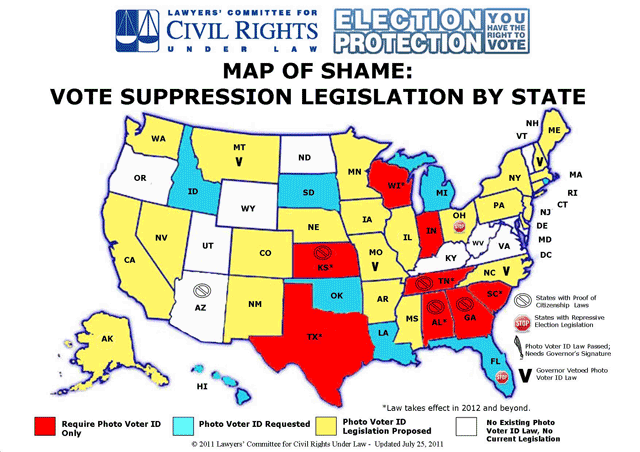
What the map doesn’t show is that five states, Florida, Georgia, Tennessee, Ohio, and West Virginia, have actually curtailed early voting as well. As Ari Berman reported, some of these ban voting on “the Sunday before the election—a day when black churches historically mobilize their constituents.”

“Americans are killed by lightning more often than they are victimized by fraud that voter ID would do something to stop,” said Justin Levitt, a professor of law at Loyola Law School. “We’ve amputated a foot to stop a potential hangnail.” The Brennan Center for Justice estimates that nearly ten percent of eligible voters lack the kind of photo ID required by these voter ID laws.

Republican defenders of voter ID laws claim that higher black turnout in Georgia during the 2006 and 2010 elections proves that voter ID laws don’t suppress the minority vote—an argument repeated by minority witness Hans von Spakovsky in his Senate testimony Thursday. But in states without such restrictions, the increase in black turnout was actually much larger. Von Spakovsky’s analyses would “fail statistics 101 at just about any college in the country,” Levitt said.

Rep. Todd Rokita (R-Ind.) tacitly acknowledged that instances of in-person voter fraud are few and far between, and prosecutions are even rarer. But, deploying the economic buzzword of the day, Rokita argued that “it’s not a matter of how many cases or convictions there are gentlemen, it’s about confidence.” Rokita suggested that more voter ID laws would increase turnout, saying that “we want to instill confidence in the process to turn up turnout.”

It’s the GOP’s economic austerity argument applied to voting: Make it harder to vote, and more people will vote. 
From the desk of Mother Jones CEO, Monika Bauerlein...

Newsrooms can be funded in many ways. One of the most controversial (and volatile) ways is by a for-profit corporation or a billionaire owner. We see it across the headlines on a weekly basis: the claw backs in public media, the gutting of The Washington Post, the bending over backwards to appeal to Trump and his allies.

But not here.

When Mother Jones first started publishing 50 years ago, our founders made a critical decision: to be a reader-supported nonprofit. They knew that no corporate owner would be interested in a muckraking newsroom; they also knew that no muckraking newsroom would be interested in following the agenda of a corporate owner.

And so, we’ve been reader-funded for half a century. We rely on contributions from our readers—readers like you—whether it’s $50, or $15 a month, or whatever fits your budget. People give what they can, and every donation makes a difference for our newsroom, which has grown tremendously—in size and reach and renown—since its inception in 1976.

You may be wondering: What does it take to publish an investigation? And what does my donation actually fund? The answers are one and the same: It takes people, resources, and time. And that’s what your donation funds directly.

Every donation Mother Jones receives from readers fortifies our newsroom, whether we’re covering underreported scandals out of Washington, DC, or the most important news of the day. And right now, each donation will be doubled because of our $50,000 match. So when you make a donation—$5, $50, any amount—it’ll go twice as far.

Your support keeps us going. If you’re able, donate today.

Thanks for reading.

—Monika

From the desk of Mother Jones CEO, Monika Bauerlein...

Newsrooms can be funded in many ways. One of the most controversial (and volatile) ways is by a for-profit corporation or a billionaire owner. We see it across the headlines on a weekly basis: the claw backs in public media, the gutting of The Washington Post, the bending over backwards to appeal to Trump and his allies.

But not here.

When Mother Jones first started publishing 50 years ago, our founders made a critical decision: to be a reader-supported nonprofit. They knew that no corporate owner would be interested in a muckraking newsroom; they also knew that no muckraking newsroom would be interested in following the agenda of a corporate owner.

And so, we’ve been reader-funded for half a century. We rely on contributions from our readers—readers like you—whether it’s $50, or $15 a month, or whatever fits your budget. People give what they can, and every donation makes a difference for our newsroom, which has grown tremendously—in size and reach and renown—since its inception in 1976.

You may be wondering: What does it take to publish an investigation? And what does my donation actually fund? The answers are one and the same: It takes people, resources, and time. And that’s what your donation funds directly.

Every donation Mother Jones receives from readers fortifies our newsroom, whether we’re covering underreported scandals out of Washington, DC, or the most important news of the day. And right now, each donation will be doubled because of our $50,000 match. So when you make a donation—$5, $50, any amount—it’ll go twice as far.

Your support keeps us going. If you’re able, donate today.

Thanks for reading.

—Monika

We Recommend

Latest

Sign up for our free newsletter

Subscribe to the Mother Jones Daily to have our top stories delivered directly to your inbox.

Get our award-winning magazine

Save big on a full year of investigations, ideas, and insights.

Subscribe

INDEPENDENT. BECAUSE OF YOU.

Mother Jones has no billionaires calling the shots—just readers like you making fearless reporting possible

Donate