Whale, Dolphin Deaths Twice Normal Rate in Gulf

Get your news from a source that’s not owned and controlled by oligarchs. Sign up for the free Mother Jones Daily.


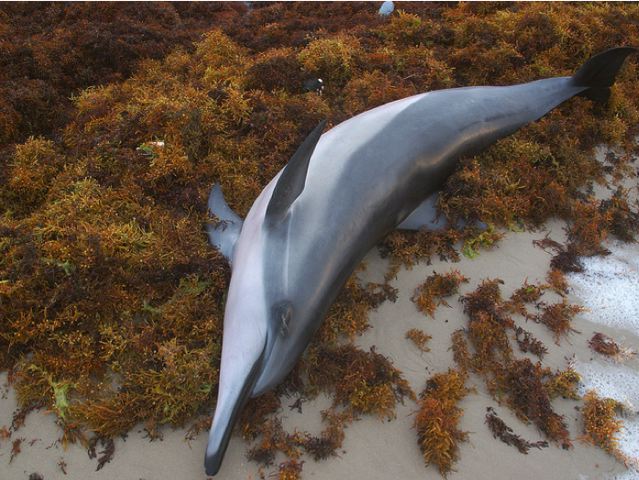
Stranded spinner dolphin.: Credit: qnr via Flickr.Stranded spinner dolphin.: Credit: qnr via Flickr. The latest NOAA report on unusual strandings of whales and dolphins in the northern Gulf of Mexico finds they’re still dying at twice the normal rate 18 months after BP’s Deepwater Horizon disaster.


Map of strandings in relation to Deepwater Horizon well.: Predicted heat index for Friday, 22 July, 2011. Credit: NOAA.Map of strandings in relation to Deepwater Horizon well Credit: NOAA.

As you can see in the map above, the most heavily oiled shoreline still corresponds with the most dead whales and dolphins. Bottlenose dolphins are shown as circles and other species as squares. Premature, stillborn, or neonatal bottlenose dolphins (with actual or estimated lengths of less than 115 cm/45 inches) are shown as a circle with a black dot inside. Pink points mark the most recent week of data. Green points mark are all other cases since January 1.
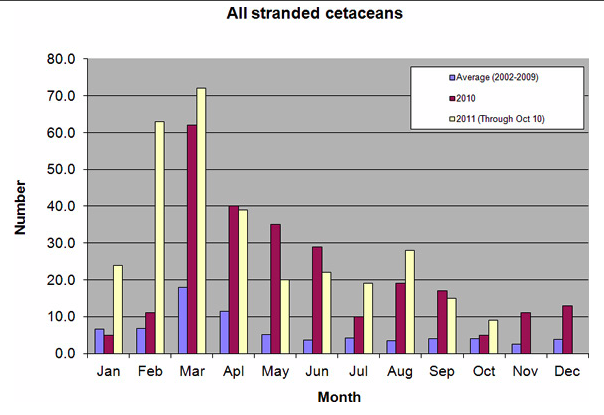
 All stranded cetaceans (dolphins and whales) from Franklin County, FL to the Texas/ Louisiana border.: Credit: NOAA.All stranded cetaceans (dolphins and whales) from Franklin County, Florida, to the Texas/Louisiana border Credit: NOAA.

Here you can see how the numbers of strandings have not yet stabilized or even begun to decline. In some cases they’re still growing. The magenta-colored bars mark strandings per month in the year 2010. The ivory-colored bars mark strandings per month so far this year.

In my Mother Jones article “The BP Cover-Up” last year, I wrote about the kind of long-term problems the Gulf might face not just from oil but from extreme quantities of oil in very deep water, as well as from chemical dispersant, including dispersant injected into very deep water.

Sadly, it seems that cetaceans—past, present, and future—may be bearing some of those burdens.

Great reporting takes time. Funding it takes less than 60 seconds.

This is the season for packed schedules and long to-do lists. For us too: Mother Jones reporters are busy digging deep into the next powerful investigations that we'll be publishing here soon. So we'll make this quick: We can't do this work without your support.

We're a nonprofit newsroom, which means articles like the one you just read are funded by readers, never by a corporate owner. And if you've read this far down the page, that means the story mattered to you. Help fund more of this essential work by making a donation of any amount today. It'll only take a minute. Thanks in advance for powering the next story.

We Recommend

Latest

Sign up for our free newsletter

Subscribe to the Mother Jones Daily to have our top stories delivered directly to your inbox.

Get our award-winning magazine

Save big on a full year of investigations, ideas, and insights.

Subscribe

INDEPENDENT. BECAUSE OF YOU.

Mother Jones has no billionaires calling the shots—just readers like you making fearless reporting possible

Donate