Why We Should Be Scared for Our Coastlines, in 55 Acronyms

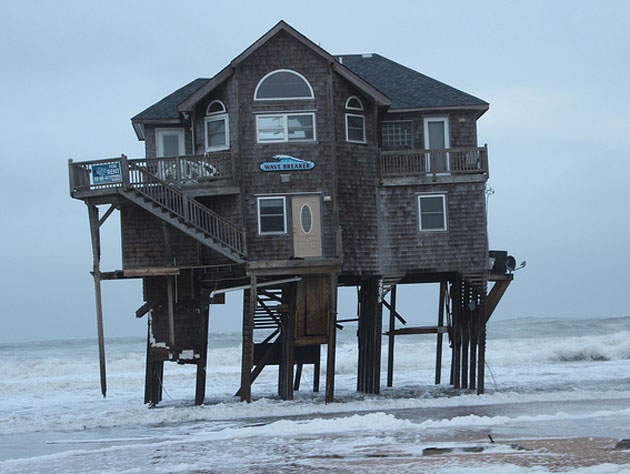
A beach house in North Carolina after Hurricane Sandy. <a href="http://www.flickr.com/photos/69214385@N04/8235405166/sizes/z/in/photostream">Don McCullough</a>/Flickr

Get your news from a source that’s not owned and controlled by oligarchs. Sign up for the free Mother Jones Daily.

This story first appeared on the Atlantic website and is reproduced here as part of the Climate Desk collaboration.

This week, a group of 78 representatives from American government agencies, universities, non-governmental organizations, and the insurance industry published a report on the threat climate change poses to U.S. coastlines. The document—formal title: “Coastal Impacts, Adaptation, and Vulnerabilities: A Technical Input to the National Climate Assessment”—clocks in at nearly 200 pages, and functions as a lengthy addendum to the U.S. Global Change Research Program’s National Climate Assessment.

The report’s findings are unsurprising: Our coastlines are particularly vulnerable to climate change’s impacts—a fact that we have had proven to us anecdotally so many sad times in the recent past. Still, though, the document is worth reading—or, perhaps, skimming—in its entirety.

If you don’t have time to read a 200-page report, you can also get a pretty good sense of the nation’s climate-to-coastline situation by skimming the report in another way: by looking at the list of acronym decodings that the report helpfully provides for its readers. There are 55 of those acronyms in all, and they are illuminating and terrifying in equal measure. SLCS? That means “sea level change scenarios.” HABs? “Harmful algae blooms.” VBZD? “Vector-borne and zoonotic disease.” CSO? “Combined sewer overflow.”

Yes. And the list goes on—helpfully, horrifically—abbreviation after abbreviation.

slide-12-1024.jpg acro2.jpg

But maybe the scariest one of all? BMP: “Best management practices.”

Here’s the full report:
More Mother Jones reporting on Climate Desk

DECEMBER IS MAKE OR BREAK

A full one-third of our annual fundraising comes in this month alone. That’s risky, because a strong December means our newsroom is on the beat and reporting at full strength—but a weak one means budget cuts and hard choices ahead.

The December 31 deadline is closing in fast. To reach our $400,000 goal, we need readers who’ve never given before to join the ranks of MoJo donors. And we need our steadfast supporters to give again—any amount today.

Managing an independent, nonprofit newsroom is staggeringly hard. There’s no cushion in our budget—no backup revenue, no corporate safety net. We can’t afford to fall short, and we can’t rely on corporations or deep-pocketed interests to fund the fierce, investigative journalism Mother Jones exists to do.

That’s why we need you right now. Please chip in to help close the gap.

DECEMBER IS MAKE OR BREAK

A full one-third of our annual fundraising comes in this month alone. That’s risky, because a strong December means our newsroom is on the beat and reporting at full strength—but a weak one means budget cuts and hard choices ahead.

The December 31 deadline is closing in fast. To reach our $400,000 goal, we need readers who’ve never given before to join the ranks of MoJo donors. And we need our steadfast supporters to give again—any amount today.

Managing an independent, nonprofit newsroom is staggeringly hard. There’s no cushion in our budget—no backup revenue, no corporate safety net. We can’t afford to fall short, and we can’t rely on corporations or deep-pocketed interests to fund the fierce, investigative journalism Mother Jones exists to do.

That’s why we need you right now. Please chip in to help close the gap.

We Recommend

Latest

Sign up for our free newsletter

Subscribe to the Mother Jones Daily to have our top stories delivered directly to your inbox.

Get our award-winning magazine

Save big on a full year of investigations, ideas, and insights.

Subscribe

Support our journalism

Help Mother Jones' reporters dig deep with a tax-deductible donation.

Donate