Perhaps the most unusual thing about the Boston Marathon bombing is that it happened at all. While we’ve seen all manner of terrorist bomb plots since September 11—the Times Square bomber, the underwear bomber, even the guys who fantasized about destroying the Sears Tower—all have been thwarted by the FBI, the perpetrators’ own bumbling, or both. If one or both of the suspects in last week’s attack, Tamerlan and Dzhokhar Tsarnaev, were motivated by radical Islamic beliefs, then they will have the dubious distinction of being the first jihadists to have set off a bomb on American soil since the 1993 World Trade Center bombing.
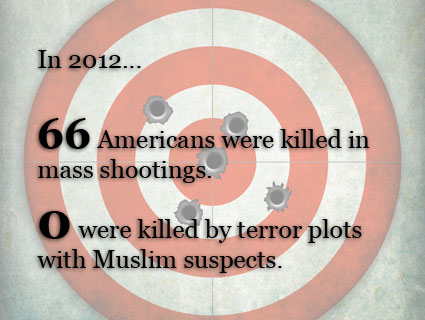
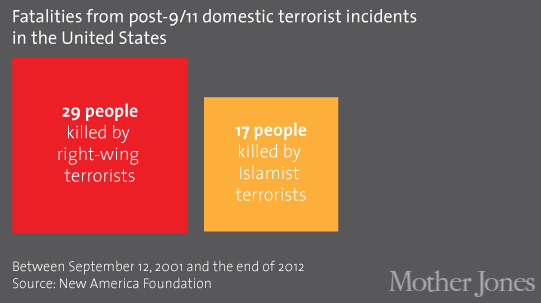
While America has been fixated on the threat of Islamic terrorism for more than a decade, all but a few domestic terror plots have failed. Between September 11, 2001, and the end of 2012, there were no successful bomb plots by jihadist terrorists in the United States. Jihadists killed 17 people in the United States in four separate incidents during this time, according to data collected by journalist Peter Bergen and the New America Foundation. All four of these incidents involved guns, including Nidal Hassan’s shooting rampage at Fort Hood, which killed 13 people. In contrast, right-wing extremists killed 29 people during those 11 years.
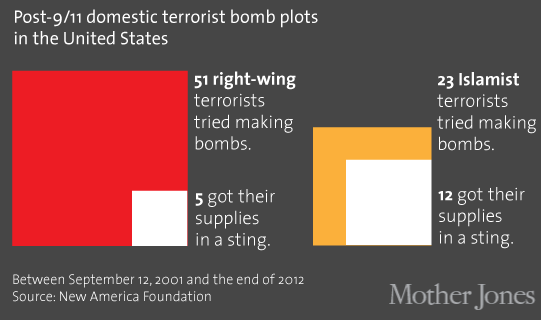
The jihadists’ record as bomb makers would probably be even worse if not for the FBI, which has reeled in dozens of would-be terrorists with its controversial informant program. Of the 203 jihadist terrorists counted by the New America Foundation, just 23 got their hands on explosives or materials to make a bomb; more than half of those obtained the components (often nonfunctioning) from federal informants or agents as part of a sting. Of the 174 nonjihadists, 51 right-wing terrorists and 5 anarchist terrorists tried making bombs. Only five of the right-wing terrorists got their bomb-making supplies via sting operations.
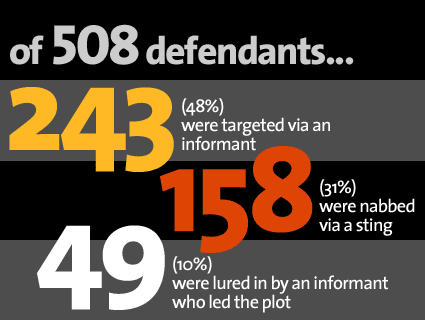
Using a slightly different methodology than Bergen, Brian Michael Jenkins of the RAND Corporation also found that “homegrown” jihadist terror plots have had little success. Most post-9/11 plots, he writes, most “never got beyond the discussion stage, and most of those that did were stings in which the FBI provided fake bombs.” A Mother Jones examination of the cases of more than 500 defendants charged in terrorism-related cases after 9/11 found that 31 percent were nabbed in a sting, while 10 percent were lured by an informant who controlled the conspiracy. Perhaps one reason the Tsarnaev brothers’ alleged plot went as far as it did was that they did not seek out collaborators, avoiding tipping off the FBI—which had already checked out Tamerlan but apparently decided not to investigate him.
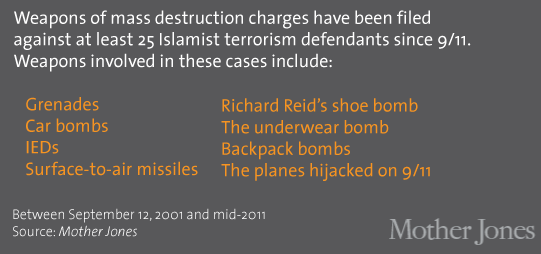
The weapons of mass destruction charges filed against Dzhokhar Tsarnaev may sound like a big deal. However, the federal WMD statute is sufficiently broad that it has been used against at least 25 defendants since 9/11, covering all kinds of destructive devices, from grenades and car bombs to the underwear bomb and the planes hijacked on 9/11. There have been no Islamist plots involving what we commonly know as WMD—biological, chemical, or nuclear weapons. However, according to the New America Foundation data, the only terror suspects who have recently obtained biological or chemical weapons such as anthrax and cyanide were right-wing extremists.
Predictably, the marathon bombing has led to renewed calls to surveil Muslim Americans and scrutinize immigrants from Chechnya, a “hotbed of Islamic extremism” as Sen. Rand Paul (R-Ky.) put it. But the numbers don’t support the rhetoric: Dzhokhar Tsarnaev is the first ethnic Chechen to be accused of domestic terrorism since 9/11. A 2011-12 Pew Research Center survey found that 93 percent of Muslims in Russia’s North Caucasus region, which includes Chechnya, think violence against civilians is “never justified as a means of defending Islam against its enemies.”
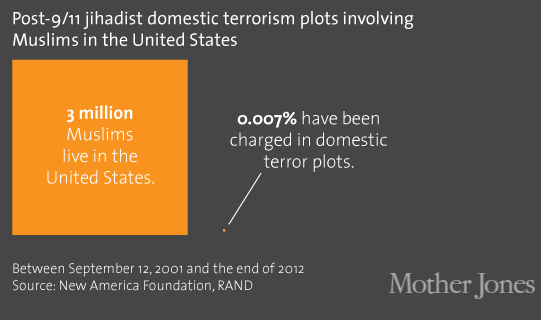
And as RAND’s Jenkins wrote in the 2010 edition of his report, “There are more than 3 million Muslims in the United States, and few more than 100 have joined jihad—about one out of every 30,000—suggesting an American Muslim population that remains hostile to jihadist ideology and its exhortations to violence.” Using Bergen’s figure of 203 jihadist terrorists, that means approximately 0.007 percent of Muslims in the United States have been involved in domestic terror plots since 9/11.
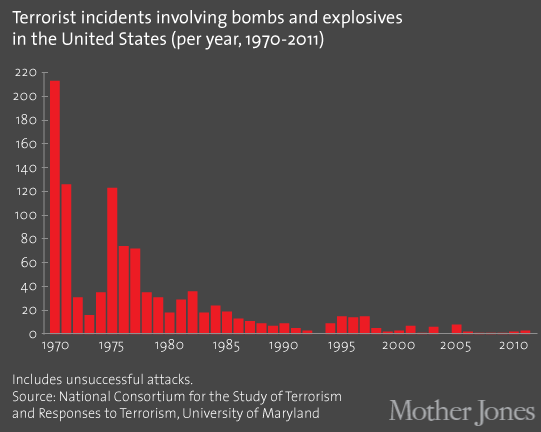
While the risk of attacks by extremists of all stripes remains real, it’s worth noting that the United States has experienced far bigger waves of domestic terrorism in its recent history. During the early and mid-1970s, there was a spate of attacks and plots that eclipses the post-9/11 plots. According to data collected by the National Consortium for the Study of Terrorism and Responses to Terrorism, most of the attacks were perpetrated by radical left-wing groups such as the Weather Underground (responsible for 41 bombing incidents) and the all but forgotten New World Liberation Front (78 bombing incidents).
As Jenkins concludes, “Qualitatively, America’s jihadist terrorists have not shown great determination or much competence.” Despite the devastation wrought by their homemade bombs and illegal guns, the Boston suspects are not evidence of the power of Islamist terrorism in post-9/11 America so much as a painful exception to its ineffectiveness.