American Civil Liberties Union
The past couple of weeks have been filled with stories of relieved immigrants: Undocumented parents of American citizens, children who arrived in the United States years ago, and other immigrants without papers can step out of the shadows now that Obama has issued an executive action granting relief to 5 million undocumented residents. (Read more details on the president’s plan here.)
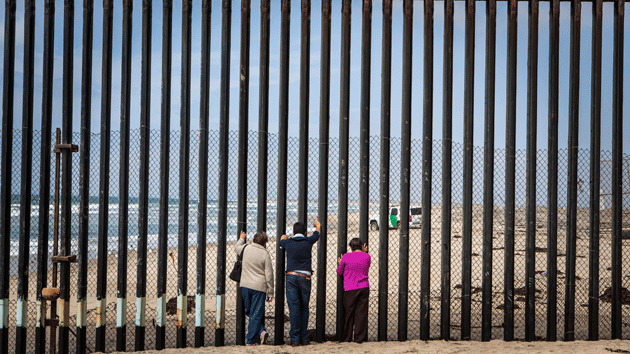
But a report released today by the American Civil Liberties Union underscores a troublesome pattern that has received far less attention: Of the 438,421 people deported in 2013, 83 percent received a summary removal, meaning that they were sent to their country of origin by US officials without a hearing. And according to the ACLU’s research, many of these removals were illegal: Asylum seekers, unaccompanied kids, and others who may have qualified for relief routinely have been turned away.
Until the mid-’90s, virtually all immigrants at risk of being deported went through an immigration hearing before a judge. But, partly in response to immigration court backlogs, a 1996 law called the Illegal Immigration Reform and Responsibility Act changed that, extending the ability to issue deportations to immigration officers—the same people who arrest and detain immigrants. Since 2003, the number of immigrants deported by officers without a trial has tripled; in fiscal year 2013, according to the ACLU, some 363,000 deported individuals “did not have a hearing, never saw an immigration judge, and were deported through cursory administrative processes where the same presiding immigration officer acted as the prosecutor, judge, and jailor.”
In theory, the current law prevents immigration courts from being completely inundated while also providing safeguards; officers are to ask individuals if they fear for their lives in their home countries and are seeking asylum, and those who do are to be referred to an officer with asylum training. But according to the ACLU’s findings, these protocols aren’t often followed: Of 89 interviewees who received summary removals, only 28 percent were asked in a language they understood if they feared persecution upon returning home. Of those, 40 percent answered “yes” but were still summarily removed. An estimated 95 percent of Mexican unaccompanied children have been turned back before seeing a judge.
The ACLU report also documents stories of immigrants for whom expedited deportation was particularly devastating. Below is an excerpt:
Braulia A. and Hermalinda L. were gang-raped and shot after being deported to Guatemala; Braulia’s son, who joined her in Guatemala after her deportation, was murdered by the same gang that raped and shot her. Nydia R., a transgender woman who actually had asylum status when she was (twice) deported without a hearing, was attacked by men who raped her and tried to cut out her breast implants; she was then kidnapped and sex-trafficked in Mexico. Laura S. told border officials that she was afraid of her abusive ex-partner; her pleas ignored, she was deported and was murdered by him within days of her removal to Mexico.
As Sarah Mehta, an ACLU human rights researcher and an author of the report, put it, “Almost every location that we went to across the northern and southern borders had the same stories: of people not knowing what their rights were when they got deported, given a form to sign that they didn’t understand, often in a language they didn’t know, and essentially pushed across the border. The stories of coercion—of mistreatment, of people being threatened with indefinite detention, of people losing their children—those stories also were not just a one-off.”
No one, the ACLU included, seems to be able to provide a realistic solution to the immigration court backlog; it’s undeniable that if all those requesting asylum were given a trial, the system would be further clogged.
But Obama’s recent executive action makes no mention of eliminating illegal summary removals—in fact, it focuses on continuing the “surge of resources” to the border. According to the White House Press Office, “The President’s actions increase the chances that anyone attempting to cross the border illegally will be caught and sent back.”