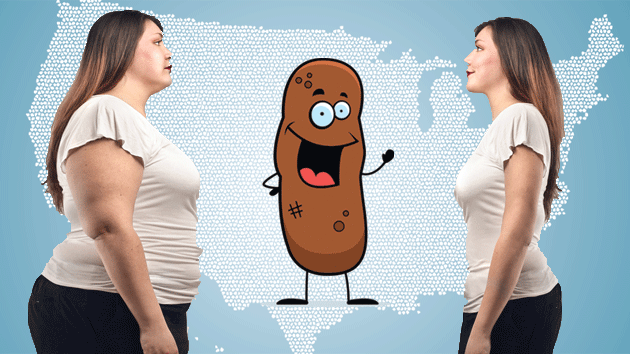
The sewage of fat cities like Little Rock and Toledo is easy to distinguish from that of skinny ones like Denver and San Diego.<a href="http://www.shutterstock.com/pic-126763280/stock-photo-young-fat-woman-and-young-woman-lean.html?src=csl_recent_image-2">Shutterstock</a> <a href="<a href="http://www.shutterstock.com/pic-146217686/stock-vector-dotted-usa-map-on-blue.html?src=csl_recent_image-1">photo</a></a> <a href="http://www.shutterstock.com/pic-222996850/stock-vector-a-cartoon-illustration-of-a-piece-of-poop-waving-and-smiling.html?src=csl_recent_image-3">collage</a>
If someone were to ask you what distinguishes skinny cities from fat ones, you might think of the prevalence of fast-food joints, the average length of automobile commutes, or the relative abundance of parks and jogging trails. But there’s also another, more underground factor: their sewage.
Researchers with the University of Wisconsin-Milwaukee collected raw sewage samples from the intakes of municipal wastewater treatment plants in 71 cities around the country. Their results, published last month in mBio, the American Society for Microbiology’s open-access journal, showed that the microbial content of that sewage predicted each city’s relative obesity with 81 to 89 percent accuracy.
The finding actually isn’t all that surprising, says lead author Ryan Newton, a visiting professor at UWM’s School of Freshwater Sciences. Other studies have shown that bacterial imbalances in your intestines can lead to metabolic syndrome, obesity, and diabetes. Newton’s study, however, is the first to demonstrate that those microbial differences also play out across entire populations, even after our poop gets flushed, mixed together, and sent through miles of pipes.
The UWM study was enabled by computing advances that have allowed scientists to rapidly sequence microbial populations and look for patterns in the results. Other researchers are using similar techniques to look for correlations between gut bacteria and a wide range of health conditions.
Newton isn’t the only scientist who sees sewage as a promising place for data dives. The Massachusetts Institute of Technology’s Underworlds project, which began in January, will study sewage for the presence of viruses such as influenza and polio; bacterial pathogens that cause cholera typhoid fever, and other diseases; and biochemical molecules ranging from antibiotics to illegal drugs like cocaine and methamphetamine. Scientists hope the resulting data could help predict epidemics and track other public health trends within particular neighborhoods.
As scientists gain a better understanding of the interplay between microbes and human health, they may eventually be able to look at municipal sewage to figure out which communities would be the best to target with public health campaigns designed to, say, get people to eat less sugar or more vegetables.
And just as important, sequencing sewage could eliminate the thorny problem of doing public health surveys. Unlike people, your poop can’t lie about what you had to eat.