<a href="https://www.flickr.com/photos/thespeakernews/19437624579/in/photolist-vBCUAg-fwVjiK-67r19c-67r1de-67vdyA-67vdBS-68U2Ni-67ZKDZ-vYT45i-CQQspx-wjrzHJ-koDq6m-wQYeoj-yrYnXc-wQNLR1-4XWpzL-5D1bto-6yEUpx-8dh5mX-8xF44J-eGHf67-zoXF3-x51US1-dQZsaA-7QbdJZ-s1aTXQ-nVWcfL">Day Donaldson</a>/Flickr
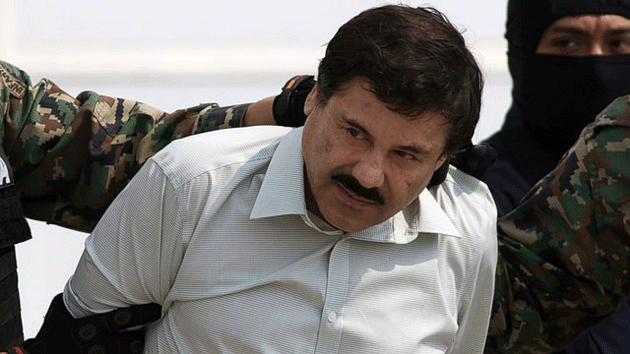
By some estimates, the just-nabbed billionaire drug kingpin Joaquín Guzmán Loera, a.k.a. El Chapo, supplies more than half the cocaine, heroin, methamphetamine, and marijuana that comes into the United States. But not all of those drugs were created equal in his eyes. While pot undoubtedly helped El Chapo get his start, it’s no longer the key to his dominion.
Guzmán, who was arrested by the Mexican police on Friday, grew up in the 1960s in Sinaloa, the remote, rugged, West Coast state still known as Mexico’s marijuana heartland. As a boy, he earned money working in marijuana fields before a friend’s father—one of the first Sinaloan farmers to traffic pot in bulk—brought him into what later became the Sinaloa Cartel. And although pot was the cartel’s bread and butter for years, El Chapo’s syndicate long ago branched into other drugs.
It was a prescient move. Since 2011, competition from high-quality pot grown legally and quasi-legally north of the border has cut the wholesale price for Sinaloan marijuana by 70 percent. Mexico now supplies only about one-third of America’s pot, down from two-thirds as recently as 2008. “It’s a big difference,” a Sinaloan farmer told NPR. “If the US continues to legalize pot, they will run us into the ground.”
Like any good businessman, El Chapo understood the importance of a diverse portfolio. In the late 1970s, Mexican traffickers began moving cocaine for producers in Colombia and Central America, first by air and boat to Central America and Mexico, and then by land into the United States. Sinaloa now controls an estimated 35 percent of Colombian cocaine shipments.
Unique among Mexican cartels, Sinaloa is both horizontally and vertically integrated. It produces its own marijuana and heroin, and starting in the 1990s it expanded into methamphetamine. After regulations made it more difficult to manufacture large quantities of meth in the United States, Sinaloa ordered precursor chemicals by the boatload from India and China to supply its own Mexican superlabs.
More recently, El Chapo has cashed in on America’s growing appetite for heroin. Since 2009, domestic seizures have increased by more than two-thirds. Almost all heroin consumed here is now smuggled across the US-Mexico border. An increasing share of the opium used to make it is grown in Mexico—mainly in Chihuahua, Durango, and Sinaloa’s “Golden Triangle” region.
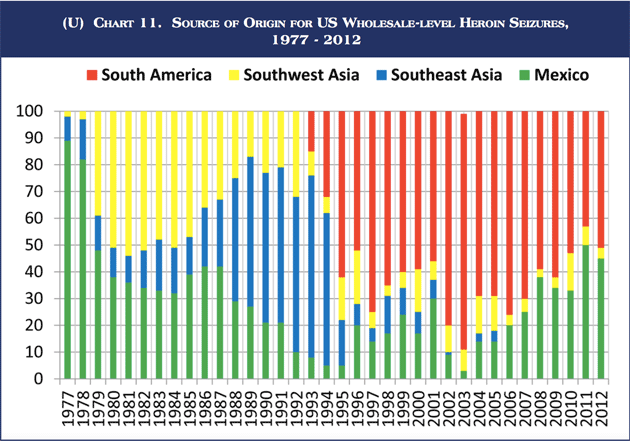
Even the heroin that isn’t grown by the Sinaloa Cartel is likely being smuggled by it. The orange areas in this map show the cartel’s sphere of influence in the United States:
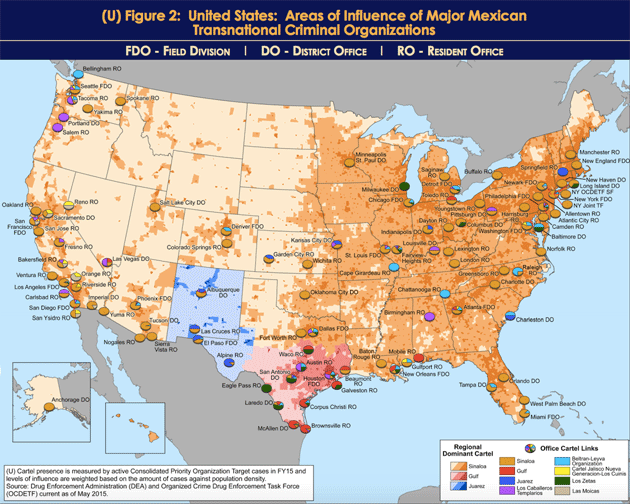
The cartel’s evolution shows how the legalization of pot has taken business away from criminal syndicates. But it also suggests that the cartels will continue to thrive amid the prohibition of other popular drugs. “It’s a reality that drugs destroy,” Guzmán told actor Sean Penn shortly before his capture. “Unfortunately, as I said, where I grew up, there was no other way and there still isn’t a way to survive, no way to work in our economy to be able to make a living.”