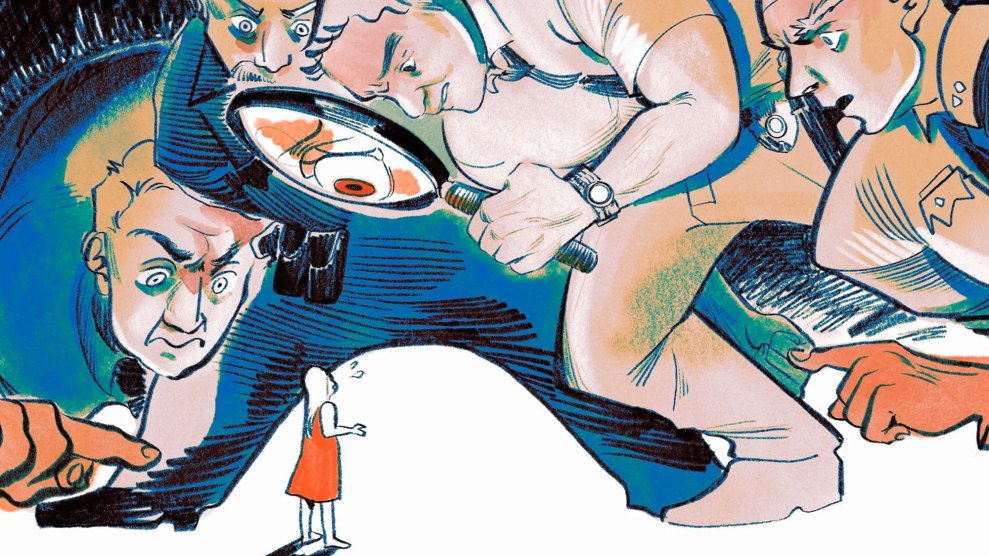
Teenagers: They’re not what they used to be. They’re less violent than they were a decade or so ago and less liable to act up at school or try to harm themselves. They’re also less likely to use drugs, get pregnant, or climb behind the wheel drunk and drive into a tree. But no amount of happy stats can counter the popular image of the teenage superpredator—or the notion that each generation is worse than the one before.
Our determination to distrust our own children shows up on every page of Maia Szalavitz’s Help at Any Cost, a compendium of nightmares drawn from the history of an industry that claims to rehabilitate wayward youth via “tough love” techniques such as forced marches, solitary confinement, food and sleep deprivation, sexual humiliation, “stress positions,” and other methods now associated with Abu Ghraib and Guantanamo. Marketed variously as boot camps, behavior-modification programs, and “therapeutic” boarding schools—and scattered across the globe—the troubled-teen industry claims to cure everything from back talk to addiction, despite the complete lack of evidence that it works and the mounting evidence of the harm it inflicts, from post-traumatic stress to more than a dozen deaths.
The love part of this equation is hard to locate in the individual stories Szalavitz recounts, like that of Aaron Bacon. When the 16-year-old high school sophomore from Phoenix started using drugs and sneaking out at night, his parents had him kidnapped by 280-pound “escorts” and placed in the hands of a wilderness program that forced him to march through the Utah desert for days on end. When he began to flag because of an undiagnosed intestinal ulcer, staffers accused him of malingering, deprived him of food, and forced him to sleep without a sleeping bag in below-freezing temperatures. Aaron died in a truck that was returning him to the beginning of the course; those charged with his care had responded to his collapse by insisting the “faker” start over.
If Help at Any Cost sometimes feels like a turkey shoot—the ludicrous “programs” Szalavitz goes after have been exposed before and are fairly easy to demolish—it’s worth remembering that these fear farms are still around despite repeatedly having been investigated, discredited, and sued. (Remarkably, though, no one knows just how many thousands of kids are sent off to them every year or the untold millions worried parents pump into programs that routinely cost as much as private colleges.) But the horror stories have done little to devalue the cultural currency of the tough-love ideal. The New York Times’ Style section recently ran a mournful column in which a father described having his son dragged from his bed and sent into the wilds, in the hope that the boy would find exile curative. And the boot-camp experience is now being packaged as entertainment: ABC has launched Brat Camp—a reality show set at a wilderness camp, in which defiant teens morph into pliant scouts over the course of a season.
To the obvious questions—How the hell did we allow this to happen? How can it still be happening?—Szalavitz mainly offers hypotheses. The most convincing is that the troubled-teen industry is another toxic side effect of the war on drugs—that too many parents let the drug czar’s PR guys convince them that the kid getting high in the basement is in grave danger and needs extreme intervention if his future is to be salvaged. The idea that things are “different” for kids today—rebellion riskier, the pot more potent—has become part of the common wisdom. In the end, torture at home is justified the same way it is abroad: There’s a war on, and extraordinary times demand extreme measures.
Help at Any Cost winds up with an appendix that helpfully outlines “evidence based” alternatives to the tough-love approach. Szalavitz also might have steered those in search of alternatives to John Hubner’s Last Chance in Texas, an account of a program that is the mirror opposite of the tough-love approach—and one that works.
Hubner spent nine months at the Giddings State School in Texas, observing the Capital Offenders group, a last-ditch effort to steer juveniles convicted of violent crimes back into society. Those who make it through the program are rewarded with an early release. Those who don’t are sent to prison, often to complete decades-long adult sen-tences. At Capital Offenders, the therapeutic process is built around narrative: Over a period of months, young people tell their life stories and act them out through role-playing in an effort to face both their own motivations and the harm they have done.
Like Szalavitz, Hubner describes a group process intended to break down kids’ defenses. The difference is that, at Giddings, young people who have robbed, assaulted, and killed are led through this process with skill and compassion and encouraged to treat each other kindly. The idea is not that they need to be “broken”—clearly, they already are—but that they can be put back together and can help rebuild each other.
The arc of tragedy in these intimate narratives approaches the Shakespearean, save for the final twist: an epilogue in which most of the young people Hubner follows emerge from the tunnel of violence as stable and productive members of society. Ronnie, who had faced a 25-year sentence for a brutal home-invasion robbery, is paroled to a job at a nursing home; within a year he is head of the custodial crew, supervising 11 people. The younger brother he once abused and terrorized tells him, “You’re a changed man. Now, you’re my brother.” Of the 17 boys and 7 girls Hubner followed, only 2 failed to meet the program’s demands and were transferred to prison. Fifteen were released. Of those, not a single one had been rearrested at the time of his book’s publication.
Those who favor a “tough love” or “tough on crime” approach often cite the need for “accountability,” a state they seem to believe can be attained only via inflicting protracted suffering. Last Chance in Texas offers a vision of accountability that is at once deeper and more hopeful than the notion that those who break the law had damn well better pay. The young people Hubner introduces us to are fierce in their demand that each among them take responsibility for the choices he has made, and in their rejection of anything resembling an excuse—including what the more flippant of the law-and-order crew have come to call “the abuse excuse.” At Capital Offenders, an examination of past abuse is not a card played in an attempt to deflect responsibility but rather a starting point for a conversation intended to heal.
A belief in tough love allows many parents to raid their children’s education funds to send them to virtual prison camps, and permits the rest of us to tolerate the expenditure of our tax dollars on failing juvenile prisons. But Hubner’s riveting account puts the lie to the notion that nothing—or nothing short of torture—works. It turns out we do have a pretty good idea of how to lead children out of delinquency and emotional turmoil and bring them back into the fold. We just choose, individually and collectively, to abandon them instead.