Wikimedia Commons
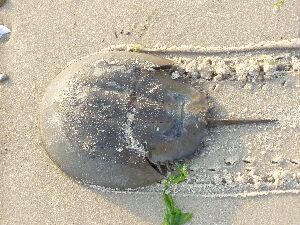
It’s also a global economy that affects millions. Notably, millions of little shorebirds known as red knots, whose numbers have declined 75 percent since the horseshoe crab fishery in Delaware Bay exploded. Prior to 1992, 100,000 crabs a year were caught. In 1997, more than 2 million. The result: 90 percent fewer crab eggs for visiting shorebirds to eat.
Here’s the background: A lot of migrating shorebirds depend on Delaware Bay as a feeding stop. Red knots can’t live without it. Until 1992 the Bay was a dependable fuel station on their annual 18,600-mile migration between the Arctic and the southern tip of South America and back. That’s right, 18,600 miles a year. Fifty percent more flying than the average American drives per year. All from a bird weighing 6 ounces.
Now a new study has found the proportion of red knots visiting Delaware Bay who manage to pack on enough weight to survive the winter in Tierra del Fuego dropped along with the crab eggs. In fact the proportion of birds who made their target weight by their target departure date declined between 50 and 75 percent between 1997 and 2007.
This despite fisheries restrictions enacted in 1997 to help red knots recover. But, tell me, what kind of restrictions allow a 2007 horseshoe crab hunt bigger than the 1990 hunt?
Idiot restrictions. I wrote about other amazing long-distance fliers in Diet for a Warm Planet: how their thriftiness equals their prosperity. We all need to learn from these extraordinary feathered economists. Especially those who practice idiot economics.