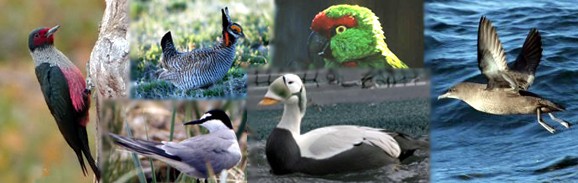
How are America’s birds doing after seven years of the antiGreens? Well, 178 species in the continental U.S. and 39 in Hawaii are in need of immediate conservation. That according to the 2007 Audubon WatchList.
“We call this a ‘WatchList’ but it is really a call to action, because the alternative is to watch these species slip ever closer to oblivion,” said Audubon Bird Conservation Director and co-author, Greg Butcher. “How quickly and effectively we act to protect and support the species on this list will determine their future; where we’ve taken aggressive action, we’ve seen improvement,” says David Pashley, American Bird Conservancy’s Director of Conservation Programs and co-author.
Could Step One be any clearer? Fast forward to 2008 & ditch the flightless leaders.
Among the most imperiled species on the list that regularly breed in the continental U.S. are:
Gunnison Sage-Grouse (not on Endangered Species Act list (ESA) [here’s why, at least in part]) • This species is restricted to Southwest …
Julia Whitty is Mother Jones’ environmental correspondent. You can read from her new book, The Fragile Edge, and other writings, here.
…Colorado and adjacent Utah. Drought, which is predicted to get worse with increased global warming, is among the factors that have reduced the Gunnison Sage-Grouse population to fewer than 5,000; habitat loss and fragmentation and excessive grazing are other threats. Protection and restoration of contiguous tracts of good habitat is critical.
Lesser Prairie-Chicken (not on ESA list) • Habitat loss and degradation have restricted this species to a number of isolated populations, many of which are on private lands in Kansas, Colorado, Oklahoma, New Mexico, and Texas. Small population size, changing habitat resulting from drought, and climate change threaten continued survival.
California Condor • Once reduced to nine individual wild birds, this raptor is slowly recovering, thanks to captive breeding and the release of individuals in California and Arizona. There are now 305 individuals, including 148 free-flying birds. Lead bullets are a critical threat to long-term survival, as fragments poison wild condors that eat the remains of hunters’ kills. Audubon California and American Bird Conservancy have spearheaded recent passage of legislation eliminating lead bullets in the range of the condor in that state.
Whooping Crane • Unregulated shooting and loss of habitat reduced this species to fewer than 20 individuals around the turn of the 20th Century. Implementation of a recovery plan developed under the Endangered Species Act has resulted in more than a 1000% increase in population to over 200 individuals, and has spawned efforts to establish additional wild breeding populations.
Piping Plover • Protection of this shorebird’s beachfront nesting grounds is helping to improve the outlook for this species. Human development along beaches, increased beach recreation, disturbance by pets, and increased predation require constant vigilance. Intensive conservation efforts supported by the Endangered Species Act have helped stabilize populations and allowed populations to increase in some regions of the Atlantic and Gulf coasts.
Black-capped Vireo • Suburban development, agricultural conversion, and fire suppression in Texas and Oklahoma have decreased available breeding habitat, reducing both the range and population size of this species. Increased predation near human development has further decreased populations, as has parasitism from Brown-headed Cowbirds, which lay their eggs in Black-capped Vireo nests, out-competing the vireo chicks. Innovative conservation efforts on public and private lands seem to be helping some populations recover.
Florida Scrub-Jay • Suburban-exurban sprawl and agricultural development have reduced habitat dramatically and isolated many populations. Maintaining natural wildfire regimes will be critical. Although ESA status has increased conservation efforts for this species, it has not been enough to stop loss of habitat.
Golden-cheeked Warbler • Breeding is restricted to the Edwards Plateau in Texas, where suburban sprawl and habitat destruction has greatly reduced population size. Winter habitat loss in southern Mexico and Central America may also be affecting populations. Innovative conservation strategies that protect and restore habitat in both the breeding and wintering grounds are underway and needed.
Kirtland’s Warbler • Dependent on jack pine habitat in northern Michigan, this warbler species has increased more than 600% since the mid-1980s because of management plans implemented under the Endangered Species Act. Singing male counts in the spring have increased from 200 to almost 1,400 (and some singing males are now found in Wisconsin and Ontario). Wild land fire management, control of the parasitic Brown-headed Cowbird, and protection of wintering habitat in the Bahamas remain essential to long-term survival.
Ashy Storm-Petrel (not on ESA list) • Breeding populations are restricted to islands off the west coast of North America. Non-native nest predators and increased gull populations threaten breeding birds, and ocean pollution and overfishing threaten feeding birds.
Kittlitz’s Murrelet (not on ESA list) • Breeding and feeding habitat seems to be linked to Alaska’s tidewater glaciers, making this species very susceptible to climate change. Oil spills, coastal pollution, and increased disturbance also threaten this species.
Red-cockaded Woodpecker • Habitat loss from logging in the Southeast’s long-leaf pine forests and suburban and agricultural development have isolated populations and greatly reduced overall population size. Protection strategies developed through the Endangered Species Act are helping populations in many places, but restoration of open long-leaf pine forest is desperately needed.
Spectacled Eider • Ingestion of lead shot is believed to be a major problem for this species, along with an increase in nest predation by foxes, mink, gulls, and jaegers in a warming Arctic. In addition, changing sea conditions in winter are affecting the distribution of clams – a preferred winter food. Proposed oil development poses an additional and very significant threat.
Reddish Egret (not on ESA list) • This species forages along the Gulf Coast and is subject to human disturbance at beaches and at nesting sites. It is dependent on high quality coastal habitat for its food. Human coastal development and decreasing water quality are serious threats.
Black Rail (not on ESA list) • This species makes its home in shallow, grassy wetlands along the Atlantic Coast, San Francisco Bay, southern Great Plains and the Lower Colorado River, habitat that is vulnerable to human conversion to other uses, including agriculture or other development. A secretive bird, it needs further study to increase understanding of its natural history, ecological role and conservation needs.
Buff-breasted Sandpiper (not on ESA list) • Traveling each fall from Alaska to Argentina, this species is one of our champion long-distance migrants. Along the way, it faces a great variety of threats, from oil development on its Arctic breeding grounds to grassland conversion to soybean fields on its Argentinean wintering grounds. It needs protected grassy stopover sites all along its migration route.
Saltmarsh Sharp-tailed Sparrow (not on ESA list) • This tiny bird is restricted to a narrow band of saltmarsh along the Atlantic and Gulf Coasts. It is threatened on one side by human coastal developments and on the other by rising sea levels. With even one foot of sea-level rise from global warming, this species will need a lot of help to maintain sufficient habitat for its survival.
Tricolored Blackbird (not on ESA list) • A highly social species, this bird is found in freshwater wetlands in the Pacific states, mainly California. With loss of this habitat, this species increasingly relies on agricultural fields for nesting, leaving chicks vulnerable to the harvest of hay and other crops. Audubon California and other conservationists are working with farmers to maintain agricultural nesting habitat long enough each season to allow the blackbirds to successfully raise their young – potentially spelling the difference between survival and extinction for this highly specialized bird.
Yellow Rail (not on ESA list) • Rails are small, secretive birds that winter in wetlands along the Gulf and Atlantic Coasts. This species prefers to breed in wet grasslands across Canada and the northern tier of states from Minnesota to Maine. These grasslands are easily converted to other uses, so protection of high-quality habitat will be essential for this migratory bird’s survival.
Xantus’s Murrelet (not on ESA list) • This tiny seabird nests on islands off southern California. Conservationists are tackling the major threat on the nesting grounds – non-native predators like rats and mice. Global warming seems to wreak havoc with the water circulation and availability of food sources in the ocean, causing shortages for this and other coastal seabirds.