«--Previous Post | Blog Index | Next Post--»
The Dark Side of Biofuels
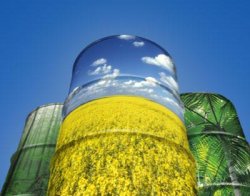
Yet another study deepening our understanding of just why converting native ecosystems to biofuel farms is increasing not mitigating climate change. This according to a study by the University of Minnesota and the Nature Conservancy published online today in Science, finding that turning rainforests, peatlands, savannas, or grasslands into biofuel-yielding croplands emits large amounts of carbon that add to the atmosphere's already heavy burden of greenhouse gases.
In Brazil, Southeast Asia, and the US, land is being planted with corn or sugarcane to produce ethanol, or with palm trees or soybeans to produce biodiesel. The land conversions pump out 17 to 423 times more carbon than the annual savings from replacing fossil fuels with the biofuels. This carbon debt must pay off before they biofuels begin to have the effect of cutting greenhouse gas emissions. In the worst scenario, peatland conversions to palm oil plantations in Indonesia ran up a carbon debt requiring 423 years to pay off. In the Amazon, soybeans will take 319 years. The conversion of U.S. grasslands for corn ethanol and Indonesian rainforests for palm biodiesel also ran up big carbon debts.
There is a solution. The researchers suggest that biofuels made from waste biomass or from biomass grown on abandoned agricultural lands planted with perennials incur little or no carbon debt and offer immediate and sustained greenhouse gas advantages. In the US, Conservation Reserve Program lands, idle lands, and others once in agriculture can be used to grow biofuels and provide energy sources much better than fossil fuels.
Julia Whitty is Mother Jones' environmental correspondent and 2008 winner of the John Burroughs Medal Award. You can read from her new book, The Fragile Edge, and other writings, here.

Comments
I think the answer here is that you don't necessarily need to be tying up valuable acreage to pursue biofuels, what you need to do is borrow some kid's electric train set, and study it carefully.
Gain a thorough understanding of the locomotive, as electric propulsion is a great concept to add to your mental toolbox, but then look for the flatbed cars. This miniature model is a scale representation of the full size version that runs on our rails daily. A large, rectangular, hard flat surface for loading cargo and transporting it. Now, take your miniature, and put an edge on it, that is continuous around the sides.
Now, 'fill' your flatbed car with potting soil. If your edge was only 1/4-1/8th inch, the full scale would be almost a foot of dirt. 1 foot deep by 10 feet wide by 40 feet long, approximately.
Something to consider. Now, go rent Silent Running, one of Bruce Dern's early movies.
Not as good as Driver, but more relevant to this discussion. In Silent Running, he and his shipmates are on a Holy Quest to save the varmit. They have eco-ships, and have been told to leave the earth. Rather than kill the eco-pods when order, his character kills his shipmates instead, and goes drifting off into space, surviving a trip through Saturn's rings. What can you say, it was the 70's. I want one of those runabout cars though, they looked like fun. But, that's another story.
Anyway, the above waste of your time is a rough representation of a mobile garden planter, big enough to really do something with.
You can make usable potting soil by dredging up muck off the ocean floor, mixing it with bull stuff(not the political variety, although Teddy Kennedy can finance his retirement by continuing the public speaking circuit with a nearby windmill to absorb the resulting wind energy), stirring vigorously, letting the little microbes do their microbe thing, probably throw in some sand and whatever else you've got handy, and then Ph'ing it, and planting your corn or your sugar cane or whatever you've got, there. Small scale, large scale, don't have to cut down the rain forest etc. Making biofuels work means eliminating the excuses and solving the problems, and getting it all worked down to the scale that an individual person can then carry out for themselves, even. Educate the public, give them the legal permission to do this stuff, and the problem will start to solve itself. Part of the need for energy independence is also the need to get away from the government taxes which ramp up prices and keep the whole sorry business going. Given the choice between wars I consider to be pointless frauds against the public and investing time, effort and energy in bona-fide greentech development, I'll take the greentech. Better the science than the fraud and war profiteering.
ARCHIVE
RECENT COMMENTS
More Cell-Phone Wariness From Docs (1)
Fair Trade wrote:
In an earlier life I had close contact with a charity invo...
[more]
How Long Will You Live? Depends Where You Live (5)
Sarah wrote:
Hey, I live in Kentucky! Some areas really are that bad, b...
[more]
Cow Poo Power Redux (2)
smitisan wrote:
Yes, there are hundreds of millions of cows out there, but...
[more]
Commemorating Bush's Sh*t (19)
hekimboard wrote:
thanks....
[more]
African-Americans Genetically Prone to HIV, AIDS (26)
UNCEF watch wrote:
UNICEF says:Malaria kills over one million people each yea...
[more]
Eat Less, Save The World (4)
elydog wrote:
Just came back from Cambodia. No one eats massive amounts...
[more]
Prescription Drugs Are in our Drinking Water: What to do Now? (6)
Folkie wrote:
Look at the bright side in all this story... You can start...
[more]
Horse Virus Spreading to Humans (3)
sixthseal wrote:
Humankind will die...and those left standing, will be left...
[more]
Beijing Spectators Risk Heart Attacks (3)
Roderick Ventura wrote:
Advice from docs #2:
Whenever possible, don't breathe. Inh...
[more]
Pharma Spends Twice as Much on Marketing as Research (1)
Shari wrote:
I wonder how much Pharmaceutical and Device Companies spen...
[more]
Movable Type 3.33


Posted by: Bert on 02/12/08 at 3:57 AM Respond