«--Previous Post | Blog Index | Next Post--»
Teenager's Science Fair Project May Deliver Us From Plastic

I bought groceries at Trader Joe's the other day. As anyone who has ever shopped there knows, Trader Joe's is full of incredibly attractive, cheap food, which, if you manage to make it through all the plastic packaging it comes in, you can actually eat. Unfortunately, by the time I started cooking I had more or less lost my appetite, since every time I discarded one of those packages I felt like I dropped another circle in hell.
So I pretty much love Daniel Burd right now. The 16-year-old from Waterloo, Ontario, as part of a science fair project, figured out a way to break down the polymers in plastic bags—compounds that can last for over 1,000 years—in about three months. Essentially, Burd hypothesized that since the bags eventually do degrade, it must be possible to isolate and augment the degrading agents.
Turns out that it's not only possible, it's kind of easy. Burd combined ground polyethylene plastic bags, sodium chloride, dirt from a landfill (which theoretically contains the microorganisms that ultimately degrade the plastic) and a yeast mixture in shakers for four weeks at a consistent temperature of about 86 degrees. At the end of the month, he took a sample of that mixture and combined it with a new one, with the goal of increasing the overall concentration of microbes. After one more repetition, he put fresh plastic bags in his solution for six weeks. In the end, the plastic degraded nearly 20%. A little more filtering to figure out exactly which microbes were the most effective, and he upped the degradation rate to 32%. He concludes, "The process of polyethylene degradation developed in this project can be used on an industrial scale for biodegradation of plastic bags. As a result, this would save the lives of millions of wildlife species and save space in landfills."
So, will this really work? Has a teenager really found a way to rid us of one of our most persistent environmental problems? Who knows, but judges at the Canada-Wide Science Fair apparently agree that it's worth pursuing. They sent Burd home with $30,000 in awards and scholarships. You can read his final report (all six pages of it) here (.pdf).
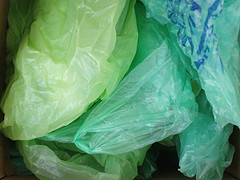
Photo used under a Creative Commons license from Arbel Egger.
—Casey Miner
Comments
I'm going to have to call BS on this. Not on the experiment, good going on that. But on the article. It's a myth that plastics last "1000's" of years. They breakdown in under a century, usually in less than 50 years even in sterile temp controlled environments like the Smithsonian. The older suits and plastic parts from Nasa equipment held there are already disintegrating. What they break down into is no better for the environment but thats another story... Get your facts straight.
Seth, I think that's the point. The Eastern Pacific Gyre is full of the separated polymers you describe as "disintegrated". The plastic itself remains intact as separated molecules floating around. Those, in turn, last for 1000's of years.
Reading this guys research paper, what he has done is isolated two bacteria that help eachother actually digest the polymers, meaning the carbon byproduct is bacteria, not more polymers.
So I call BS on your BS, and the facts are legitimate.
Posted by: Kris on 05/24/08 at 7:37 AM Respond
I call BS on your BS Kris. Get your facts straight. The bacteria cant be isolated as they have inverse density values. This means the plastic cant be degraded. Less in the time stated by the article.
Posted by: Kreth on 05/24/08 at 8:03 AM Respond
I call BS on your BS kreth, which is calling BS on Kris' BS call on Seth's BS, because the bacterias density means nothing. This experiment needs to be reproduced.
Posted by: Steve on 05/24/08 at 8:42 AM Respond
I use BS to breakdown arguments and make them seem less important. A mix of doubt, multi-faceted BS, and some regular baker's yeast, blended by a educated 30-40 year old male who studied "political science" and is well versed in things like "science" because its in the name, resulted in a 64% chance it will appear on a Fox news story as true. No need to reproduce the experiment. It's done everyday.
Posted by: Fleve on 05/24/08 at 8:49 AM Respond
If true even a little, I hope he retains the copyright on the process, etc.
Posted by: Jeff on 05/24/08 at 9:14 AM Respond
LOL the comments made me laugh
Posted by: Justin on 05/24/08 at 9:24 AM Respond
But Justin, the question is, did the bacteria make you digest plastic?
Posted by: Kris on 05/24/08 at 9:28 AM Respond
So Kreth, if the bacteria can't be isolated, what is it you think was in his LB agar dishes?
My guess is you don't know the first thing about growing bacteria beyond the experiments in your fridge...
Posted by: Kris on 05/24/08 at 9:30 AM Respond
BS is a renewable resource.
Posted by: BS on 05/24/08 at 11:40 AM Respond
Is it possible that if plastic on or in the ground biodegrades that it could more easily work its way into the water table. If so would we end up drinking it? Do we always need or want everything to biodegrade? These might be dumb questions but I do find this confusing. Fascinating article and comments except for the silly attitudes. Can't we argue with out becoming rude?
Posted by: John on 05/24/08 at 12:05 PM Respond
I want to congratulate this guy for his work, but seriously. We should RECYCLE. IF we digest all the plastic we throw away with bacteria, its just being wasteful. Gl waiting another 5 million years for it to turn into oil so we can make plastics out of it again. Its about reusing what we throw away not digesting plastics.
Posted by: BS on All of you on 05/24/08 at 12:35 PM Respond
Yes, but does it blend?
Posted by: Anonymous on 05/24/08 at 12:44 PM Respond
hahaha, that show destroys all...even canadian teenagers with braces that make scientific "breakthroughs" (i wonder if he blends)...in all seriousness what is the point of breaking down the plastic bags. Like someone else said before, we should be reusing not breaking down. A bag that degrades in 3 months is just as useless as one that degrade in 1000 years.
It would be very interesting to find out what the byproducts of the degrading process are.
Posted by: ICE on 05/24/08 at 12:58 PM Respond
Interesting step toward solving waste issues
Posted by: Christina on 05/24/08 at 1:49 PM Respond
It actually is very useful that this kid discovered this. And to all of the people that said breaking down plastic is useless, bio-degradable plastic will save space in landfills and all of the other problems that leftover plastic causes. The plastic will go into giving the bacteria energy and not just be lying around the earth.
Posted by: blah on 05/24/08 at 2:27 PM Respond
Will this bacteria grow and take over the world, being feed so much? Or will it just be obesse?
Posted by: davebuoy on 05/24/08 at 2:56 PM Respond
Good work to the kid for doing such an experiment in high school. But this article needs to work on its facts. Plastics readily degrade, they start degrading soon after they are made from oxidation, sun light and temperature. The companies that make plastics have to put in additives so the plastic is usable for a decent amount of time. They don't last 1000's of years, even with these additives.
Posted by: anon on 05/24/08 at 3:05 PM Respond
since when do Canadians do anything right?
Posted by: jon on 05/24/08 at 3:10 PM Respond
haha i agree!
Posted by: mikeVG on 05/24/08 at 3:10 PM Respond
Just to enlighten people, this child did not discover anything. The existence of plastic degrading bacteria has been known for many years now. The problem is mass producing it. All this child has done is culture it in his own home.
Posted by: Brook on 05/24/08 at 3:20 PM Respond
Are you serious you feel like you drop a level in hell when you open something that is in plastic? Seriously, don't make statements that are too big to back up you idiot.
Posted by: Tom on 05/24/08 at 3:28 PM Respond
The british TV series "Doomwatch", in the 1970s started with a storyline of a research scientist trying to isolate bacteria to break down plastics. His work was hailed by the international community, as the way to save us from the menace of a build-up of discarded, but undegradeable waste that would be with us forever. The first episode opened with a transatlantic airliner whose overhead lockers start to melt and deform, then drip... as do its cable insulators, controls, fuel line seals etc.
Once again, something had been developed, but not properly thought through before general release. Nobody stopped to think, "can we confine it to only waste?", and of course, nobody stopped to think those bacteria might evolve into better and better plastics munchers.
Doomwatch looks incredibly corny, and dated now, I saw a bit on youtube..
But, HELP!!! MY KEYBOARD'S MELTING!!!!!!!!
Posted by: soubriquet on 05/24/08 at 3:44 PM Respond
I certainly commend the 16 year old Daniel for attempting to solve a very big problem. However, as was mentioned before plastics do degrade naturally in landfills; in the right conditions this can occur in less than 50 years. I agree with the recycling tidbit, but the fact is hardly any of the plastic in waste streams is recycled, so our landfills grow larger and larger everyday. The issue I take with the kid's experiment is the fact that growing bacteria in a petri dish doesn't transfer over so nicely to remediation in landfills. As we have seen with bioremediation of chemical spills, the sad fact is that these bacteria become "pussies" and can't stand living under any conditions other than the petri dish, the process has proved not to be so feasible. It's still pretty neat that a 16 year old thought of doing this though...
Posted by: Josepe' on 05/24/08 at 3:52 PM Respond
The idea that plastics take so long to degrade has actually been propagated by the Project for the New American Century, to distract from the fact that they have cornered the market on plastics.
Also,I do not enjoy the sex that I am having.
Posted by: Nick on 05/24/08 at 3:57 PM Respond
If you feel like you've dropped a "circle in Hell" when you throw something away, you have a lot more than the environment to be worrying about.
Posted by: J on 05/24/08 at 3:59 PM Respond
America is Canada's [deleted].
Posted by: IO on 05/24/08 at 3:59 PM Respond
This has been known for some time. Dupont, for instance, did similar studies back in the 60s, and numerous other labs have looked at bacteria as a mechanism for converting plastics.
This is not a new discovery, it's just further evidence that life adapts.
Posted by: dave on 05/24/08 at 4:39 PM Respond
I'll have to chime in as well. First, kudos to Daniel on a well-done science experiment. Given some of the methods taught in high schools these days, he is to be commended for following the scientific process. On to Seth's comment. His premise is right on the mark, except about the actual time for degradation of the plastic. It is certainly a myth that it takes 1000's of years, but it is also misleading to say it takes any specific amount of time. The fact is the plastics used in packaging for food, grocery bags, etc is designed to degrade in less than 3 months time. That's right - less than 3 months. The problem, and the reason it doesn't actually happen, is that the bags must be exposed to sunlight in order to catalyze the reaction that degrades them. When we put them in landfills, they no longer get the sunlight, and the reaction slows to a crawl, greatly extending the time it takes to degrade into it's constituent parts. How do I know? It is my job to engineer these, and similar items.
Posted by: Science Guy on 05/24/08 at 4:52 PM Respond
This is an interesting because it was done by a high schooler, but that is all. The study and facultative breakdown of chlorinated hydrocarbons has been around since the early nineties and the mechanism of degradation is still being studied today, its called bioremediation. If you have any further questions or doubt the legitamacy of my claim, please direct your attention to http://www.nature.com and search for plastic or chlorinated hydrocarbons remediation practices, research, or advancement. You will be pleasantly surprised to find over one hundred peer-reviewed articles/research papers on the subject. Have a pleasant evening.
WK
Posted by: William on 05/24/08 at 5:30 PM Respond
you are so stupid, what happens if you bio degrade plastics? how much of our technoligy is based on plastics? Just think if you created a virus that would destroy plastic in two years how much of your lives would be left without plastics? IDIOTS
Posted by: Duratus on 05/24/08 at 5:33 PM Respond
so im reading the comments and i think people are honestly thinking into this whole issue alittle too much. Ofcourse plastic degredation happens naturally, if it didn't we'd be knee deep in plastic waste. This kids experiment identified which agents degrade the plastics naturally and and effectively. by doing so, as stated, he wishes for further research to allow for an idustrial implementation of a similar quick degradation process. this is by no means a solution but it is knowledge gained that scientist had not focused on before. i dont understand how an arguement can occur as i dont see anything to be disputed.
Posted by: some pothead on 05/24/08 at 5:47 PM Respond
The basic fact remains with plastic, no matter how you ultimately dispose of it - you are using a non-renewable resource. It won't turn back into usable oil. The world economy, the whole damn thing, is based at its core on oil.
Posted by: ryan on 05/24/08 at 5:59 PM Respond
This is a great article and if true, this can be a blessing to one of many issues at hand. However, this technology should be used to degrade the billions of tons of plastic currently in our landfills and our oceans but not offer a reason to use plastic products in the first place. This, combined with biodegradeable plastic, will certainly help with the current issue at hand but ultimately we need to learn to use more of the renewable and reusable resources and not so much of disposable.
Posted by: anon on 05/24/08 at 6:11 PM Respond
Cool, but pointless. You would have to sort out the plastic at landfills. If you do that, you might as well recycle it - not degrade it.
Posted by: zach on 05/24/08 at 7:34 PM Respond
Plastics do indeed degrade. Different types of polymers however degrade by different chemical processes over varying timescales and, is dependent upon the catalyst employed to break down those chains.
Better to make it law for the suppliers and manufactures to accept back our packaging and force them to be accountable or invent their own solution for disposal?
Posted by: Chris Wilson on 05/24/08 at 8:30 PM Respond
Want to watch plastics degrade?
Pour some DEET (insect repellent) onto a plastic bag. See it go hard and crinkly? Thats degradation.
However, there are two problems I see with this experiment. One is that while the plastic has been 'degraded', are the final products any safer than the starting products?
I don't see the point in making more waste barrels filled with toxic organics.
Secondly, from what I've read there this process involves heating the reaction mixture for over a month.
In industrial terms, this is costly beyond need. And all that for a 32% yield?
Good idea, bright kid, bad chemistry.
Posted by: ChemGrad on 05/25/08 at 3:37 AM Respond
As others have said, this is all nicey nice and good, but the real problem isn't so much that we have plastics in landfills, but that we use so much of them in the first place. Two things need to happen before we get comfortable with the idea of easily degradable plastic: 1 - Use less of it in packaging, and 2 - recycle what we can. When we get in the habit of doing those things as a society then we can pat ourselves on the back for figuring out a way to speed up the decomposition of the stuff we can't recycle.
Posted by: itsalljustaride on 05/25/08 at 12:35 PM Respond
I think this kid is brilliant and I loved reading all of your comments even if they were ridiculous. Weeed!
Posted by: Another pothead on 05/28/08 at 2:35 PM Respond
All well and good, but if the bags (and anything else that's organic) were feed for thermal depolymerization, then there wouldn't be any problem, and it could all be recycled.
Posted by: politicalbear on 05/28/08 at 3:05 PM Respond
I believe all of the above commentaries miss the point. Bill Moyers in his last program brought out the fact that many plastics, especially in food packaging, are finding their way into our bodies, where they damage
our hormone and endocrine systems. Go to the grocery store and try to find anything that is packed in glass, now. And it also lines cans and even paper milk and juice cartons. It's ubiquitous.
Posted by: Anne on 05/28/08 at 3:13 PM Respond
My question is, what sort of gases are released into the air
during an accelerated break down process?
Posted by: Martee on 05/28/08 at 3:22 PM Respond
I am not sure why this kid got that amount of money for a research paper which in my opinion is rather childish and not comparing to any industry application.
As also often stated the idea of bacteria degration is not new.
Further more are there plastics today which are bio degradable - those are developed and produced.
However again the idea of degrading plastic instead of recycling is seriously stupid and a waste of recourses. This paper might proof a point but is it an important point of our industrial application and furture? I doubt it.
It would be much better to tackle the real problem which is consumer behaviors - here in the USA people love plastic bags and are to lazy to bring their own bags and in addition in out food packaging industry plastic is overly used.
Promoting concepts to here I think would have been more subject of a nice award of 30 grand than this rather already known home experiment.
Posted by: claas on 05/28/08 at 7:29 PM Respond
What the student started should be encouraged to continue. There is all kinds of equipment available such as gas chromatography and mass spectroscopy to identify products at stages of degradation. I stop now because I have an awful headache from all the toxic comments, like Carbon Monoxide.
Posted by: GPFrank on 05/28/08 at 7:42 PM Respond
This is definatly a better mousetrap and you who asked since when do Canadians...This time bucko. There is hope for earth in the next generation
Posted by: Jackie Entrekin on 05/28/08 at 10:10 PM Respond
Often ignoramous
Posted by: Jackie Entrekin on 05/28/08 at 10:11 PM Respond
I worked at a grocery store two summers back and unless they changed their policy again, all the baggers and cashiers are required to bag all the customer's groceries in plastic bags UNLESS they ask for paper.
There's no more deal with inquiring "Paper or plastic" and most people didn't bother asking for paper (not that that's any less harmful to the environment).
My point is that people are lazy and uncaring and they're not going to bother asking for no bags. And even if they did know about that option, they would rather take the bags so it's easier for them to carry their groceries ten yards into the house.
I think Costco has the right idea because there are no bags, and if someone wants something to carry their food in then they can use one of the discarded packaging boxes. I'm not saying that Costco is the pinnacle of eco-friendliness, since they clearly don't offer bags to increase their profit margin, but they are doing something that is probably least detrimental in the end.
Posted by: Abcd on 05/29/08 at 7:15 AM Respond
I call BS on your BS Steve, which is calling BS Kreth's BS on Kris' BS call on Seth's BS. The kid is on to something, and they don't just hand out $30K to anyone with a crackpot idea without proven scientific merit.
Posted by: R3ap3R on 05/29/08 at 3:00 PM Respond
UNBELIEVABLE!
This was a SCIENCE PROJECT, not some government funded study that cost millions of dollars to restate the obvious. The point of the project was that the kid followed a controlled process of scientific investigation to move from hypothesis through to experimentation to results.
His results in the end confirmed his hypothesis. He is to be commended.
To all you folks that have nothing better to do than tarnish some smart kids moment in the sun, SHAME ON YOU!!! Maybe industry has been studying this for years, but fact is this kid, and the press coverage he gets is making people talk about it. Making them think about things and making them act (we hope).
We can sit around all day and play the devils advocate. We can talk about how this or that or the other thing won't work, or how it's been looked at before, and so on, but MAYBE just MAYBE someone will take this idea and run with it. Improve it, and in the end, make it useable.
It's easy to sit on our duffs and whine. The kid did something concrete and positive. Give him his dues, and shut up! As for how long it takes for things to degrade naturally etc... it's details. Fact is, we need help, and if you are not part of the solution, you ARE part of the problem.
Congradulations on your win at the science fair Daniel. I hope that what you learned from the process of investigation can be leveraged in your future and that one day you actually put all these loud mouthed cry babies to rest!
Posted by: Randy on 05/30/08 at 8:53 AM Respond
I try to use my own non-plastic bags as much as possible, AND I reuse my plastic bags, but they end up at the landfill eventually.
Congratulations to this kid, and good luck, if he needs support in the future, I'll be happy to help him.
Posted by: Bunny on 05/31/08 at 3:38 PM Respond
Thank you Randy and Bunny for bringing this back to reality.
Daniel, a 16 year old Canadian kid from small town Waterloo Ontario has put world industries and governments on the spot by illustrating intelligence, competence, understanding, care and action.
Here in Beijing, China, June 1st is the day "thin" (un-reusable) plastic bags are no longer permitted, and merchants must charge for "re-usable" plastic bags.
We have nominated Daniel as an official "Climate Change Agent", and part of the solution, not (like many of the whining, self-important posts here) part of the problem!
Good on you Daniel, and your passion to save the animals.
We human animals will also benefit from your excellent attitude.
Send us a photo of yourself showing the "Peace Plus One" sustainability symbol... you may become another Canadian hero (in the spirit of Bethune) to millions of Chinese.
Posted by: Peace Plus One on 05/31/08 at 6:28 PM Respond
My question to the author of this article is "Why are you shopping at Trader Joe's and do you honestly believe that 'Trader Joe's is full of incredibly attractive, cheap food?'"
Your mention of T.J.'s does further you another circle in hell. Their food is NOT CHEAP. It's all about packaging and marketing. Most people shopping there are doing so because they feel like they are being trendy and have a higher status. Kind of like people whom go to Starbucks.
Posted by: ChuckfromPA on 06/01/08 at 2:53 PM Respond
TJ's is much cheeper then larger supermarkets. I have bought similar items at both TJ's and Ralphs(at different times of course) and the bill at TJ's was almost $20 less. Besides the fact that the veggies lasted longer in the fridge. I'm about saving money not about being "trendy". But, maybe it has to do with what items you buy.
Posted by: Danielle on 06/02/08 at 12:10 AM Respond
Some of TJ's food is cheap because the producers cut corners and endanger farmworkers' (and consumers') health and safety. That plus all the plastic = unsustainable, unhealthy, drop-a-circle-in-hell food. Might be better than Ralphs, though.
Posted by: JD on 06/02/08 at 6:45 PM Respond
Very Cool! Congratulations Daniel! As far as degrading vs. re-use: We already have far more plastic waste than we can feasibly recycle. This is particularly exciting for permanently disposing of the floating plastic masses in the oceans. The bonus is under certain conditions the bacteria can be processed back into petroleum.
Posted by: Anne on 06/03/08 at 2:50 PM Respond
Good article and bravo to the budding scientist.
But some of the people making comments need to identify what is making them so angry. Get a grip!
Posted by: heather on 06/06/08 at 3:09 PM Respond
Wow, maybe what we need is ideas hatched out of a brain that hasn't accepted what is and still is looking at the world in a fresh way.
I was voting for Obama anyway, but now I feel like I ought to raise the pay of the kid who mows my lawn.
Posted by: Dianne Lee on 06/08/08 at 8:04 AM Respond
Too much dependence on fossil fuels? Most people I talk with don't even know plastics are made with fossil fuels. It's time to educate the masses people. Get the word out. When I go to a store and see people putting bags into bags, a single fruit or vegetable that already has a skin or will be washed (hopefully) when you get it home, into a plastic bag and then putting that bag into another plastic bag!!?? What's wrong with that picture. Then they go home and throw the bag away. All I can say is, I mourn the death of the thought process!
Posted by: dazed and confused on 06/09/08 at 5:50 AM Respond
Why isn't anyone talking about the fact that plastic can be made of hemp oil and is not toxic to landfills when it breaks down. We have to STOP using crude oil based plastic's period. We lived before it and we will live after it. Technology brought us here and can figure this out. The BIG question is WHY ARE WE USING CRUDE? Oh ....I know! The transnational energy corporations make a ton of money on it. WHY ARE WE USING
GMO Corn and Soy??? .... because MONSANTO...DUPOnt...etc...want to own the world food supply and be incontrol of the biofuel markets worldwide don't believe me? Check this out THE WORLD ACCORDING TO MONSANTO http://wideeyecinema.com/?p=105
Posted by: Vivian on 06/09/08 at 11:22 AM Respond
If Daniel Burd's invention to breakdown plastic by using sodium chloride, and dirt sounds too good to be true is because it is. Not being an environmentalist his concern with the problem of sodium chloride being toxic to Nature, and humans has not been considered. We humans are part of Nature, although the Corporate Executives want you to believe otherwise.
My advice to Daniel Burd is first learn to treat, and view Nature as a sacred life force, without which mankind will not be able to survive. Check out this website: www.livingthefield.com and read the book by L.McTaggart to gain insight about the inner workings of Mother Earth. Focusing on money and self-aggrandizement is not the right way to serve the wellbeing of humanity and Mother Nature. This is what the Corporate World has focused from the beginning of the Industrial Revolution, by serving their own interests first, and now our planet is seventy percent polluted. If Nikola Tesla's inventions had been accepted by the "robber barons" such a J.P. Morgan, and Rockefeller we would not have now to deal with global warming, pollution and the war in Iraq. Soon this planet will be inhabitable if we keep destroying precious ecosystems. Only twenty percent of the world's rain forests remain. How much longer do you think we can keep on this destructive pace? The world must demand from all industries that the design, and manufacture of products, and scientific inventions be conscious of the impact upon the environment. If it is harmful to life, it should be illegal, and not forced upon the world as oil, coal, nuclear, and biofuels were. Do you not see a pattern here? Only technologies that are harmful to Nature are mass produced, while green technologies such as solar, and geo-thermal are suppressed and not implemented on a wide scale.
Daniel think outside the box. This is what the planet needs desperately now; inventors that refuse to play the game of sightless Corporate CEOs who are no more than King Midas copycats.
Therefore, Daniel make sure first that you dedicate more time in research, and come up with natural ways of eliminating toxic chemicals such as polyethylene without adding more toxic chemicals as sodium chloride, and preventing these from leaching into Nature. This is the key to prevent cancerous chemicals from seeping into the rivers,lakes, and Oceans. Our planet is our home, if we ruin this one we will not be able to find another one nearby, where we could escape to. Planet Earth is worth more than money; and must be saved at all costs for the cost we will pay as people will be immense, tragic, and senseless.
Posted by: M. Daaz on 06/10/08 at 9:44 AM Respond
The only solution to the plastic bag problem is to stop manufacturing them. We got along just fine when paper bags were used exclusively. Better yet, strong cloth bags are available everywhere. No science involved!!
Posted by: Shirley on 06/12/08 at 7:29 AM Respond
I still don't quite understand why everyone here is congratulating this guy on his accomplishment as though you are talking to him personally.
Great or not, if he's busy working on the degradation of plastic and the problem of landfills, I doubt he's reading this website.
Posted by: Heather on 06/14/08 at 4:35 PM Respond
Oh, and I have to agree with Shirley. We are only dependent on plastic bags because we collectively choose to do nothing about it.
Of course, there are benefits to plastic bags over cloth or paper, such as retaining liquids.
Regardless, with the domino effect that everything has on everything else, changing over to reusable cloth bags would then likely require additional cost in the way of washing them every so often (and I sure some would do it MORE often) which would lead to water usage, soap usage, electricity usage, etc. And paper bags or cardboard boxes would ALWAYS have to be offered as an alternative for those that forgot their cloth bag at home.
Bringing the focus back on paper bags - even if we switched entirely to paper bags and ALWAYS recycled, recycling facilities would use more resources to run and we'd probably need to increase the number of recycling facilities we had available.
The bottom line is that no matter what, there will be evils that work towards our detriment. The only issue is which ones work toward it the slowest.
Posted by: Heather on 06/14/08 at 4:48 PM Respond
Wow! Weird on man! Crazy ideas, but who knows... only time will tell.
Posted by: Linkvana on 08/13/08 at 9:47 PM Respond
This is a bit unrealistic I'd say. Maybe I'm not as optimistic as most, but this doesn't sound too promising.
Posted by: Dave on 08/13/08 at 10:04 PM Respond
s33 im not all that smart but that sounds very good and plus I think that you and him will go very far in life for talking about this
Posted by: Halli3 on 10/30/08 at 2:33 PM Respond
I would be really interested in the the real value of this new method. No way to know though, I'm afraid.
Posted by: PVC-muncher on 11/16/08 at 10:48 AM Respond
ARCHIVE
RECENT COMMENTS
Making Iraq Fertile (2)
researcher wrote:
let americans pay for it.
wanna bet how much they hate us...
[more]
Brazil Changes on Climate Change (4)
Jimmy wrote:
I took care of my own guilt by getting a bunch of free car...
[more]
Steve Irwin, Illegal Whaling Ship Hunter? (11)
Thundersalmon wrote:
Steve Irwin never went about using acts of terrorism to sp...
[more]
More Genetic Tests: Still Creepy (2)
dan wrote:
Well said Michael. I'd also note for every LaBron James (...
[more]
Charge Your Cellphone By Talking (3)
Bill Moore wrote:
I think we should harness all of the hot air coming out of...
[more]
Obama's (And Our) Clean-Coal Blues (5)
Scott wrote:
The media is not the last word on all things green. Two e...
[more]
WTF? ExxonMobil Funds Research—By An Astrophysicist—On Polar Bears And Climate Change (4)
Tina wrote:
As of now, the Minister of the Environment has asked Envir...
[more]
Listen Up, Pandas, You Need to Fight (17)
ziggxzagg wrote:
i totally agree,
ive been asking for a panda for the last ...
[more]
Huntington vs. Burlington: How to Grow a Healthy City (20)
yerbatera wrote:
Great story! Have lived in both urban liberal enclaves & ...
[more]
All-Expenses-Paid India Vacation, Courtesy of Your Health Insurer (7)
fixedknee wrote:
I agree that doctors' bills are high. Part of the problem ...
[more]
Movable Type 3.33


Posted by: Seth on 05/24/08 at 7:00 AM Respond
