It has become one of the mantras of the president’s reelection campaign: Only George W. Bush can keep America
safe from the next terrorist attack. Regardless of what evidence emerges, nothing seems to shake
this carefully scripted image. A July 14 Washington Post poll showed that 55 percent of Americans
approved of the way Bush has handled the war on terrorism. That’s stunning, particularly
given the facts that Matthew Brzezinski lays out in his cover story in this issue (“Red Alert,”
page 38). As Brzezinski details, for all the macho talk and tough-guy photo ops, the administration
has failed to do what’s needed to make the United States more secure: The nation’s ports,
planes, trains, nuclear facilities, and chemical plants all remain dangerously vulnerable to
attack. For while it has squandered billions of dollars in Iraq, the administration has failed
to address basic security at home. It would take an estimated $6 billion to provide adequate protection
for the nation’s commuter trains; Bush’s budget allocated $100 million. It would take
$3 billion to equip all airports to screen baggage for explosives; Bush’s budget allocated
$400 million. By comparison, the United States spends $3 billion in Iraq every ten days.
The Department of Homeland Security—touted as the administration’s
bold response to terrorism—has turned out to be little more than a paper tiger. Saddled with
special interests and ignored by the White House, DHS is, as Brzezinski observes, “a premier
example of how the administration’s misplaced priorities—and its obsession with
Iraq—have come at the direct expense of homeland security.” After reading Brzezinski’s
tale of trying to find DHS’s headquarters in an obscure bureaucratic corner of Washington,
you may have even more difficulty taking seriously those ever-changing, color-coded warnings.
Also for this issue, contributing writer Ted Williams traveled to the
vice president’s home state of Wyoming to witness firsthand the impact of the Bush-Cheney
energy policy, which has opened up vast, unspoiled Western lands to oil and gas development; Williams’
report (“For a Week’s Worth of Gas,” page 66) makes clear the steep environmental
price being paid. On women’s issues, as longtime Bush observer and Mother Jones contributor
Molly Ivins points out, the administration’s policies have been less blatant, but no less
damaging. It turns out that while campaigning on the slogan “W is for Women,” the president
has proved himself to be anything but. In an attempt to placate the Christian right, his administration
has used phony science to justify faulty information on women’s health, has eliminated economic
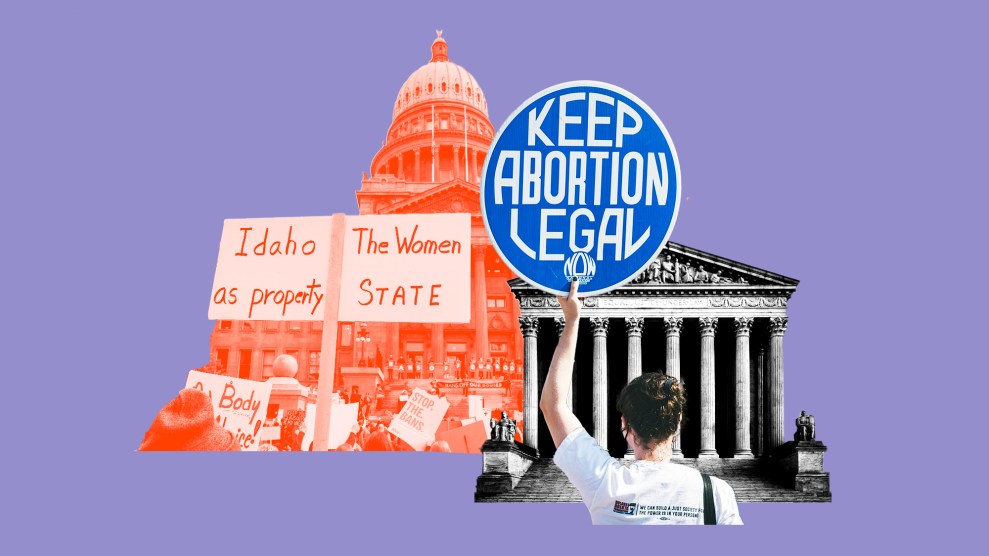
statistics on discrimination against women, and has begun chipping away at abortion rights, most
notably with the Partial Birth Abortion Ban. It was the passage of that ban last November that prompted
writer Eleanor Cooney to recall the illegal late-term abortion she had as a young woman some 40 years
ago. Her harrowing account of that experience (“The Way It Was,” page 50) should be read
by anyone who came of age after Roe v. Wade—and by the president and the nine male legislators
who stood behind him, smiling, as he signed the ban into law. —Roger Cohn