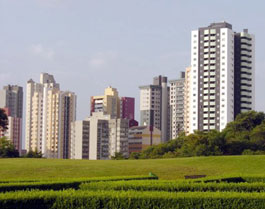
Photo: AFP Imageforum
The first time I went there, I had never heard of Curitiba. I had no idea
that its bus system was the best on Earth or that a municipal shepherd and
his flock of 30 sheep trimmed the grass in its vast parks. It was just a
midsize Brazilian city where an airline schedule forced me to spend the
night midway through a long South American reporting trip. I reached my
hotel, took a nap, and then went out in the early evening for a
walk–warily, because I had just come from crime-soaked Rio.
But the street in front of the hotel was cobbled, closed to cars, and strung
with lights. It opened onto another such street, which in turn opened into a
broad and leafy plaza, with more shop-lined streets stretching off in all
directions. Though the night was frosty-Brazil stretches well south of the
tropics, and Curitiba is in the mountains-people strolled and shopped,
butcher to baker to bookstore. There were almost no cars, but at one of the
squares, a steady line of buses rolled off, full, every few seconds. I
walked for an hour, and then another. I felt my shoulders, hunched from the
tension of Rio (and probably New York as well) straightening. Though I flew
out the next day as scheduled, I never forgot the city.
From time to time over the next few years, I would see Curitiba mentioned in
planning magazines or come across a short newspaper account of it winning
various awards from the United Nations. Its success seemed demographically
unlikely. For one thing, it’s relatively poor – average per capita (cash)
income is about $2,500. Worse, a flood of displaced peasants has tripled its
population to a million and a half in the last 25 years. It should resemble
a small-scale version of urban nightmares like São Paulo or Mexico City. But
I knew from my evening’s stroll it wasn’t like that, and I wondered why.
Maybe an effort to convince myself that a decay in public life was not
inevitable was why I went back to Curitiba to spend some real time, to see
if its charms extended beyond the lovely downtown. For a month, my wife and
baby and I lived in a small apartment near the city center. Morning after
morning I interviewed cops, merchants, urban foresters, civil engineers,
novelists, planners; in the afternoons, we pushed the stroller across the
town, learning the city’s rhythms and habits. And we decided, with great
delight, that Curitiba is among the world’s great cities.
Not for its physical location; there are no beaches, no broad bridge-spanned
rivers. Not in terms of culture or glamour; it’s a fairly provincial place.
But measured for “livability,” I have never been any place like it. In a
recent survey, 60 percent of New Yorkers wanted to leave their rich and
cosmopolitan city; 99 percent of Curitibans told
pollsters that they were happy with their town; and 70 percent of the
residents of São Paulo said they thought life would be better in Curitiba.
This city has slums: some of the same shantytown favelas that dominate most
Third World cities have sprouted on the edge of town as the population has
rocketed. But even they are different, hopeful in palpable ways. They are
clean, for instance-under a city program, a slumdweller who collects a sack
of garbage gets a sack of food from the city in return. And Curitiba is the
classic example of decent lives helping produce a decent environment.
Because of its fine transit system, and because its inhabitants are
attracted toward the city center instead of repelled out to a sprawl of
suburbs, Curitibans use 25 percent less fuel per capita than other
Brazilians, even though they are actually more likely to own cars.
Curitiba started out as a backwater town, a good stopover on the way to São
Paulo. By 1940, there were 125,000 residents. By 1950, the number had jumped
to 180,000, and by 1960, doubled to 361,000-the explosive, confident growth
that marked the entire country was underway in Curitiba as well. And with
many of the same effects: traffic downtown started to snarl, and the air was
growing thick with exhaust. It was clear that the time had come to plan,
and, as in almost every other city, planning meant planning for automobiles.
The official scheme called for widening the main streets of the city to add
more lanes-which would have meant knocking down the turn-of-the-century
buildings that lined the downtown-and for building an overpass that would
link two of the city’s main squares by going over the top of Rua Quinze de
Novembro, the main shopping street. But resistance to the plan was
unexpectedly fierce. Opposition was centered in the architecture and
planning departments of the local branch of the federal university, and the
loudest voice belonged to Jaime Lerner.
Jaime Lerner is a chubby man with a large, friendly, and open face. He looks
like Norm, the guy at the end of the bar in “Cheers.” He also looks silly
stuffed into a suit; so even though he’s been mayor of Curitiba on and off
for the last two decades, he normally wears a polo shirt. In the late 1960s,
however, he was just a young planner and architect who had grown up in the
city, working in his Polish father’s dry goods store. And he organized the
drive against the overpass, out of what might almost be called nostalgia.
“They were trying to throw away the story of the city,” he recalls.
It was a good thing that Jaime Lerner had grown up loving the mix of people
in Curitiba. Because through a chain of political flukes, Lerner found
himself the mayor of Curitiba at the age of 33. All of a sudden, his friends
and colleagues were pulling their plans out of the cupboards. All of a
sudden, they were going to get their chance to remake Curitiba-not for cars,
but for people.
And so the story of Curitiba begins with its central street, Rua Quinze-the
one that the old plan wanted to obliterate with an overpass. Lerner insisted
instead that it should become a pedestrian mall, an emblem of his drive for
a human-scale city. “I knew we’d have a big fight,” he says. “I had no way
to convince the store-owners a pedestrian mall would be good for them,
because there was no other pedestrian mall in Brazil. But I knew if they had
a chance to actually see it, everyone would love it.”
To prevent opposition, he planned carefully. “I told my staff, ‘This is like
war.’ My secretary of public works said the job would take two months. I got
him down to one month. Maybe one week, he said, but that’s final. I said,
‘Let’s start Friday night, and we have to finish by Monday morning.'” And
they did-jackhammering the pavement, putting down cobblestones, erecting
streetlights and kiosks, and putting in tens of thousands of flowers.
“It was a horrible risk-he could easily have been fired,” said Oswaldo
Alves, who helped with the work. But by midday Monday, the same storeowners
who had been threatening legal action were petitioning the mayor to extend
the mall. The next weekend, when offended members of the local automobile
club threatened to “reclaim” the street by driving their cars down it,
Lerner didn’t call out the police. Instead, he had city workers lay down
strips of paper the length of the mall. When the auto club arrived, its
members found dozens of children sitting in the former street painting
pictures. The transformation of Curitiba had begun.
Cheapness is one of the three cardinal dictates of Curitiban planning. Many
of the city’s buildings are “recycled.” The planning headquarters is in an
old furniture factory; the gunpowder depot became a furniture factory; a
glue plant was turned into the children’s center. An old trolley stationed
on the Rua Quinze has become a free babysitting center where shoppers can
park their kids for a few hours. The city’s parks provide the best example
of brilliance on the cheap. When Lerner took office for the first time in
1971, the only park in Curitiba was smack downtown – the Passeio Publico, a
cozy zoo and playground with a moat for paddleboats and a canopy of old and
beautiful ipé trees, which blossom blue in the spring. “In that first term,
we wanted to develop a lot of squares and plazas,” recalls Alves. “We picked
one plot, we built a lot of walls, and we planted a lot of trees. And then
we realized this was very expensive.”
At the same time, as luck would have it, most Brazilian cities were
installing elaborate flood-control projects. Curitiba had federal money to
“channelize” the five rivers flowing through town, putting them in concrete
viaducts so that they wouldn’t flood the city with every heavy summer rain
and endanger the buildings starting to spring up in the floodplain.
“The bankers wanted all the rivers enclosed,” says Alves; instead, city hall
took the same loan and spent it – on land. At a number of sites throughout
the city, engineers built small dams and backed up the rivers into lakes.
Each of these became the center of a park; and if the rains were heavy, the
lake might rise a foot or two-perhaps the jogging track would get a little
soggy or the duck in the big new zoo would find itself swimming a few feet
higher than usual. “Every river has a right to overflow,” insists parks
chief Nicolau Klupel.
Mostly because of its flood-control scheme, in 20 years-even as it tripled
in population-the city went from two square feet of green area per
inhabitant to more than 150 square feet per inhabitant. The official
literature always points out, with understandable pride, that this figure is
four times the World Health Organization standard of 12 square meters. From
every single window in Curitiba, I could see as much green as I could
concrete. And green begets green; land values around the new parks have
risen sharply, and with them tax revenues.
Though the population continues to grow steadily, it’s indeed possible that
Curitiba may have broken the back of its social problems. Since many of the
people in the favelas have been evicted from their homes in the countryside,
a house is an urgent need. Not just a shelter-a house they own, on a lot
they own.
Consider housing. Until the mid-1980s, COHAB, Curitiba’s public housing
program, was fairly standard. It built more units per capita than any other
Brazilian city and did a good job of scattering them around in small pockets
so they blended in with neighborhoods. But the main source of funding, the
national housing bank, collapsed in 1985. At the same time, the demand for
housing skyrocketed as the countryside poured into the favelas. Abandoning
the policy of small, scattered sites, the city bought one of the few large
plots of land left within its limits, a swath of farmland bounded by several
rivers called Novo Bairro, or New Neighborhood.
We stood on a rise in Novo Bairro and watched as bulldozers scraped and
contoured the hills. This cleared field would soon be home to 50,000
families, perhaps 200,000 people. Small houses crept like a tidemark across
the land. The city was not building the homes-the new landowners were,
sometimes with the aid of a city mortgage on a small pile of bricks and
windows. Every third house seemed to be doubling as a building supply store;
and everywhere, people plastered, framed, roofed.
“Sixty percent of the lower-income people are involved in the construction
industry anyhow,” says one COHAB executive. “They know how to build.” And
here is the moving part: With your plot of land comes not only a deed and a
pair of trees (one fruit bearing and one ornamental), but also an hour
downtown with an architect. “The person explains what’s important to him-a
big window out front, or room in the kitchen. They tell how many kids they
have, and so on. And then we help draw up a plan,” says one architect, who
has more than 3,000 of “his” homes scattered around the city.
“Most people can only afford to build one room at a time, so we also show
them the logical order to go in,” another designer explains.
At the moment, in the center of Novo Bairro, COHAB is building “Technology
Street,” an avenue of 24 homes, each built using some different construction
technique-bamboo covered with plaster, say-so that people can get ideas for
the kind of house they might want. The houses are all smaller than most
Americans would want to live in, but they all say something about the people
who built them. “It’s a house built out of love,” says the housing chief.
“And because of that, people won’t leave it behind. They’re going to
consolidate their lives there, become part of the city.”
One of the first structures to go up at Novo Bairro was a glass tube bus
station, linking this enclave to the rest of the city. “Integration” is a
word one hears constantly from official Curitiba, another of its mantras. It
means knitting together the entire city-rich, poor, and
in-between-culturally and economically and physically. Hitoshi Nakamura is
the city parks commissioner and one of Lerner’s longtime collaborators. “We
have to have communication with the people of the slums,” he said one day as
we were talking about the problems posed by settlers invading fragile
bottomlands along the rivers. “If we don’t, if they start to feel like
falvelados, then they will go against the city….If we give them attention,
they don’t feel abandoned. They feel like citizens.”
To learn from Curitiba, the rest of the world would have to break some
longstanding habits. And the hardest habit to break, in fact, may be what
Lerner calls the “syndrome of tragedy, of feeling like we’re terminal
patients.” Many cities have “a lot of people who are specialists in proving
change is not possible. What I try to explain to them when I go visit is
that it takes the same energy to say why something can’t be done as to
figure out how to do it.”
Excerpted from The Impossible Will Take a Little While: A Citizen’s Guide to
Hope in a Time of Fear, edited by Paul Rogat Loeb. See www.theimpossible.org.