This story first appeared on the TomDispatch website.
The debate rages over whether we have already reached the point of peak world oil output or will not do so until at least the next decade. There can, however, be little doubt of one thing: we are moving from an era in which oil was the world’s principal energy source to one in which petroleum alternatives — especially renewable supplies derived from the sun, wind, and waves — will provide an ever larger share of our total supply. But buckle your seatbelts, it’s going to be a bumpy ride under Xtreme conditions.
It would, of course, be ideal if the shift from dwindling oil to its climate-friendly successors were to happen smoothly via a mammoth, well-coordinated, interlaced system of wind, solar, tidal, geothermal, and other renewable energy installations. Unfortunately, this is unlikely to occur. Instead, we will surely first pass through an era characterized by excessive reliance on oil’s final, least attractive reserves along with coal, heavily polluting “unconventional” hydrocarbons like Canadian oil sands, and other unappealing fuel choices.
There can be no question that Barack Obama and many members of Congress would like to accelerate a shift from oil dependency to non-polluting alternatives. As the president said in January, “We will commit ourselves to steady, focused, pragmatic pursuit of an America that is free from our [oil] dependence and empowered by a new energy economy that puts millions of our citizens to work.” Indeed, the $787 billion economic stimulus package he signed in February provided $11 billion to modernize the nation’s electrical grid, $14 billion in tax incentives to businesses to invest in renewable energy, $6 billion to states for energy efficiency initiatives, and billions more directed to research on renewable sources of energy. More of the same can be expected if a sweeping climate bill is passed by Congress. The version of the bill recently passed by the House of Representatives, for example, mandates that 20% of U.S. electrical production be supplied by renewable energy by 2020.
But here’s the bad news: even if all these initiatives were to pass, and more like them many times over, it would still take decades for this country to substantially reduce its dependence on oil and other non-renewable, polluting fuels. So great is our demand for energy, and so well-entrenched the existing systems for delivering the fuels we consume, that (barring a staggering surprise) we will remain for years to come in a no-man’s-land between the Petroleum Age and an age that will see the great flowering of renewable energy. Think of this interim period as — to give it a label — the Era of Xtreme Energy, and in just about every sense imaginable from pricing to climate change, it is bound to be an ugly time.
An Oil Field as Deep as Mt. Everest Is High
Don’t be fooled by the fact that this grim new era will surely witness the arrival of many more wind turbines, solar arrays, and hybrid vehicles. Most new buildings will perhaps come equipped with solar panels, and more light-rail systems will be built. Despite all this, however, our civilization is likely to remain remarkably dependent on oil-fueled cars, trucks, ships, and planes for most transportation purposes, as well as on coal for electricity generation. Much of the existing infrastructure for producing and distributing our energy supply will also remain intact, even as many existing sources of oil, coal, and natural gas become exhausted, forcing us to rely on previously untouched, far more undesirable (and often far less accessible) sources of these fuels.
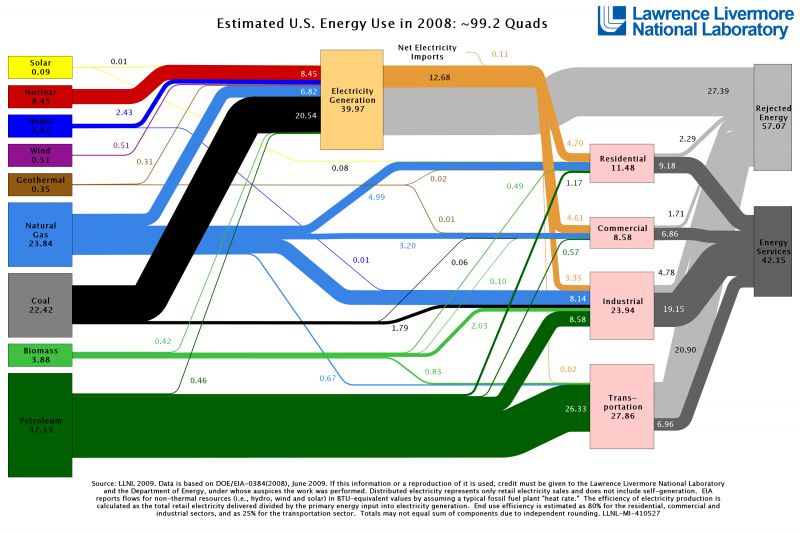
Some indication of the likely fuel mix in this new era can be seen in the most recent projections of the Department of Energy (DoE) on future U.S. energy consumption. According to the department’s Annual Energy Outlook for 2009, the United States will consume an estimated 114 quadrillion British thermal units (BTUs) of energy in 2030, of which 37% will be supplied by oil and other petroleum liquids, 23% by coal, 22% by natural gas, 8% by nuclear power, 3% by hydropower, and only 7% by wind, solar, biomass, and other renewable sources.
Clearly, this does not yet suggest a dramatic shift away from oil and other fossil fuels. On the basis of current trends, the DoE also predicts that even two decades from now, in 2030, oil, natural gas, and coal will still make up 82% of America’s primary energy supply, only two percentage points less than in 2009. (It is of course conceivable that a dramatic shift in national and international priorities will lead to a greater increase in renewable energy in the next two decades, but at this point that remains a dim hope rather than a sure thing.)
While fossil fuels will remain dominant in 2030, the nature of these fuels, and the ways in which we acquire them, will undergo profound change. Today, most of our oil and natural gas come from “conventional” sources of supply: large underground reservoirs found mainly in relatively accessible sites on land or in shallow coastal areas. These are the reserves that can be easily exploited using familiar technology, most notably modern versions of the towering oil rigs made famous most recently in the 2007 film There Will Be Blood.
 Ever more of these fields will, however, be depleted as global consumption soars, forcing the energy industry to increasingly rely on deep offshore oil and gas, Canadian oil sands, oil and gas from a climate-altered but still hard to reach and exploit Arctic, and gas extracted from shale rock using costly, environmentally threatening techniques. In 2030, says the DoE, such unconventional liquids will provide 13% of world oil supply (up from a mere 4% in 2007). A similar pattern holds for natural gas, especially in the United States where the share of energy supplied by unconventional but nonrenewable sources is expected to rise from 47% to 56% in the same two decades.
Just how important these supplies have become is evident to anyone who follows the oil industry’s trade journals or simply regularly checks out the business pages of the Wall Street Journal. Absent from them have been announcements of major discoveries of giant new oil and gas reserves in any parts of the world accessible to familiar drilling techniques and connected to key markets by existing pipelines or trade routes (or located outside active war zones such as Iraq and the Niger Delta region of Nigeria). The announcements are there, but virtually all of them have been of reserves in the Arctic, Siberia, or the very deep waters of the Atlantic and the Gulf of Mexico.
Recently the press has been abuzz with major discoveries in the Gulf of Mexico and far off Brazil’s coast that might give the impression of adding time to the Age of Petroleum. On September 2nd, for example, BP (formerly British Petroleum) announced that it had found a giant oil field in the Gulf of Mexico about 250 miles southeast of Houston. Dubbed Tiber, it is expected to produce hundreds of thousands of barrels per day when production begins some years from now, giving a boost to BP’s status as a major offshore producer. “This is big,” commented Chris Ruppel, a senior energy analyst at Execution LLC, a London investment bank. “It says we’re seeing that improved technology is unlocking resources that were before either undiscovered or too costly to exploit because of economics.”
As it happens, though, anyone who jumped to the conclusion that this field could quickly or easily add to the nation’s oil supply would be woefully mistaken. As a start, it’s located at a depth of 35,000 feet — greater than the height of Mount Everest, as a reporter from the New York Times noted — and well below the Gulf’s floor. To get to the oil, BP’s engineers will have to drill through miles of rock, salt, and compressed sand using costly and sophisticated equipment. To make matters worse, Tiber is located smack in the middle of the area in the Gulf regularly hit by massive storms in hurricane season, so any drills operating there must be designed to withstand hurricane-strength waves and winds, as well as sit idle for weeks at a time when operating personnel are forced to evacuate.
A similar picture prevails in the case of Brazil’s Tupi field, the other giant discovery of recent years. Located about 200 miles east of Rio de Janeiro in the deep waters of the Atlantic Ocean, Tupi has regularly been described as the biggest field to be found in 40 years. Thought to contain some five to eight billion barrels of recoverable oil, it will surely push Brazil into the front ranks of major oil producers once the Brazilians have overcome their own series of staggering hurdles: the Tupi field is located below one-and-a-half miles of ocean water and another two-and-a-half miles of rock, sand, and salt and so accessible only to cutting edge, super-sophisticated drilling technologies. It will cost an estimated $70-$120 billion to develop the field and require many years of dedicated effort.
Xtreme Acts of Energy Recovery
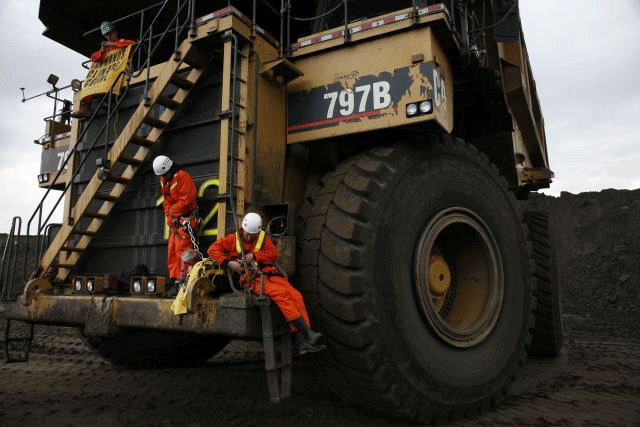
Given the potentially soaring costs involved in recovering these last tough-oil reserves, it’s no wonder that Canadian oil sands, also called tar sands, are the other big “play” in the oil business these days. Not oil as conventionally understood, the oil sands are a mixture of rock, sand, and bitumen (a very heavy, dense form of petroleum) that must be extracted from the ground using mining, rather than oil-drilling, techniques. They must also be extensively processed before being converted into a usable liquid fuel. Only because the big energy firms have themselves become convinced that we are running out of conventional oil of an easily accessible sort have they been tripping over each other in the race to buy up leases to mine bitumen in the Athabasca region of northern Alberta.
The mining of oil sands and their conversion into useful liquids is a costly and difficult process, and so the urge to do so tells us a great deal about our particular state of energy dependency. Deposits near the surface can be strip-mined, but those deeper underground can only be exploited by pumping in steam to separate the bitumen from the sand and then pumping the bitumen to the surface — a process that consumes vast amounts of water and energy in the form of natural gas (to heat that water into steam). Much of the water used to produce steam is collected at the site and used over again, but some is returned to the local water supply in northern Alberta, causing environmentalists to worry about the risk of large-scale contamination.
The clearing of enormous tracts of virgin forest to allow strip-mining and the consumption of valuable natural gas to extract the bitumen are other sources of concern. Nevertheless, such is the need of our civilization for petroleum products that Canadian oil sands are expected to generate 4.2 million barrels of fuel per day in 2030 — three times the amount being produced today — even as they devastate huge parts of Alberta, consume staggering amounts of natural gas, cause potentially extensive pollution, and sabotage Canada’s efforts to curb its greenhouse-gas emissions.
North of Alberta lies another source of Xtreme energy: Arctic oil and gas. Once largely neglected because of the difficulty of simply surviving, no less producing energy, in the region, the Arctic is now the site of a major “oil rush” as global warming makes it easier for energy firms to operate in northern latitudes. Norway’s state-owned energy company, StatoilHydro, is now running the world’s first natural gas facility above the Arctic Circle, and companies from around the world are making plans to develop oil and gas fields in the Artic territories of Canada, Greenland (administered by Denmark), Russia, and the United States, where offshore drilling in northern Alaskan waters may soon be the order of the day.
It will not, however, be easy to obtain oil and natural gas from the Arctic. Even if global warming raises average temperatures and reduces the extent of the polar ice cap, winter conditions will still make oil production extremely difficult and hazardous. Fierce storms and plunging temperatures will remain common, posing great risk to any humans not hunkered down in secure facilities and making the transport of energy a major undertaking.
Given fears of dwindling oil supplies, none of this has been enough to deter energy-craving companies from plunging into the icy waters. “Despite grueling conditions, interest in oil and gas reserves in the far north is heating up,” Brian Baskin reported in the Wall Street Journal. “Virtually every major producer is looking to the Arctic sea floor as the next — some say last — great resource play.”
What is true of oil generally is also true of natural gas and coal: most easy-to-reach conventional deposits are quickly being depleted. What remains are largely the “unconventional” supplies.
U.S. producers of natural gas, for example, are reporting a significant increase in domestic output, producing a dramatic reduction in prices. According to the DoE, U.S. gas production is projected to increase from about 20 trillion cubic feet in 2009 to 24 trillion in 2030, a real boon for U.S. consumers, who rely to a significant degree on natural gas for home heating and electricity generation. As noted by the Energy Department however, “Unconventional natural gas is the largest contributor to the growth in U.S. natural gas production, as rising prices and improvements in drilling technology provide the economic incentives necessary for exploitation of more costly resources.”
Most of the unconventional gas in the United States is currently obtained from tight-sand formations (or sandstone), but a growing percentage is acquired from shale rock through a process known as hydraulic fracturing. In this method, water is forced into the underground shale formations to crack the rock open and release the gas. Huge amounts of water are employed in the process, and environmentalists fear that some of this water, laced with pollutants, will find its ways into the nation’s drinking supply. In many areas, moreover, water itself is a scarce resource, and the diversion of crucial supplies to gas extraction may diminish the amounts available for farming, habitat preservation, and human consumption. Nonetheless, production of shale gas is projected to jump from two trillion cubic feet per year in 2009 to four trillion in 2030.
Coal presents a somewhat similar picture. Although many environmentalists object to the burning of coal because it releases far more climate-altering greenhouse gases than other fossil fuels for each BTU produced, the nation’s electric-power industry continues to rely on coal because it remains relatively cheap and plentiful. Yet many of the country’s most productive sources of anthracite and bituminous coal — the types with the greatest energy potential — have been depleted, leaving (as with oil) less productive sources of these types, along with large deposits of less desirable, more heavily polluting sub-bituminous coal, much of it located in Wyoming.
To get at what remains of the more valuable bituminous coal in Appalachia, mining companies increasingly rely on a technique known as mountaintop removal, described by John M. Broder of the New York Times as “blasting off the tops of mountains and dumping the rubble into valleys and streams.” Long opposed by environmentalists and residents of rural Kentucky and West Virginia, whose water supplies are endangered by the dumping of excess rock, dirt, and a variety of contaminants, mountaintop removal received a strong endorsement from the Bush administration, which in December 2008 approved a regulation allowing for a vast expansion of the practice. President Obama has vowed to reverse this regulation, but he favors the use of “clean coal” as part of a transitional energy strategy. It remains to be seen how far he will go in reining in the coal industry.
Xtreme Conflict
So let’s be blunt: we are not (yet) entering the much-heralded Age of Renewables. That bright day will undoubtedly arrive eventually, but not until we have moved much closer to the middle of this century and potentially staggering amounts of damage has been done to this planet in a fevered search for older forms of energy.
In the meantime, the Era of Xtreme Energy will be characterized by an ever deepening reliance on the least accessible, least desirable sources of oil, coal, and natural gas. This period will surely involve an intense struggle over the environmental consequences of reliance on such unappealing sources of energy. In this way, Big Oil and Big Coal — the major energy firms — may grow even larger, while the relatively moderate fuel and energy prices of the present moment will be on the rise, especially given the high cost of extracting oil, gas, and coal from less accessible and more challenging locations.
One other thing is, unfortunately, guaranteed: the Era of Xtreme Energy will also involve intense geopolitical struggle as major energy consumers and producers like the United States, China, the European Union, Russia, India, and Japan vie with one another for control of the remaining supplies. Russia and Norway, for example, are already sparring over their maritime boundary in the Barents Sea, a promising source of natural gas in the far north, while China and Japan have tussled over a similar boundary dispute in the East China Sea, the site of another large gas field. All of the Arctic nations — Canada, Denmark, Norway, Russia, and the United States — have laid claim to large, sometimes overlapping, slices of the Arctic Ocean, generating fresh boundary disputes in these energy-rich areas.
None of these disputes has yet resulted in violent conflict, but warships and planes have been deployed on some occasions and the potential exists for future escalation as tensions rise and the perceived value of these assets grows. And while we’re at it, don’t forget today’s energy hotspots like Nigeria, the Middle East, and the Caspian Basin. In the Xtreme era to come, they are no less likely to generate conflicts of every sort over the ever more precious supplies of more easily accessible energy.
For most of us, life in the Era of Xtreme Energy will not be easy. Energy prices will rise, environmental perils will multiply, ever more carbon dioxide will pour into the atmosphere, and the risk of conflict will grow. We possess just two options for shortening this difficult era and mitigating its impact. They are both perfectly obvious — which, unfortunately, makes them no easier to bring about: drastically speed up the development of renewable sources of energy and greatly reduce our reliance on fossil fuels by reorganizing our lives and our civilization so that we might consume less of them in everything we do.
That may sound easy enough, but tell that to governments around the world. Tell that to Big Energy. Hope for it, work for it, but in the meantime, keep your seatbelts buckled. This roller-coaster ride is about to begin.